Midwifery & Obstetrical Nursing
Anatomy and Physiology of Female Reproductive System
Female reproductive organs, menstrual cycle, ovulation, fertilisation, implantation, hormonal regulation and reproductive functions.
Open quizzes and study tools Download PDF
CHAPTER 03 / MIDWIFERY AND OBSTETRICAL NURSING 03. Anatomy and Physiology of Female Reproductive System
1. External genitalia and internal organs
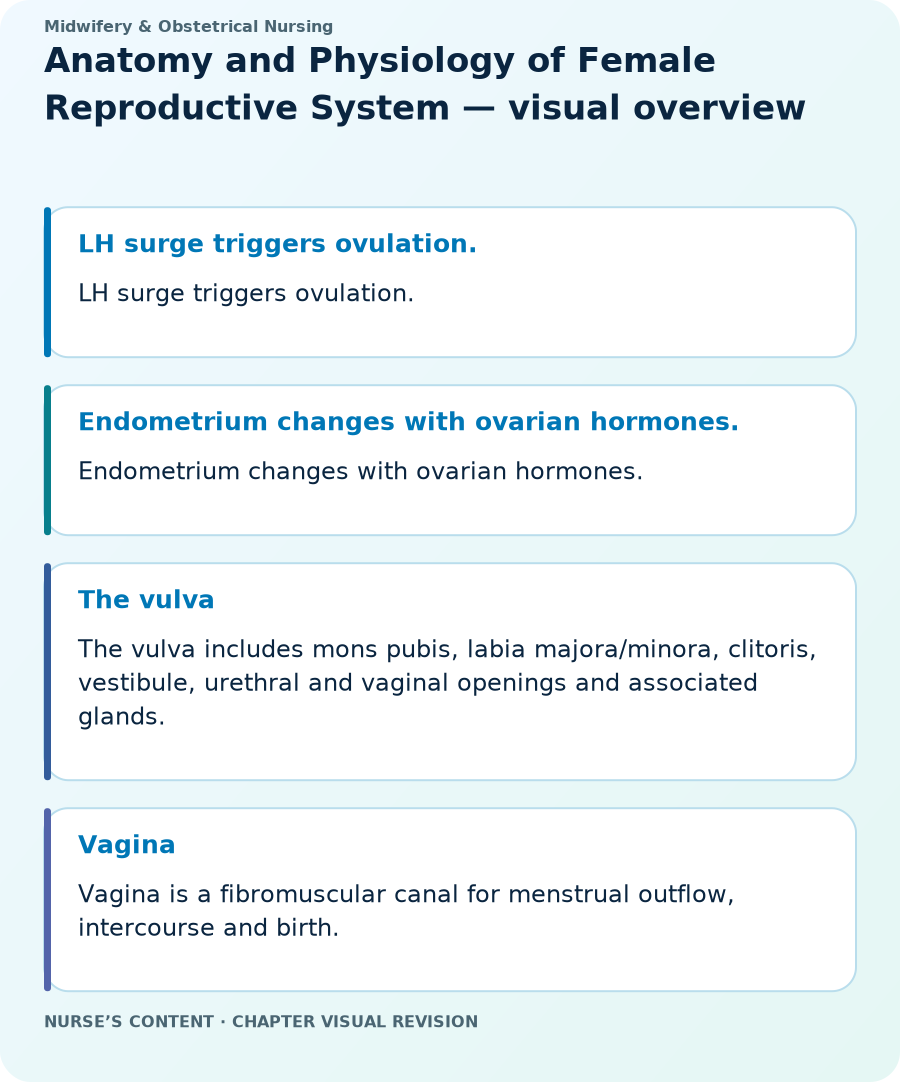
The vulva includes mons pubis, labia majora/minora, clitoris, vestibule, urethral and vaginal openings and associated glands. Vagina is a fibromuscular canal for menstrual outflow, intercourse and birth. Uterus is a muscular pelvic organ: fundus, body, isthmus/lower segment and cervix; wall layers perimetrium, myometrium and endometrium. Cervix opens through internal and external os. Fallopian tubes include interstitial/intramural part, isthmus, ampulla (common site of fertilization) and infundibulum/fimbriae. Ovaries produce oocytes and hormones. Ligaments and pelvic floor support reproductive organs.
2. Menstrual cycle and ovarian cycle
Typical educational cycle 28 days; actual cycles vary. Day 1 is first day of menstrual bleeding. Hypothalamic GnRH stimulates pituitary FSH/LH, ovarian follicular development and steroid production.
| Ovarian phase | Hormones / uterine changes |
|---|---|
| Follicular | FSH supports follicles; rising oestrogen promotes proliferative endometrium. |
| Ovulation | Sustained oestrogen feedback triggers LH surge; follicle releases oocyte. Often about 14 days before next menses, not always day 14. |
| Ovarian phase | Hormones / uterine changes |
|---|---|
| Luteal | Corpus luteum secretes progesterone/oestrogen; secretory endometrium supports implantation. |
| No pregnancy | Corpus luteum regresses, steroids fall and functional endometrium sheds (menses). |
3. Fertilization and implantation
Sperm may survive several days in reproductive tract; oocyte viability is limited after ovulation. Fertilization generally occurs in ampulla, forming zygote; cleavage → morula → blastocyst. Implantation begins roughly 6–7 days after fertilization. Trophoblast produces hCG which maintains early corpus luteum progesterone, later placenta produces hormones. Fertile window varies; ovulation prediction is not infallible.
4. Hormonal regulation and reproductive functions
Oestrogen supports reproductive tissue and endometrial proliferation; progesterone supports secretory endometrium and pregnancy; FSH follicle development, LH ovulation/corpus luteum; prolactin milk synthesis and oxytocin uterine contraction/milk ejection. Menopause results from declining ovarian follicular function with cessation of menses (diagnosed retrospectively after 12 months without other cause). Assess abnormal bleeding, pelvic pain, discharge or infertility respectfully and refer appropriately.
5. Important Examination Questions
Long Answer Questions
- 1. Describe female reproductive organs, menstrual cycle and hormonal regulation with suitable diagram.
Short Answer Questions
- 1. Write functions of ovary, uterus and tubes
- 2. explain ovulation and implantation.
Very Short Answer Questions (with answers)
- 1. Common site of fertilization? — Ampulla of fallopian tube.
- 2. Main hormone supporting luteal phase? — Progesterone.
6. Quick Revision
- • Cycle lengths vary.
- • LH surge triggers ovulation.
- • Endometrium changes with ovarian hormones.
7. Conclusion
Cycle lengths vary. LH surge triggers ovulation. Endometrium changes with ovarian hormones.
Chapter reference images