Midwifery & Obstetrical Nursing
Reproductive Health and Family Planning
Reproductive health, responsible parenthood, family planning methods, contraceptive methods, counselling, infertility and reproductive health services.
Open quizzes and study tools Download PDF
CHAPTER 02 / MIDWIFERY AND OBSTETRICAL NURSING 02. Reproductive Health and Family Planning
1. Concepts
Reproductive health includes physical, mental and social well-being in relation to reproduction, sexual health and reproductive decisions. Responsible parenthood involves voluntary, informed planning, preparation for caregiving and support for the health and rights of parents and children. Family planning helps people achieve their desired number and spacing of pregnancies; participation must be voluntary and noncoercive.
2. Contraceptive methods
| Method | Mechanism / practical points |
|---|---|
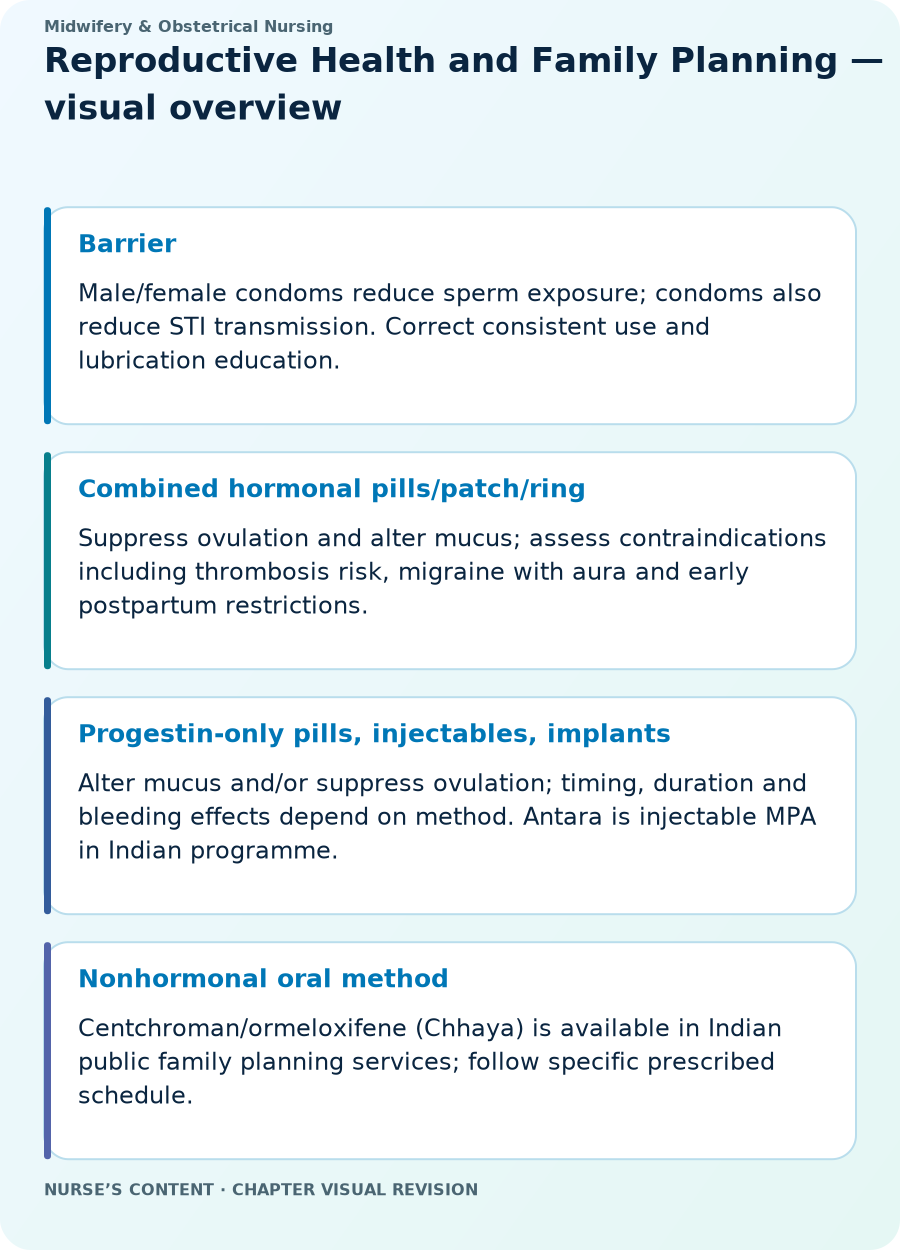
| Barrier | Male/female condoms reduce sperm exposure; condoms also reduce STI transmission. Correct consistent use and lubrication education. |
| Combined hormonal pills/patch/ring | Suppress ovulation and alter mucus; assess contraindications including thrombosis risk, migraine with aura and early postpartum restrictions. |
| Progestin-only pills, injectables, implants | Alter mucus and/or suppress ovulation; timing, duration and bleeding effects depend on method. Antara is injectable MPA in Indian programme. |
| Nonhormonal oral method | Centchroman/ormeloxifene (Chhaya) is available in Indian public family planning services; follow specific prescribed schedule. |
| Copper IUCD | Intrauterine copper prevents fertilization; long-acting, hormone-free; assess contraindications, possible heavier bleeding. |
| Levonorgestrel IUS | Local progestin effect, often lighter bleeding; availability varies. |
| Emergency contraception | Oral levonorgestrel, ulipristal where available or copper IUCD within appropriate windows; does not terminate established pregnancy. |
| Natural/fertility awareness | Identify fertile days; requires understanding and consistent use; failure rates vary. |
| LAM | Lactational amenorrhoea method requires all three: <6 months postpartum, amenorrhoeic and fully/nearly fully breastfeeding. |
| Permanent | Vasectomy or tubal sterilization after informed voluntary consent; vasectomy not immediately effective, use backup until clearance. |
3. Counselling and service delivery
Assess goals, medical eligibility, postpartum/breastfeeding status, STI risk, preferences, access and prior methods. Explain effectiveness, side effects, reversibility, warning signs, emergency contraception and backup instructions. Use WHO medical eligibility and Indian programme guidance, never pressure a patient. Postpartum IUCD may be offered within approved timing by trained personnel; discuss expulsion and follow-up. Condoms plus another effective method may provide dual protection.
4. Infertility
Infertility is failure to achieve pregnancy after approximately 12 months of regular unprotected intercourse; earlier evaluation may be indicated with age/risk. Causes include ovulatory disorders, tubal disease, endometriosis, uterine factors, sperm disorders and unexplained infertility. Evaluate both partners where applicable, taking history, semen analysis and ovulatory/tubal assessments as indicated. Treatment may include addressing causes, ovulation induction or assisted reproduction by specialists. Provide confidential emotional support and referral without blame.
5. Nursing responsibilities
Promote STI testing/prevention, preconception care (folic acid, chronic disease control, vaccination review), safe sexual health, spacing counselling, method-specific follow-up and referral. Report reproductive complications promptly. Document informed choice, method, instructions, adverse effects and next appointment.
6. Important Examination Questions
Long Answer Questions
- 1. Classify contraceptive methods and explain nursing counselling and reproductive health services.
Short Answer Questions
- 1. Explain LAM
- 2. compare IUCD and hormonal contraception
- 3. discuss infertility assessment.
Very Short Answer Questions (with answers)
- 1. Which contraceptive reduces STI transmission? — Condoms.
- 2. Is vasectomy immediately effective? — No.
7. Quick Revision
- • Family planning is voluntary.
- • Method selection depends on eligibility and preference.
- • Evaluate infertility without blame.
8. Conclusion
Family planning is voluntary. Method selection depends on eligibility and preference. Evaluate infertility without blame.
Chapter reference images