Mental Health Nursing
Mental Health Promotion and Prevention
Mental health promotion, primary, secondary and tertiary prevention, early identification, suicide prevention, stress management, resilience and mental health awareness.
Open quizzes and study tools Download PDF
CHAPTER 25 / MENTAL HEALTH NURSING 25. Mental Health Promotion and Prevention
1. Mental health promotion
Promotion strengthens well-being, coping, social connectedness, functioning and supportive environments. Protective factors include secure relationships, sleep, nutrition, safe housing, education, employment, physical activity and access to healthcare. Address social determinants and discrimination; avoid placing responsibility entirely on individual.
2. Levels of prevention
| Level | Purpose and examples |
|---|---|
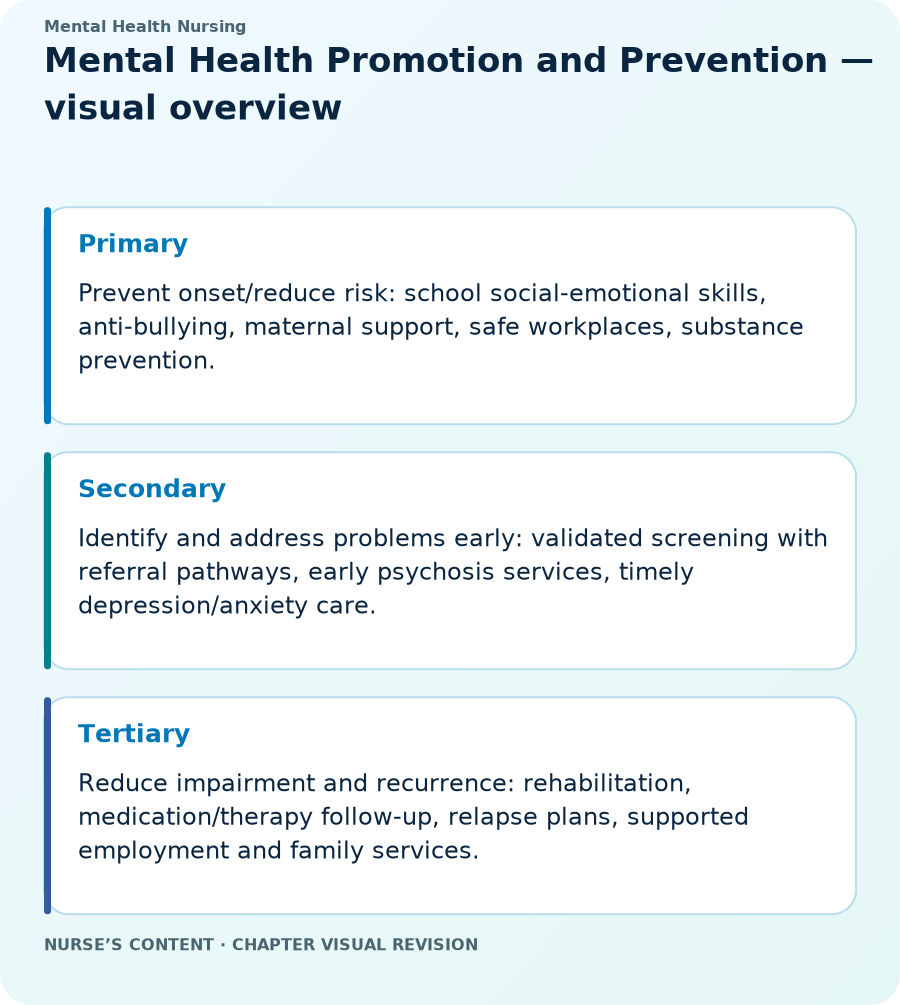
| Primary | Prevent onset/reduce risk: school social-emotional skills, anti-bullying, maternal support, safe workplaces, substance prevention. |
| Secondary | Identify and address problems early: validated screening with referral pathways, early psychosis services, timely depression/anxiety care. |
| Tertiary | Reduce impairment and recurrence: rehabilitation, medication/therapy follow-up, relapse plans, supported employment and family services. |
Universal interventions target whole population, selective target elevated-risk groups, indicated target early symptoms without full disorder (in prevention frameworks).
3. Suicide prevention
Population measures include access to mental healthcare, reducing access to lethal means, responsible media reporting, school and workplace support and follow-up after crises. Individual care: ask directly about suicidal thoughts, intent and access, assess injury/overdose and supports, intervene urgently when imminent, collaborative safety plan and follow-up. Avoid simplistic risk scoring, stigma, no-suicide contracts or promises of secrecy. In India Tele-MANAS 14416 provides support/referral; immediate emergency needs appropriate emergency services.
4. Stress management and resilience
Teach problem-focused and emotion-focused coping, realistic planning, sleep habits, physical activity, relaxation, social connection and help-seeking. Resilience is adaptation with resources, not compulsory toughness. Workplace/academic interventions include safe workloads, mentorship, protection from harassment and access to counselling. For persistent distress or functional decline arrange professional assessment.
5. Nursing education and evaluation
Assess population needs, plan culturally appropriate education, engage schools/community leaders and service users with consent, share accurate information, implement screening only with follow-up resources. Evaluate reach, knowledge, referral completion, access, safety and patient-defined outcomes, protect confidentiality. Challenge myths (people with mental disorders are not uniformly dangerous; treatment can help; seeking care is not weakness).
6. Important Examination Questions
Long Answer Questions
- 1. Explain levels of prevention and nurses' role in mental health promotion and suicide prevention.
Short Answer Questions
- 1. Describe resilience
- 2. explain protective factors
- 3. discuss early intervention.
Very Short Answer Questions (with answers)
- 1. What is primary prevention? — Measures to reduce onset/risk.
- 2. Can screening replace clinical assessment? — No.
7. Quick Revision
- • Promotion is both individual and social.
- • Suicide prevention requires practical support and safety.
- • Follow-up is essential after screening.
8. Conclusion
Promotion is both individual and social. Suicide prevention requires practical support and safety. Follow-up is essential after screening.
Chapter reference images