Mental Health Nursing
Legal and Ethical Aspects of Mental Health Nursing
Mental Healthcare Act, 2017, patient rights, informed consent, confidentiality, capacity, admission and discharge procedures, restraint guidelines and ethical responsibilities of psychiatric nurses.
Open quizzes and study tools Download PDF
CHAPTER 24 / MENTAL HEALTH NURSING 24. Legal and Ethical Aspects of Mental Health Nursing
1. Mental Healthcare Act, 2017 (India)
The Act establishes rights-based mental healthcare, access to services, protection from cruel/inhuman/degrading treatment and legal safeguards for decisions and admission. It provides for Mental Health Authorities and Review Boards. Use the Act and rules/regulations/current institutional procedures for clinical decisions; this is a study summary, not legal advice.
2. Rights and key sections
| Section / area | Concept |
|---|---|
| Section 4 | Capacity for mental healthcare decisions: ability to understand relevant information, appreciate foreseeable consequences and communicate decision; presume capacity under Act's criteria and provide support. |
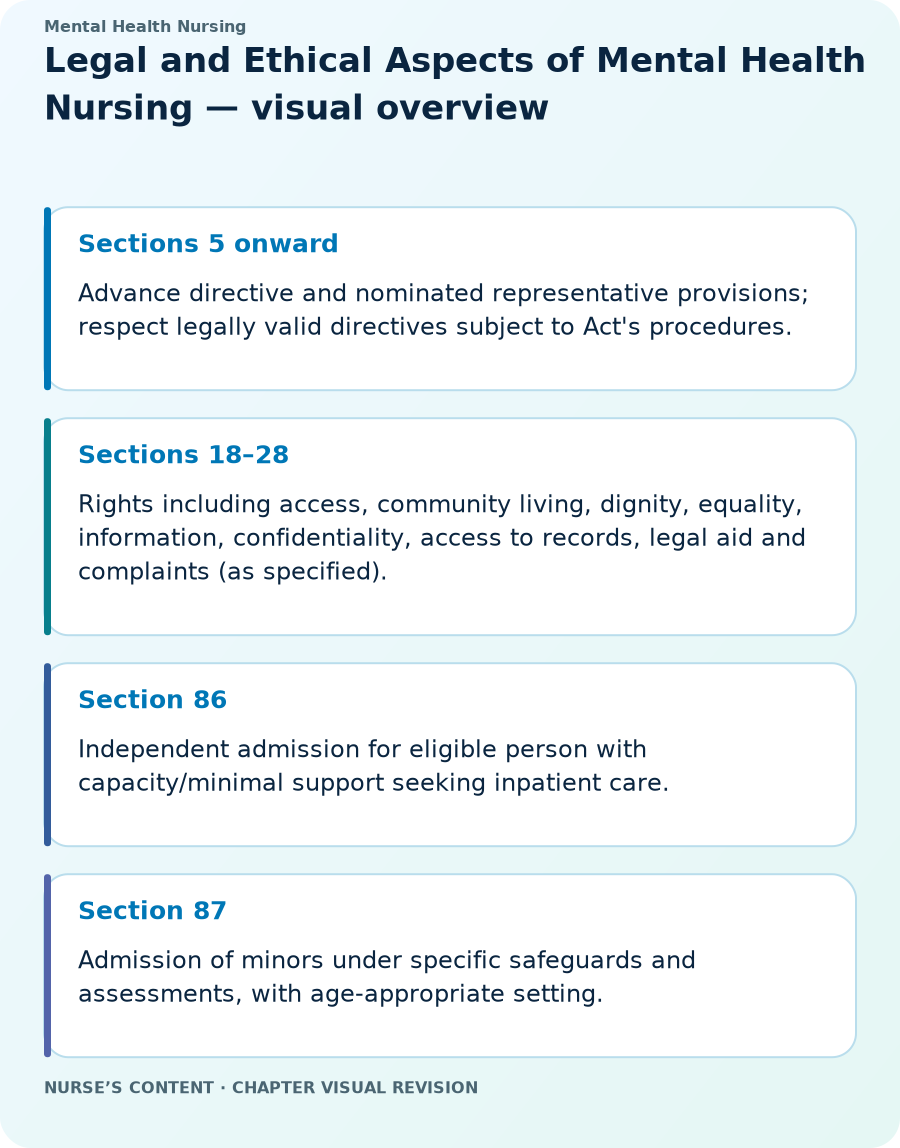
| Sections 5 onward | Advance directive and nominated representative provisions; respect legally valid directives subject to Act's procedures. |
| Sections 18–28 | Rights including access, community living, dignity, equality, information, confidentiality, access to records, legal aid and complaints (as specified). |
| Section 86 | Independent admission for eligible person with capacity/minimal support seeking inpatient care. |
| Section 87 | Admission of minors under specific safeguards and assessments, with age-appropriate setting. |
| Sections 89–90 | Supported admission for high support needs under statutory criteria; section 89 up to 30 days, section 90 governs longer supported admission with review. |
| Section 94 | Emergency treatment under specific conditions and time limits; ECT not emergency treatment under this section. |
| Section 95 | Prohibits unmodified ECT, chaining, sterilization as treatment for mental illness; ECT in minors generally prohibited with statutory exceptional consent/Board pathway. |
| Section 97 | Prohibits seclusion/solitary confinement; physical restraint only as sole available way to prevent imminent immediate harm and authorized by treating psychiatrist. |
| Section 115 | Presumption of severe stress after suicide attempt unless proved otherwise, and duty of government to provide care, treatment and rehabilitation; understand alongside current criminal law. |
3. Consent, confidentiality and capacity
Capacity is decision-specific and may fluctuate; mental illness diagnosis does not automatically establish incapacity. Provide comprehensible information, interpreter/support and time. Document assessment by authorized professionals, consent/refusal, legal basis, nominated representative and advance directive when relevant. Confidentiality has lawful exceptions (e.g., necessary care and safety/reporting requirements as permitted); disclose only appropriate information through approved channels. Do not release records to family automatically.
4. Admission/discharge and restraint responsibilities
Verify legal category and documentation, rights information, necessary authorizations and review dates. Independent patients' discharge requests handled according to Act (including limited statutory assessment procedure if supported admission indicated). Supported discharge and review must follow sections and Board requirements. Use least restrictive alternatives, monitor restraint physically/psychologically as required, end as soon as criteria no longer apply, record duration, reasons, monitoring, authorization and notifications; inform nominated representative within statutory timeline when applicable. Never use restraint as discipline or due to staff shortage.
5. Ethical principles and accountability
Autonomy, beneficence, nonmaleficence, justice, veracity, fidelity and confidentiality. Report abuse/unsafe care, maintain competence and accurate records, seek supervision, escalate conflicts through professional/legal channels. Respect dignity, sexuality, communication and non-discrimination, and support reasonable accommodations.
6. Important Examination Questions
Long Answer Questions
- 1. Discuss MHCA 2017 rights, admission categories and restraint/ECT safeguards.
Short Answer Questions
- 1. Explain capacity
- 2. describe advance directives and nominated representative
- 3. discuss confidentiality and section 115.
Very Short Answer Questions (with answers)
- 1. Which section prohibits seclusion? — Section 97.
- 2. Does diagnosis automatically mean incapacity? — No.
7. Quick Revision
- • Use statutory safeguards and least restrictive care.
- • Capacity requires supported decision-making assessment.
- • Documentation and rights information are essential.
8. Conclusion
Use statutory safeguards and least restrictive care. Capacity requires supported decision-making assessment. Documentation and rights information are essential.
Chapter reference images