Mental Health Nursing
Rehabilitation and Community Mental Health Nursing
Psychiatric rehabilitation, psychosocial rehabilitation, community-based care, follow-up services, halfway homes, occupational therapy, social skills training and relapse prevention.
Open quizzes and study tools Download PDF
CHAPTER 21 / MENTAL HEALTH NURSING 21. Rehabilitation and Community Mental Health Nursing
1. Definition and principles
Psychiatric rehabilitation supports people with mental illness to live meaningful lives in their chosen communities, maximize function and participation and reduce barriers. Recovery is a personal process, not identical to symptom remission. Psychosocial rehabilitation combines skills training, environmental support and access to social resources.
2. Community-based continuum
Community screening/primary care → outpatient specialist or DMHP → acute inpatient care as indicated → supported discharge and follow-up → rehabilitation, supported housing/employment and community reintegration. Home visits identify adherence, physical health, social support and household safety with consent. Halfway homes and supported living provide transitional/community accommodation according to needs and rights; they must not become unnecessary long-term confinement.
| Intervention | Purpose |
|---|---|
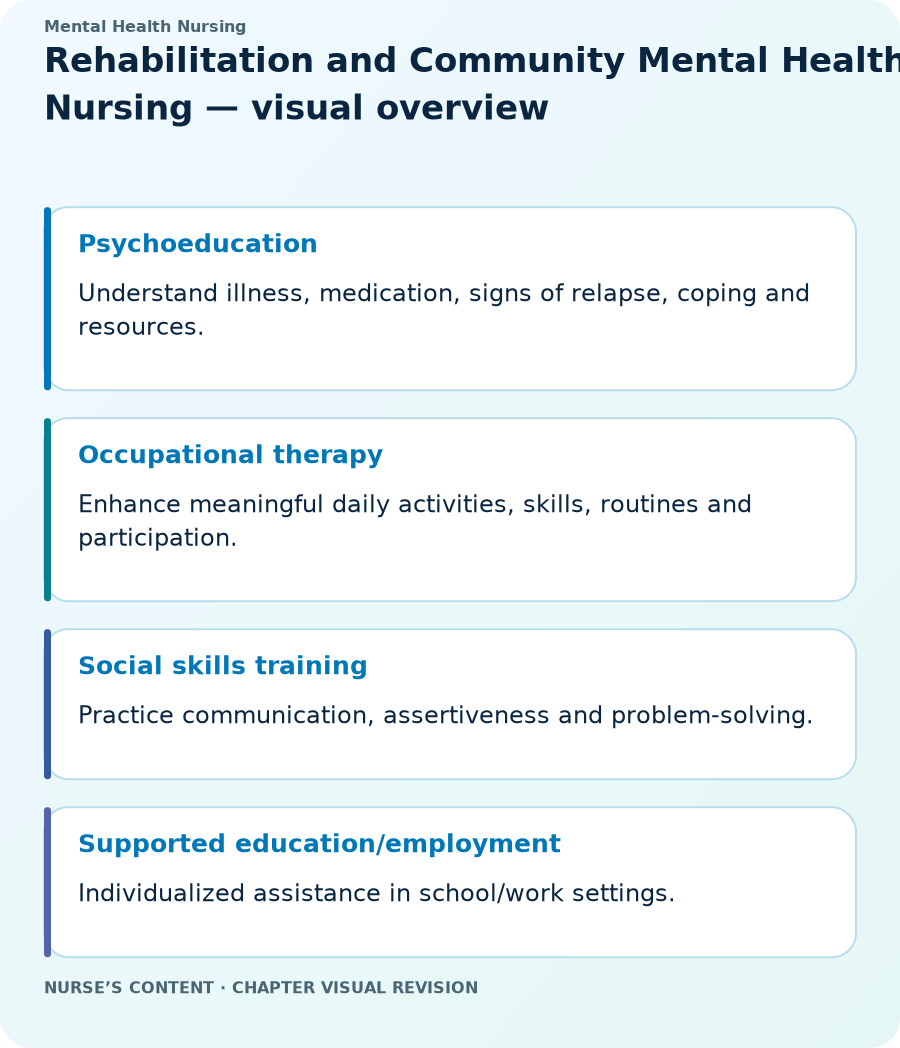
| Psychoeducation | Understand illness, medication, signs of relapse, coping and resources. |
| Occupational therapy | Enhance meaningful daily activities, skills, routines and participation. |
| Social skills training | Practice communication, assertiveness and problem-solving. |
| Supported education/employment | Individualized assistance in school/work settings. |
| Case management | Coordinate care, benefits, housing, physical health and follow-up. |
| Peer and family support | Mutual support, advocacy and caregiver resources, with consent. |
3. Relapse prevention and discharge plan
Identify individual early signs (e.g., reduced sleep, increasing voices or withdrawal), triggers and protective factors; agree who to contact and what to do, review medicines and adverse effects, plan appointments, access, transport, crisis pathways and social support. Ensure physical health monitoring including metabolic risks and tobacco/alcohol support. Assess housing/safety and need for supported decisions. Use teach-back and written plan in preferred language.
4. Nursing responsibilities
Assess daily living skills, strengths, goals and social barriers; build therapeutic relationship, monitor progress, teach coping and self-care, conduct home outreach within policy, coordinate referrals, maintain confidentiality and advocate against stigma. Evaluate outcomes such as functioning, attendance, quality of life and patient-defined goals, not merely readmission.
5. Important Examination Questions
Long Answer Questions
- 1. Describe psychiatric rehabilitation and community-based mental health nursing.
Short Answer Questions
- 1. Explain halfway homes
- 2. describe occupational therapy and social skills training
- 3. discuss relapse prevention.
Very Short Answer Questions (with answers)
- 1. What is psychosocial rehabilitation? — Support for functioning and community participation.
- 2. Is recovery synonymous with symptom absence? — No.
6. Quick Revision
- • Rehabilitation emphasizes participation.
- • Follow-up must be practical and accessible.
- • Support autonomy and social inclusion.
7. Conclusion
Rehabilitation emphasizes participation. Follow-up must be practical and accessible. Support autonomy and social inclusion.
Chapter reference images