Mental Health Nursing
Somatic Symptom and Dissociative Disorders
Somatic symptom disorder, illness anxiety disorder, conversion disorder, dissociative amnesia, dissociative identity disorder and nursing management.
Open quizzes and study tools Download PDF
CHAPTER 15 / MENTAL HEALTH NURSING 15. Somatic Symptom and Dissociative Disorders
1. Definitions and differential assessment
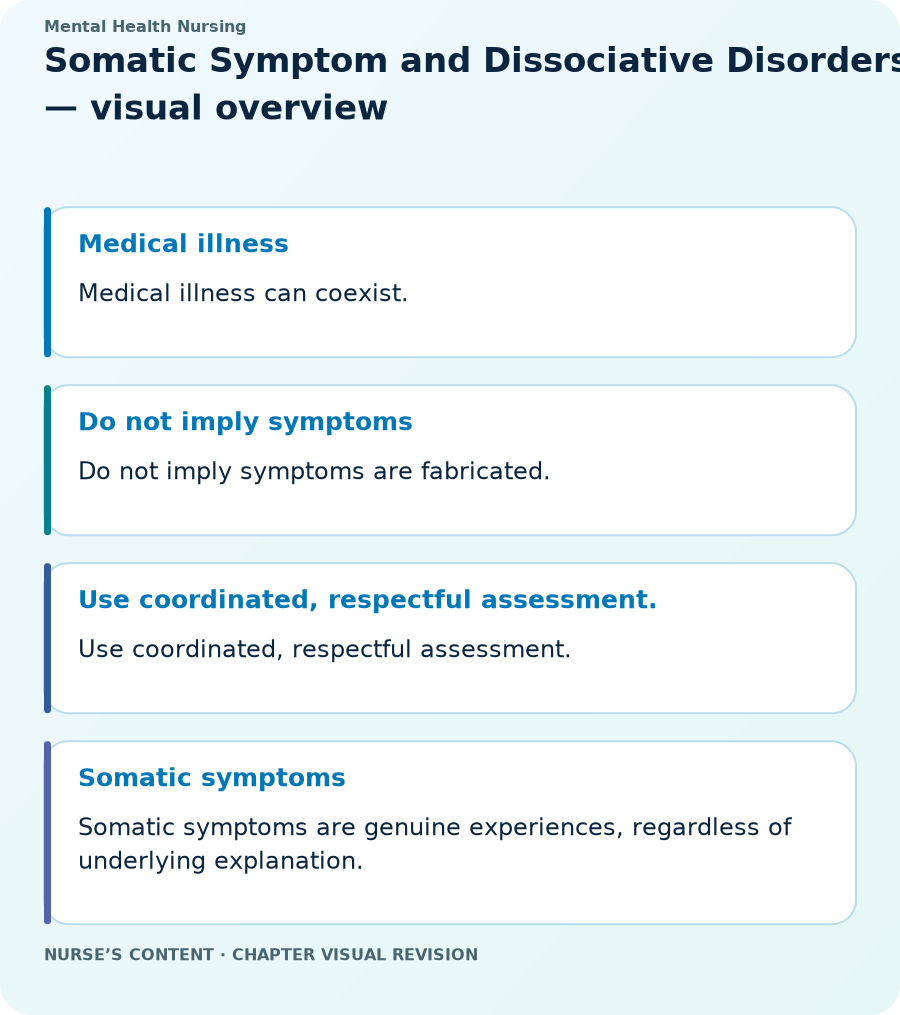
Somatic symptoms are genuine experiences, regardless of underlying explanation. Somatic symptom disorder involves distressing physical symptoms with disproportionate thoughts/feelings/behaviour; symptoms need not be medically unexplained. Dissociation concerns disruption in integration of awareness, memory, identity or perception. Assess medical/neurological causes, medication effects, trauma and safety without implying fabrication.
Somatic symptom disorder
Definition and pathophysiology: Persistent distress and excessive symptom-related thoughts/anxiety/behaviour; actual medical disease may coexist.
Clinical features and investigations: Pain, fatigue or other symptoms, health-related distress and impairment; review medical history and relevant examination/tests.
Management and nursing care: Coordinated regular care, validate suffering, set functional goals, avoid unnecessary repeated tests while addressing new signs, CBT and treatment of comorbidity as indicated.
Illness anxiety disorder
Definition and pathophysiology: Preoccupation with having/acquiring serious illness, typically little or mild somatic symptoms.
Clinical features and investigations: Repeated checking/reassurance seeking or avoidance; assess duration, functional impact and realistic medical risk.
Management and nursing care: Support planned follow-up, CBT, uncertainty tolerance and health education; avoid indiscriminate reassurance or dismissal.
Functional neurological symptom disorder (conversion disorder)
Definition and pathophysiology: Genuine motor/sensory neurological symptoms with clinical evidence of incompatibility with recognized neurological disease patterns; stressor not required.
Clinical features and investigations: Weakness, tremor, non-epileptic functional seizures or sensory symptoms; neurologic positive signs and specialist diagnosis.
Management and nursing care: Explain symptoms respectfully, rehab/physiotherapy and psychological support as indicated; assess injury and urgent medical mimics. Do not use painful stimuli or accuse patient of faking.
Dissociative amnesia and dissociative identity disorder
Definition and pathophysiology: Amnesia involves inability to recall important autobiographical information inconsistent with ordinary forgetting; DID involves disruption of identity with discontinuity and memory gaps.
Clinical features and investigations: Memory gaps, altered self experience, distress/impairment; exclude neurological, substance and cultural explanations.
Management and nursing care: Safety, grounding, predictable environment, specialist trauma-informed psychotherapy and treatment of comorbidity. Avoid suggestive memory retrieval techniques and forced disclosure.
2. Nursing care
Listen and validate feelings, explain tests and plan, observe patterns objectively, maintain boundaries and encourage normal activity as tolerated. Teach grounding and coping; coordinate medical and mental health services. Factitious disorder is intentional falsification without obvious external incentive; malingering involves external incentive; neither should be assumed from symptoms or unexplained tests.
3. Important Examination Questions
Long Answer Questions
- 1. Explain somatic symptom and dissociative disorders with nursing care.
Short Answer Questions
- 1. Differentiate illness anxiety and somatic symptom disorder
- 2. describe functional neurological disorder
- 3. explain dissociative amnesia.
Very Short Answer Questions (with answers)
- 1. Are functional symptoms genuine? — Yes.
- 2. What is dissociation? — Disruption of integrated mental functions.
4. Quick Revision
- • Medical illness can coexist.
- • Do not imply symptoms are fabricated.
- • Use coordinated, respectful assessment.
5. Conclusion
Medical illness can coexist. Do not imply symptoms are fabricated. Use coordinated, respectful assessment.
Chapter reference images