Mental Health Nursing
Organic and Neurocognitive Disorders
Delirium, dementia, amnestic disorders, mental disorders due to medical conditions, clinical manifestations, investigations and nursing management.
Open quizzes and study tools Download PDF
CHAPTER 14 / MENTAL HEALTH NURSING 14. Organic and Neurocognitive Disorders
1. Concepts
Older term “organic mental disorders” refers to psychiatric or cognitive symptoms associated with medical, neurological or substance-related causes. Modern terminology is more specific (delirium, major/mild neurocognitive disorders, mental disorders due to another condition). New mental status changes warrant assessment of medical causes before psychiatric attribution.
2. Delirium versus dementia
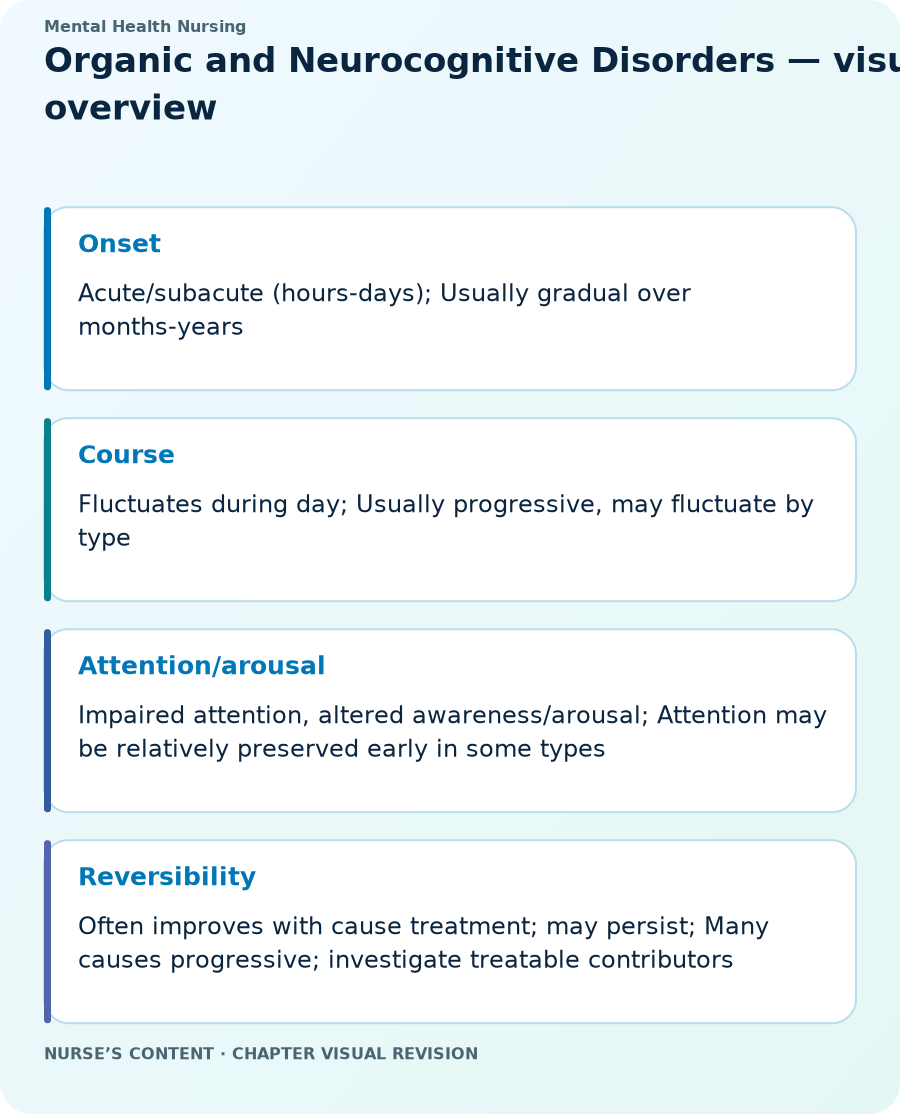
| Feature | Delirium | Dementia/major neurocognitive disorder |
|---|---|---|
| Onset | Acute/subacute (hours-days) | Usually gradual over months-years |
| Course | Fluctuates during day | Usually progressive, may fluctuate by type |
| Attention/arousal | Impaired attention, altered awareness/arousal | Attention may be relatively preserved early in some types |
| Reversibility | Often improves with cause treatment; may persist | Many causes progressive; investigate treatable contributors |
| Priority | Medical urgency and precipitant treatment | Function, diagnosis, support and planning |
Delirium
Definition and pathophysiology: Acute brain dysfunction related to infection, hypoxia, metabolic abnormalities, medication, withdrawal, pain or other triggers.
Clinical features and investigations: Inattention, fluctuating awareness and cognition, hyperactive/hypoactive/mixed presentation; use CAM/4AT where trained, assess vitals, glucose, medical cause.
Management and nursing care: Urgent assessment, treat cause, reorientation, hydration/nutrition, sensory aids, sleep preservation, mobility and medication review. Avoid routine restraints and sedatives; severe distress/risk requires specialist approach.
Dementia
Definition and pathophysiology: Acquired cognitive decline affecting independence; Alzheimer, vascular, Lewy body and frontotemporal types are examples.
Clinical features and investigations: Memory, language, executive, visuospatial or behavioural changes; history/collateral, cognitive and functional assessment, investigations for contributors.
Management and nursing care: Person-centred routines, cues and safe environment, support functional independence, caregiver education, prescribed therapy by type. Be aware of antipsychotic sensitivity in Lewy body dementia.
Amnestic disorders and secondary psychiatric syndromes
Definition and pathophysiology: Memory impairment may follow brain injury, thiamine deficiency, neurodegeneration or other causes. Endocrine, infectious, epileptic, metabolic or medication disorders may cause psychiatric symptoms.
Clinical features and investigations: Anterograde (new memory) or retrograde (prior memory) deficits; confabulation may occur. Investigate with history, neuro exam, labs and imaging as indicated.
Management and nursing care: Treat cause promptly, provide memory aids, structured routine, rehabilitation and safety; suspected Wernicke encephalopathy needs urgent prescribed parenteral thiamine and medical management.
3. Documentation and care
Record baseline cognition and acute changes, medication review, hydration/output, attention, sleep, orientation, falls and response. Ensure swallowing/nutrition safety, avoid overstimulation and use accessible communication. Capacity is decision-specific; involve support appropriately. Do not confuse delirium with psychiatric relapse or assume incapacity because of diagnosis.
4. Important Examination Questions
Long Answer Questions
- 1. Compare delirium and dementia and describe nursing management.
Short Answer Questions
- 1. Describe causes of delirium
- 2. explain amnestic disorders
- 3. discuss dementia caregiver support.
Very Short Answer Questions (with answers)
- 1. What is confabulation? — Unintentional inaccurate memory account.
- 2. Is hypoactive delirium possible? — Yes.
5. Quick Revision
- • Acute inattention is a warning sign.
- • Identify reversible causes.
- • Support dignity and functional ability.
6. Conclusion
Acute inattention is a warning sign. Identify reversible causes. Support dignity and functional ability.
Chapter reference images