Mental Health Nursing
Neurodevelopmental and Childhood Psychiatric Disorders
Autism spectrum disorder, attention-deficit/hyperactivity disorder (ADHD), intellectual disability, learning disorders, behavioural disorders and nursing care of children.
Open quizzes and study tools Download PDF
CHAPTER 12 / MENTAL HEALTH NURSING 12. Neurodevelopmental and Childhood Psychiatric Disorders
1. Assessment principles
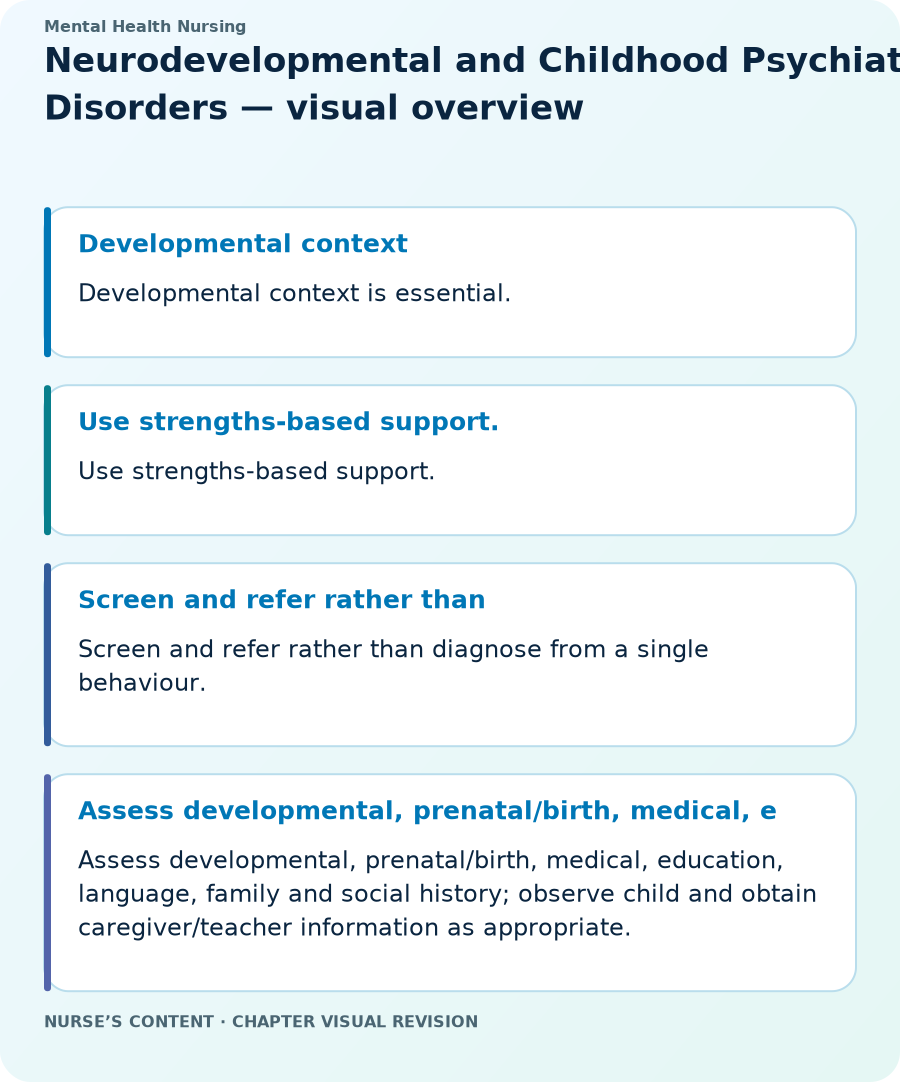
Assess developmental, prenatal/birth, medical, education, language, family and social history; observe child and obtain caregiver/teacher information as appropriate. Screen hearing, vision, sleep, nutrition, trauma and other causes. Obtain proper consent/assent and preserve safeguarding. Symptoms must be understood relative to development, settings and impairment.
Autism spectrum disorder
Definition and pathophysiology: Neurodevelopmental differences in social communication and restricted/repetitive behaviour or sensory patterns.
Clinical features and investigations: Variable communication, routines, sensory needs and interests; specialist assessment based on history and observation.
Management and nursing care: Individualized communication, educational and occupational support, environmental adaptation and strengths-based goals; address coexisting conditions. Avoid claims of cure or forced normalization.
ADHD
Definition and pathophysiology: Persistent impairing inattention and/or hyperactivity-impulsivity across settings, with developmental onset.
Clinical features and investigations: Difficulty sustaining attention, organizing, waiting, excessive movement or impulsivity; assess sleep, learning and anxiety.
Management and nursing care: Behavioural/parent and school strategies, structured routines, prescribed stimulant/nonstimulant medication when indicated; monitor growth, appetite, sleep, pulse/BP and adverse effects.
Intellectual disability
Definition and pathophysiology: Significant deficits in intellectual and adaptive functioning with developmental onset.
Clinical features and investigations: Difficulties in conceptual, social and practical skills; standardized assessment and clinical history.
Management and nursing care: Accessible communication, adaptive skills support, early intervention and inclusive education; assessment of comorbidities, caregiver support and safeguarding. Severity based on adaptive function/support needs.
Specific learning and communication disorders
Definition and pathophysiology: Persistent difficulty acquiring academic or language skills, distinct from lack of opportunity.
Clinical features and investigations: Reading, writing, mathematics, speech or receptive/expressive communication difficulties; specialist evaluation.
Management and nursing care: Tailored educational support, speech-language therapy, accommodations and self-esteem support; assess hearing/vision.
Disruptive and behavioural disorders
Definition and pathophysiology: Oppositional defiant or conduct-related patterns may involve persistent impairment; behaviour can also reflect trauma, unmet needs or neurodevelopment.
Clinical features and investigations: Observe context, frequency and triggers, assess safety, family/school needs and alternatives.
Management and nursing care: Parent management and behavioural support, predictable routines, positive reinforcement and problem-solving, multidisciplinary care; avoid humiliation and corporal punishment.
2. Role of the nurse
Create child-friendly assessment, explain procedures at developmental level, support family and school, document demonstrated abilities, monitor medication and safety, refer early. Maintain inclusion and respect child's preferences. Loss of acquired skills, abuse concerns or serious self-harm requires prompt evaluation.
3. Important Examination Questions
Long Answer Questions
- 1. Explain autism, ADHD and intellectual disability with nursing care.
Short Answer Questions
- 1. Describe childhood assessment
- 2. discuss learning disorders
- 3. explain role of family/school.
Very Short Answer Questions (with answers)
- 1. What does ADHD stand for? — Attention-deficit/hyperactivity disorder.
- 2. Is intellectual disability severity determined solely by IQ? — No.
4. Quick Revision
- • Developmental context is essential.
- • Use strengths-based support.
- • Screen and refer rather than diagnose from a single behaviour.
5. Conclusion
Developmental context is essential. Use strengths-based support. Screen and refer rather than diagnose from a single behaviour.
Chapter reference images