Mental Health Nursing
Personality Disorders
Classification of personality disorders, clinical features, borderline personality disorder, antisocial personality disorder, management approaches and nursing interventions.
Open quizzes and study tools Download PDF
CHAPTER 11 / MENTAL HEALTH NURSING 11. Personality Disorders
1. Definition and classification
Personality disorders involve enduring inflexible patterns of inner experience and behaviour causing significant dysfunction or distress, typically beginning by adolescence or early adulthood. DSM traditional clusters: A (paranoid, schizoid, schizotypal), B (antisocial, borderline, histrionic, narcissistic), C (avoidant, dependent, obsessive-compulsive personality disorder). ICD-11 uses severity and trait qualifiers with optional borderline pattern. Personality traits alone are not diagnoses; assess culture, trauma, neurodevelopment and medical/substance causes.
| Disorder/group | Typical features (not a diagnostic checklist) |
|---|---|
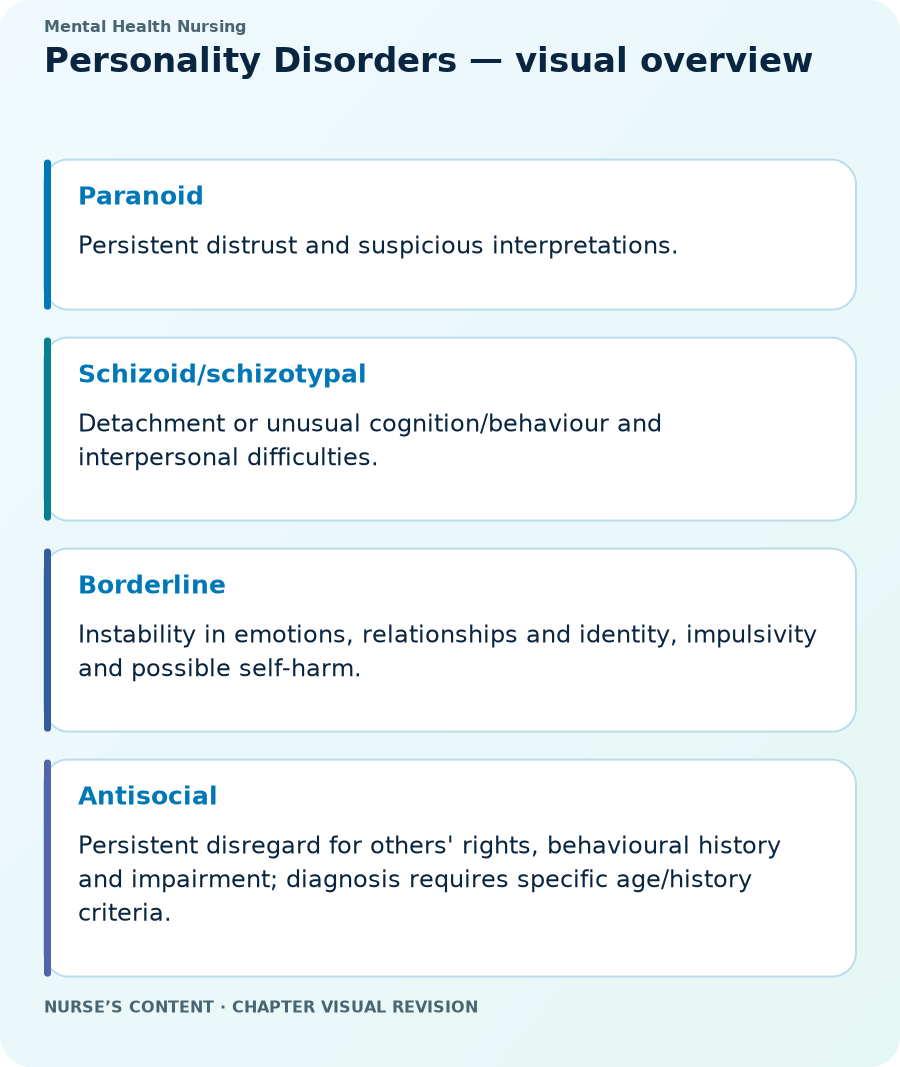
| Paranoid | Persistent distrust and suspicious interpretations. |
| Schizoid/schizotypal | Detachment or unusual cognition/behaviour and interpersonal difficulties. |
| Borderline | Instability in emotions, relationships and identity, impulsivity and possible self-harm. |
| Antisocial | Persistent disregard for others' rights, behavioural history and impairment; diagnosis requires specific age/history criteria. |
| Histrionic/narcissistic | Excessive emotional/attention patterns or grandiosity/admiration needs and interpersonal difficulty. |
| Avoidant/dependent | Inhibition/fear of rejection or excessive reliance on others. |
| OCPD | Pervasive perfectionism/order/control, distinct from OCD obsessions/compulsions. |
2. Management approaches
Structured psychological interventions are key; dialectical behaviour therapy (DBT), mentalization-based or other evidence-based approaches may be offered for borderline personality disorder. There is no routine medication that treats all core personality features; drugs may target selected comorbid conditions/symptoms under specialist guidance. Assess suicide/self-harm and interpersonal risk without assuming motive; address co-occurring substance use, depression and trauma.
3. Nursing interventions
Establish collaborative goals, consistent respectful boundaries and clear communication. Validate distress, encourage emotion regulation, distress tolerance, problem-solving and interpersonal effectiveness using trained approaches. Avoid labelling behaviour “manipulative” or punitive responses; document observable actions. Coordinate team consistency, use supervision to manage emotional reactions. For aggression use individualized risk assessment and least restrictive de-escalation; for self-harm assess medically, protect safety and support safety planning. Provide follow-up and family education with consent.
4. Important Examination Questions
Long Answer Questions
- 1. Explain classification and nursing care of patients with personality disorders.
Short Answer Questions
- 1. Discuss borderline and antisocial personality disorders
- 2. differentiate OCD and OCPD
- 3. describe DBT.
Very Short Answer Questions (with answers)
- 1. What is DBT? — Dialectical behaviour therapy.
- 2. Does one personality trait prove disorder? — No.
5. Quick Revision
- • Use consistent boundaries without judgment.
- • Assess specific risk rather than stereotype.
- • Psychotherapy and functional goals are central.
6. Conclusion
Use consistent boundaries without judgment. Assess specific risk rather than stereotype. Psychotherapy and functional goals are central.
Chapter reference images