Mental Health Nursing
Schizophrenia and Other Psychotic Disorders
Schizophrenia, delusions, hallucinations, disorganised thinking, negative symptoms, brief psychotic disorder and nursing management of patients with psychosis.
Open quizzes and study tools Download PDF
CHAPTER 09 / MENTAL HEALTH NURSING 09. Schizophrenia and Other Psychotic Disorders
1. Psychosis and schizophrenia
Psychosis involves impaired reality testing, which may include delusions, hallucinations and disorganized thinking/behaviour. It can occur in schizophrenia, mood disorders, delirium, substance use or neurological disease. Schizophrenia is a chronic or episodic syndrome of characteristic symptoms and functional effects; DSM uses at least 6 months of disturbance with active symptoms generally at least 1 month, while ICD-11 requirements differ. Do not infer prognosis from diagnosis alone.
2. Symptom categories
| Category | Examples |
|---|---|
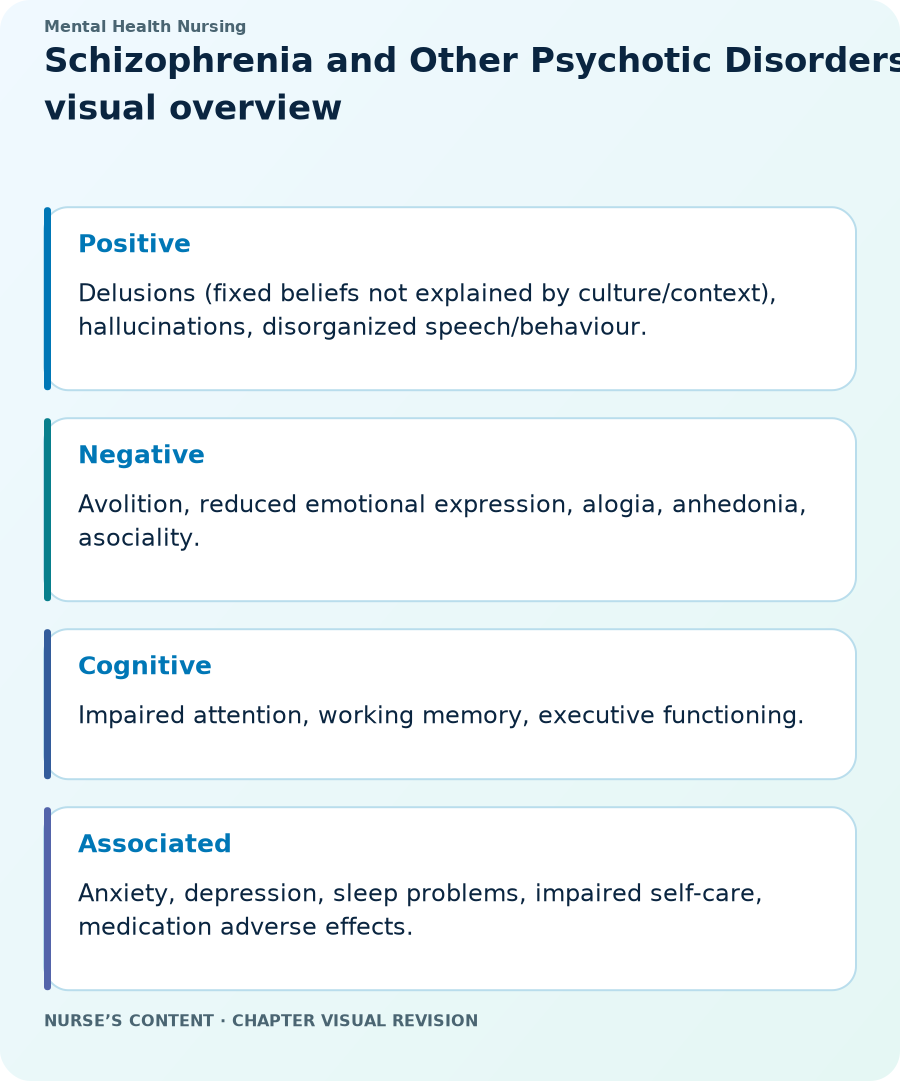
| Positive | Delusions (fixed beliefs not explained by culture/context), hallucinations, disorganized speech/behaviour. |
| Negative | Avolition, reduced emotional expression, alogia, anhedonia, asociality. |
| Cognitive | Impaired attention, working memory, executive functioning. |
| Associated | Anxiety, depression, sleep problems, impaired self-care, medication adverse effects. |
Delusion types include persecutory, grandiose, referential and somatic. Hallucinations may be auditory, visual, tactile, olfactory or gustatory; command content requires specific safety assessment. Illusion is misinterpretation of a real stimulus; thought disorder involves impaired organization of speech/thinking.
Schizophrenia
Definition and pathophysiology: Interacting genetic/neurodevelopmental and environmental factors contribute; not a split personality.
Clinical features and investigations: Assess history, symptom course, functioning, MSE, substance exposure and medical causes; establish differential with mood and other psychotic disorders.
Management and nursing care: Prescribed antipsychotics, psychoeducation, psychosocial interventions, supported education/employment and family support. Monitor metabolic and movement effects, relapse and physical health; clozapine for selected treatment-resistant cases with required monitoring.
Brief psychotic and related disorders
Definition and pathophysiology: DSM brief psychotic disorder lasts ≥1 day and <1 month with eventual return to prior functioning; schizophreniform lasts 1–<6 months. Other systems differ.
Clinical features and investigations: Acute delusions, hallucinations, disorganization; evaluate delirium, substances, medical causes and postpartum psychosis.
Management and nursing care: Urgent assessment, safe supportive setting, cause-specific treatment and follow-up; outcomes vary and diagnostic formulation may change.
3. Nursing management
Assess voices (content, distress, commands, perceived ability to resist), suicidal/violence concerns, self-care and nutrition. Use calm concise communication, acknowledge distress without confirming hallucination or delusion; avoid debate. Reduce overwhelming stimuli, offer meaningful structured activities and support sleep. Promote medication choice and adherence through shared discussion; observe EPS, akathisia, metabolic effects and NMS warning signs. New fever, rigidity and confusion requires urgent assessment. Plan relapse warning signs, support networks and crisis access.
4. Important Examination Questions
Long Answer Questions
- 1. Explain schizophrenia symptoms, investigations and nursing management.
Short Answer Questions
- 1. Differentiate hallucinations/delusions
- 2. describe negative symptoms
- 3. discuss brief psychotic disorder.
Very Short Answer Questions (with answers)
- 1. What is avolition? — Reduced motivation to initiate goal-directed activity.
- 2. Are hallucinations always due to schizophrenia? — No.
5. Quick Revision
- • Psychosis has many possible causes.
- • Assess command hallucination safety.
- • Recovery-oriented care focuses on function and choice.
6. Conclusion
Psychosis has many possible causes. Assess command hallucination safety. Recovery-oriented care focuses on function and choice.
Chapter reference images