Mental Health Nursing
Mood Disorders
Depressive disorders, bipolar disorders, mania, hypomania, suicide risk assessment, clinical features, treatment approaches and nursing management.
Open quizzes and study tools Download PDF
CHAPTER 08 / MENTAL HEALTH NURSING 08. Mood Disorders
1. Depression and bipolar concepts
Mood disorders involve clinically significant disturbances of mood and related functioning. Depressive symptoms can follow illness, grief, medication, substances or psychiatric conditions. Assess prior elevated mood, family history, physical health and suicide risk before assuming unipolar depression.
Major depressive disorder
Definition and pathophysiology: Persistent depressed mood and/or loss of interest plus associated symptoms causing impairment; DSM episode typically ≥2 weeks and five or more symptoms with required core feature/exclusions.
Clinical features and investigations: Sleep/appetite changes, low energy, guilt, poor concentration, psychomotor changes, suicidal ideation. Severity and psychosis vary.
Management and nursing care: Support evidence-based psychotherapy, antidepressant or other treatment as prescribed; monitor self-harm risk, activation and adverse effects; address nutrition, sleep, self-care and gradual activity. ECT may be indicated for severe/urgent presentations.
Bipolar I and II disorders
Definition and pathophysiology: Bipolar I requires history of mania; bipolar II involves hypomania and major depression without mania.
Clinical features and investigations: Mania: elevated/irritable mood and increased energy, decreased need for sleep, pressured speech, grandiosity, distractibility, risky behaviour; DSM mania usually ≥1 week or shorter if hospitalization necessary. Hypomania usually ≥4 days, less severe without marked impairment/psychosis.
Management and nursing care: Mood stabilizer/antipsychotic and psychosocial care as prescribed; avoid antidepressant monotherapy in bipolar I. Monitor sleep, nutrition, impulsivity, sexual/financial and physical safety; low-stimulation environment, clear limits and short instructions.
2. Comparison
| Feature | Mania | Hypomania |
|---|---|---|
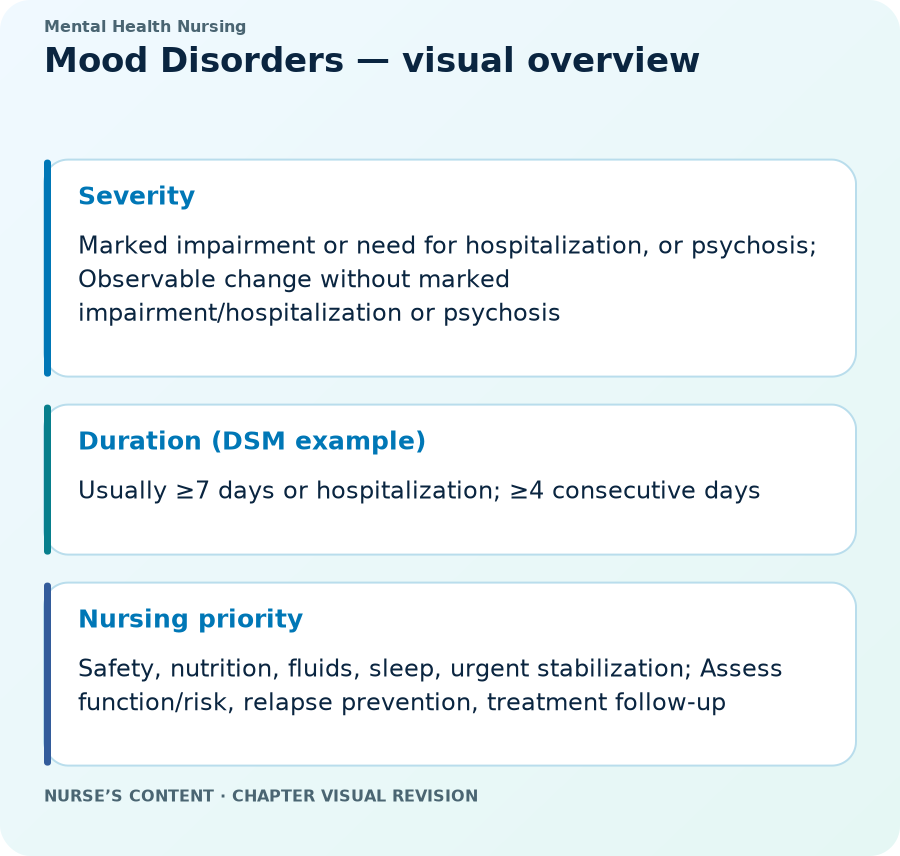
| Severity | Marked impairment or need for hospitalization, or psychosis | Observable change without marked impairment/hospitalization or psychosis |
| Duration (DSM example) | Usually ≥7 days or hospitalization | ≥4 consecutive days |
| Nursing priority | Safety, nutrition, fluids, sleep, urgent stabilization | Assess function/risk, relapse prevention, treatment follow-up |
3. Suicide risk assessment and management
Ask directly about thoughts of death, intent, plan, access, recent attempts, precipitating events and protective supports. Attend to immediate safety, remove accessible hazards according to protocol, ensure observation level and urgent professional assessment for imminent risk. Use collaborative safety plan with warning signs, coping strategies, contacts and reducing access to lethal means, not a promise-only contract. Assess physical injury or overdose. Document exact concerns, actions, observation and handover; reassess during transitions.
4. Nursing care
Depression: encourage manageable activities, active listening without clichés, monitor eating/sleep and prescribed treatment. Mania: decrease stimuli, set consistent respectful boundaries, offer frequent fluids/nutrition as appropriate, monitor exhaustion and unsafe behaviour. Include family with consent, education about early warning signs and medication adherence.
5. Important Examination Questions
Long Answer Questions
- 1. Explain clinical features and nursing management of depression and mania.
Short Answer Questions
- 1. Differentiate mania/hypomania
- 2. explain bipolar I/II
- 3. describe suicide assessment.
Very Short Answer Questions (with answers)
- 1. What is anhedonia? — Reduced interest/pleasure.
- 2. Does bipolar II include a history of mania? — No.
6. Quick Revision
- • Suicide assessment is direct and individualized.
- • Check past mania before depression treatment.
- • Monitor sleep and physical health in mania.
7. Conclusion
Suicide assessment is direct and individualized. Check past mania before depression treatment. Monitor sleep and physical health in mania.
Chapter reference images