Mental Health Nursing
Anxiety, Stress and Trauma-Related Disorders
Anxiety disorders, panic disorder, phobias, obsessive-compulsive disorder, post-traumatic stress disorder, acute stress disorder, stress responses and nursing management.
Open quizzes and study tools Download PDF
CHAPTER 07 / MENTAL HEALTH NURSING 07. Anxiety, Stress and Trauma-Related Disorders
1. Anxiety and stress concepts
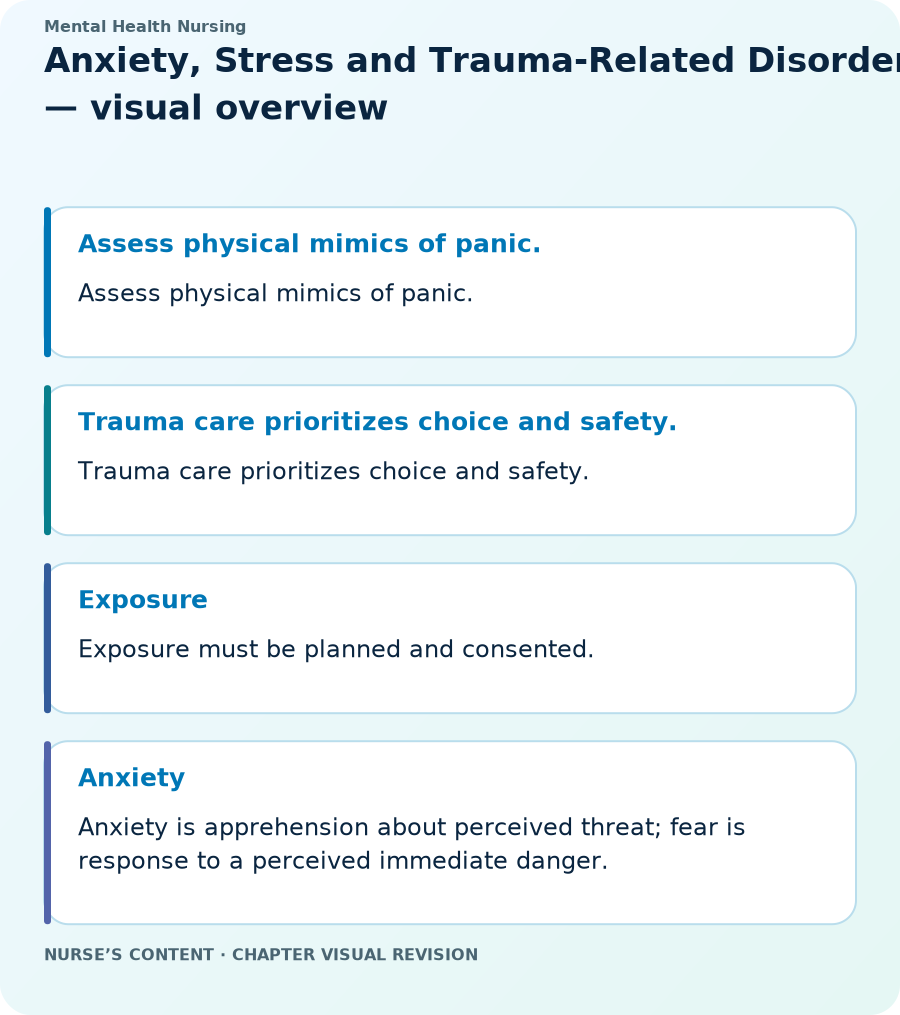
Anxiety is apprehension about perceived threat; fear is response to a perceived immediate danger. Stress results from demands and appraisal of resources. Anxiety can be mild, moderate, severe or panic-level in nursing descriptions; these levels do not independently diagnose disorders. Sympathetic activation can cause tachycardia, sweating, tremor and hyperventilation. Assess cardiac, respiratory, endocrine, substance and medication causes before assuming panic.
Generalized anxiety disorder
Definition and pathophysiology: Persistent excessive worry across several domains, difficult to control; DSM commonly requires ≥6 months in appropriate context.
Clinical features and investigations: Restlessness, fatigue, muscle tension, sleep/concentration difficulty, functional impairment; assess comorbidity and medical causes.
Management and nursing care: CBT and prescribed SSRI/SNRI or other treatment when indicated; education, graded relaxation, sleep and coping support. Avoid routine long-term benzodiazepines due to dependence and sedation.
Panic disorder
Definition and pathophysiology: Recurrent unexpected panic attacks plus persistent concern or behavioural change.
Clinical features and investigations: Abrupt intense fear/discomfort, palpitation, dyspnoea, dizziness, fear of losing control; assess urgent medical causes.
Management and nursing care: Remain calm, reduce stimulation, explain assessed symptoms, encourage slow comfortable breathing (no paper bag), support CBT and prescribed treatment; escalate chest pain/syncope/hypoxia.
Phobias
Definition and pathophysiology: Persistent excessive fear/avoidance of specified object/situation, social scrutiny or difficult escape contexts (distinct diagnoses).
Clinical features and investigations: Avoidance, anticipatory anxiety and impairment.
Management and nursing care: Therapist-led graded exposure and CBT, support agreed goals; never force exposure without consent and plan.
Obsessive-compulsive disorder (OCD)
Definition and pathophysiology: Obsessions are intrusive unwanted thoughts/urges/images; compulsions are repetitive acts/mental rituals to reduce distress or prevent feared outcome.
Clinical features and investigations: Time-consuming symptoms, distress/impairment; insight variable; assess actual risk separately from intrusive thoughts.
Management and nursing care: Exposure and response prevention (ERP) is a key CBT approach; SSRIs or other specialist treatment as prescribed. Avoid repeatedly reassuring or participating in rituals; collaborate on gradual goals without punishment.
PTSD and acute stress disorder
Definition and pathophysiology: Trauma-related disorders following qualifying exposure; DSM acute stress disorder lasts 3 days–1 month, PTSD persists beyond 1 month.
Clinical features and investigations: Intrusions, avoidance, negative mood/cognitions, hyperarousal, possible dissociation; assess safety and functioning.
Management and nursing care: Trauma-informed care, choice, privacy, grounding and social support; trauma-focused psychotherapy and indicated medications. Do not force detailed retelling. Assess ongoing violence and refer.
2. Nursing management and coping
Assess triggers, severity, functions and safety; identify strengths. Encourage grounding, comfortable breathing, progressive relaxation and appropriate activity; teach stressor-specific planning and emotion regulation. At severe anxiety use short clear messages, stay with patient as indicated, address medical risks and seek assistance. Monitor medication benefits and adverse effects, evaluate function rather than only symptom score.
3. Important Examination Questions
Long Answer Questions
- 1. Discuss anxiety disorders, OCD and PTSD with nursing management.
Short Answer Questions
- 1. Differentiate fear/anxiety
- 2. explain ERP
- 3. compare acute stress disorder and PTSD.
Very Short Answer Questions (with answers)
- 1. What is ERP? — Exposure and response prevention.
- 2. Are intrusive thoughts by themselves equivalent to intent? — No.
4. Quick Revision
- • Assess physical mimics of panic.
- • Trauma care prioritizes choice and safety.
- • Exposure must be planned and consented.
5. Conclusion
Assess physical mimics of panic. Trauma care prioritizes choice and safety. Exposure must be planned and consented.
Chapter reference images