Mental Health Nursing
Psychiatric Nursing Process and Care Planning
Psychiatric nursing assessment, nursing diagnoses, planning, implementation, evaluation, individualised care plans and clinical documentation.
Open quizzes and study tools Download PDF
CHAPTER 06 / MENTAL HEALTH NURSING 06. Psychiatric Nursing Process and Care Planning
1. Assessment and formulation
Collect psychiatric and physical history, MSE, functional capacity, sleep, medicines, substance history, nutrition, coping, support and safety concerns. Identify strengths as well as problems. Formulate factors predisposing, precipitating, perpetuating and protecting the individual (4 Ps); diagnoses guide but do not replace individualized assessment.
2. ADPIE and nursing diagnoses
Assessment → nursing diagnosis → planning → implementation → evaluation. Nursing diagnoses describe responses (e.g., anxiety, impaired sleep, risk for self-directed injury, social isolation where supported), not medical diagnoses. Terminology should follow current institutional nursing classification. Problem-focused diagnoses may use PES: problem, related factor, evidence. Risk diagnoses use risk factors, not signs of a problem that has not occurred.
3. Sample care plan: depressive symptoms and self-harm risk
| Nursing process | Example (illustrative) |
|---|---|
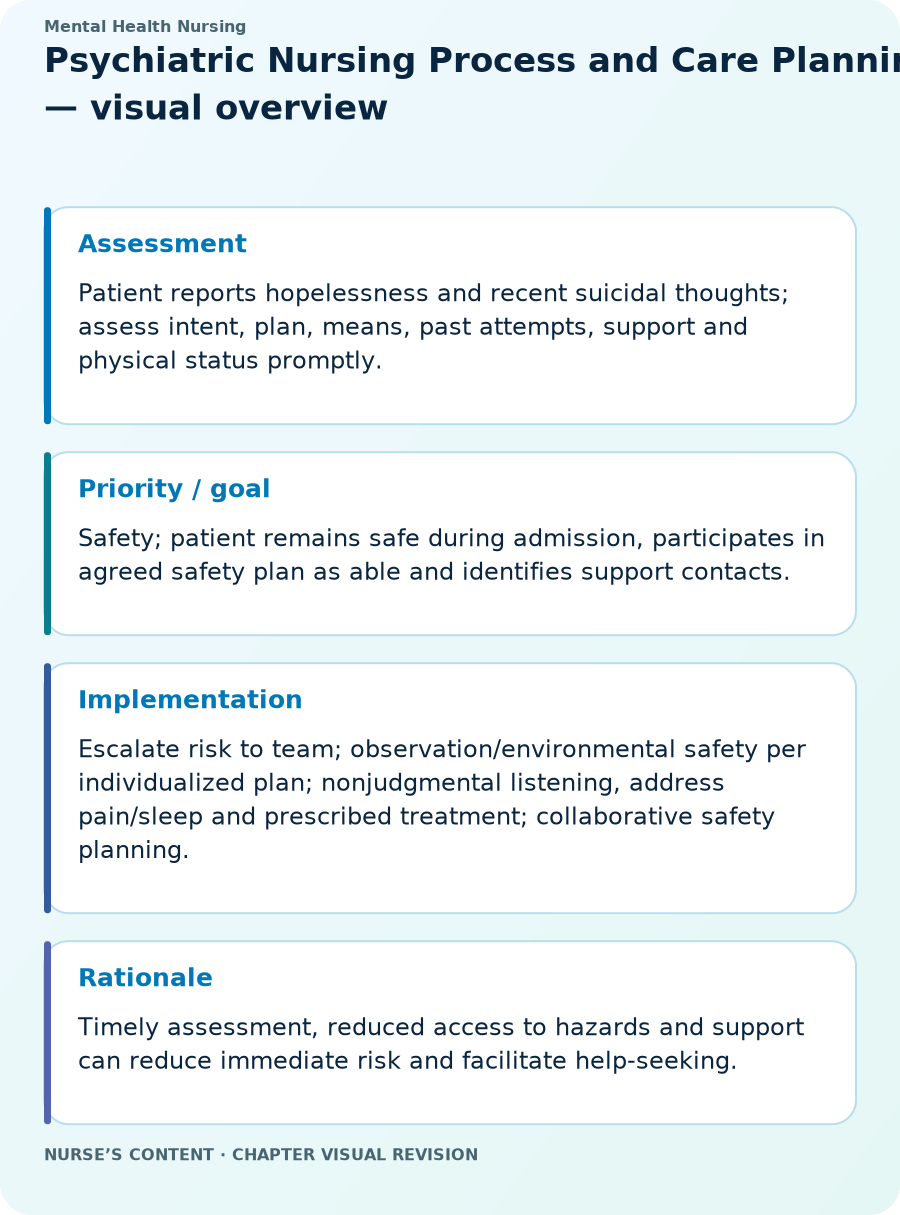
| Assessment | Patient reports hopelessness and recent suicidal thoughts; assess intent, plan, means, past attempts, support and physical status promptly. |
| Priority / goal | Safety; patient remains safe during admission, participates in agreed safety plan as able and identifies support contacts. |
| Implementation | Escalate risk to team; observation/environmental safety per individualized plan; nonjudgmental listening, address pain/sleep and prescribed treatment; collaborative safety planning. |
| Rationale | Timely assessment, reduced access to hazards and support can reduce immediate risk and facilitate help-seeking. |
| Evaluation | Reassess ideation, intent, distress and protective factors; document actual response and update plan. |
4. Additional care planning examples
For hallucinations: assess content, associated fear and safety, use reality-based communication and coping, monitor prescribed medication and distress. For mania: reduce stimulation, support sleep/nutrition, use clear consistent limits and monitor risk. For withdrawal: assess substance/timing and severity, vitals, prescribed protocol and escalation. Outcomes should be measurable and agreed where possible, not merely “patient will be cured.”
5. Documentation and collaboration
Write date/time, specific findings, interventions, consent, medication and effects, safety level, communication and reassessment. Review within multidisciplinary team, at transfer and discharge. Include relapse warning signs, medication education, follow-up and crisis contacts; ensure accessible written plan. Never use a no-suicide contract as substitute for assessment or safety planning.
6. Important Examination Questions
Long Answer Questions
- 1. Explain psychiatric nursing process and prepare a care plan for depression or psychosis.
Short Answer Questions
- 1. Write PES format
- 2. explain risk diagnosis
- 3. describe evaluation and documentation.
Very Short Answer Questions (with answers)
- 1. What is a nursing diagnosis? — Clinical judgment about human responses.
- 2. What is a SMART goal? — Specific, measurable, achievable, relevant, time-bound.
7. Quick Revision
- • Safety is a priority.
- • Plans must be individualized and reviewed.
- • Record outcomes rather than assumptions.
8. Conclusion
Safety is a priority. Plans must be individualized and reviewed. Record outcomes rather than assumptions.
Chapter reference images