Mental Health Nursing
Therapeutic Communication and Nurse–Patient Relationship
Principles of therapeutic communication, techniques, barriers, phases of nurse–patient relationship, therapeutic use of self and management of challenging interactions.
Open quizzes and study tools Download PDF
CHAPTER 05 / MENTAL HEALTH NURSING 05. Therapeutic Communication and Nurse–Patient Relationship
1. Definition and principles
Therapeutic communication is purposeful professional interaction that supports understanding, expression of needs, safety and recovery. Use respect, empathy, genuineness, active listening, clear language, privacy, appropriate boundaries and collaboration. Therapeutic use of self means using self-awareness, communication and professional conduct intentionally to support patient goals.
| Technique | Example |
|---|---|
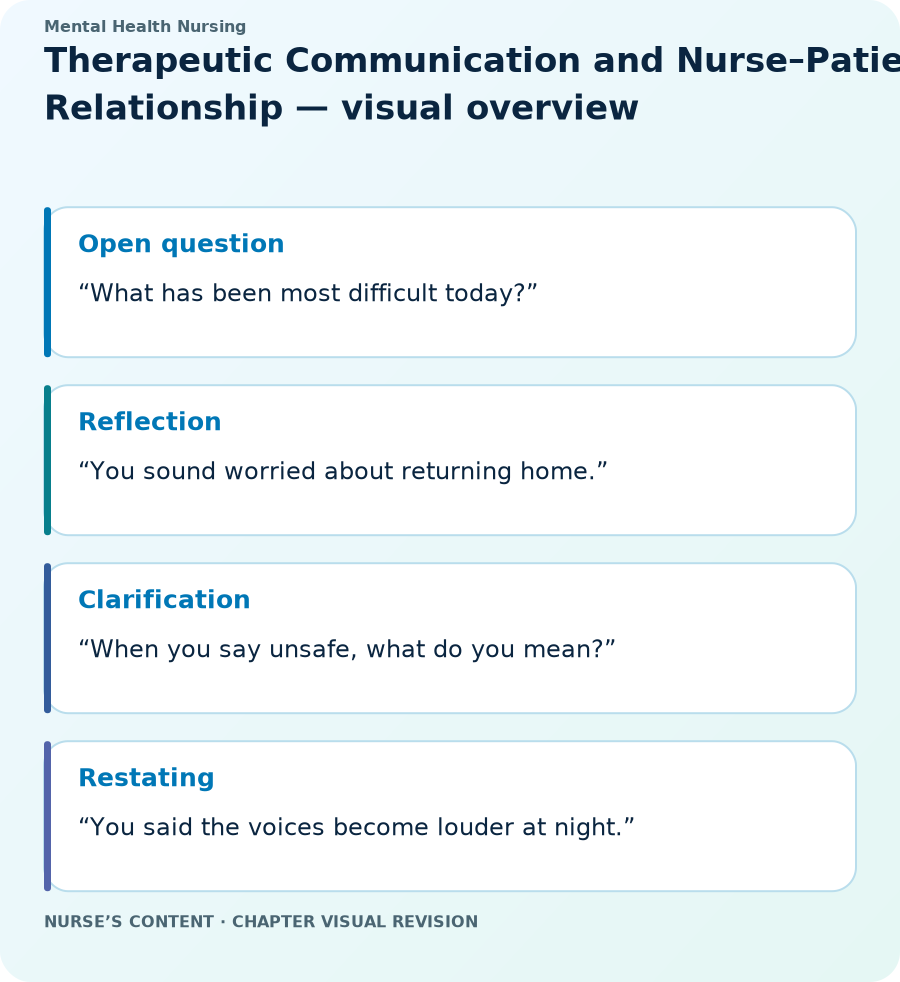
| Open question | “What has been most difficult today?” |
| Reflection | “You sound worried about returning home.” |
| Clarification | “When you say unsafe, what do you mean?” |
| Restating | “You said the voices become louder at night.” |
| Offering self | “I can sit with you for a few minutes.” |
| Focusing/summarizing | Review one important concern and agreed next step. |
| Presenting reality | “I do not hear the voice, but I understand it is distressing.” |
| Silence | Allow time for thought without pressure. |
Avoid false reassurance, interrogation, judgment, arguing about delusions, reinforcing their content, excessive self-disclosure, promises of secrecy and intrusive personal advice. Communication with psychosis should acknowledge distress while maintaining reality-based statements.
2. Phases of nurse–patient relationship
Pre-interaction: review information, own attitudes and safety needs. Orientation: introduce role, establish trust, negotiate goals and explain boundaries. Working: support coping, problem-solving, treatment, education and evaluation. Termination: review goals, prepare transitions, discuss feelings and follow-up. Transference is shifting feelings about a past relationship onto clinician; countertransference is clinician's emotional response influenced by own experiences. Seek supervision when boundaries or strong feelings arise.
3. Challenging interactions and barriers
Anxiety, language differences, hearing impairment, stigma, distraction, cognitive changes and power imbalance can interfere. Use interpreter, simple statements, appropriate distance, calm tone, time and teach-back. With escalating agitation use one calm speaker, nonthreatening stance, adequate personal space and exit access; identify triggers and offer choices. Do not threaten, crowd or touch unexpectedly. Assess immediate risk and involve trained team as needed. For silence or withdrawal offer time and low-pressure contact; do not force disclosure.
4. Important Examination Questions
Long Answer Questions
- 1. Describe therapeutic communication techniques and phases of nurse–patient relationship.
Short Answer Questions
- 1. Compare empathy and sympathy
- 2. explain therapeutic use of self
- 3. list barriers and de-escalation principles.
Very Short Answer Questions (with answers)
- 1. What is transference? — Feelings from previous relationships redirected towards another person.
- 2. Should a nurse validate a delusion as factual? — No.
5. Quick Revision
- • Acknowledge emotion without reinforcing false beliefs.
- • Boundaries protect both parties.
- • De-escalation begins with safety and respect.
6. Conclusion
Acknowledge emotion without reinforcing false beliefs. Boundaries protect both parties. De-escalation begins with safety and respect.
Chapter reference images