Mental Health Nursing
Classification of Mental Disorders
Introduction to ICD and DSM classifications, diagnostic criteria, signs and symptoms, causes and clinical features of common psychiatric disorders.
Open quizzes and study tools Download PDF
CHAPTER 04 / MENTAL HEALTH NURSING 04. Classification of Mental Disorders
1. Meaning and purpose
Classification organizes mental, behavioural and neurodevelopmental conditions using descriptive criteria. It supports diagnosis, communication, research, service planning, treatment selection and statistics. Labels should not replace formulation of individual needs and recovery goals.
2. ICD and DSM systems
ICD-11 (WHO) is the international classification of diseases, including mental, behavioural and neurodevelopmental disorders; WHO published clinical descriptions and diagnostic requirements in
- 2024. DSM-5-TR (American Psychiatric Association, 2022) provides diagnostic criteria and explanatory material. ICD and DSM categories and duration thresholds may differ; use the system required by institution. Avoid equating historical terms such as neurosis/psychosis with the entire modern classification.
| Group | Examples and characteristic features |
|---|---|
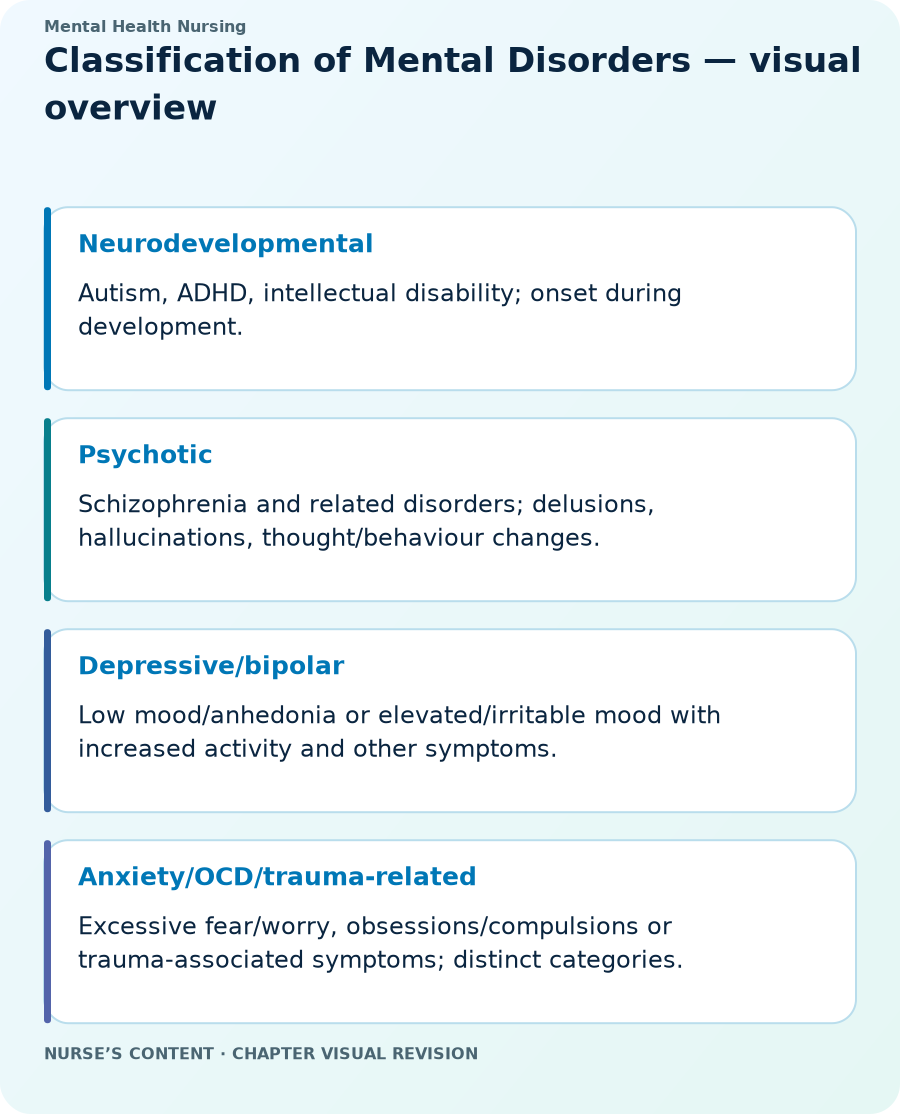
| Neurodevelopmental | Autism, ADHD, intellectual disability; onset during development. |
| Psychotic | Schizophrenia and related disorders; delusions, hallucinations, thought/behaviour changes. |
| Depressive/bipolar | Low mood/anhedonia or elevated/irritable mood with increased activity and other symptoms. |
| Anxiety/OCD/trauma-related | Excessive fear/worry, obsessions/compulsions or trauma-associated symptoms; distinct categories. |
| Substance-related/addictive | Impaired control, harmful use and consequences; intoxication/withdrawal may occur. |
| Personality | Enduring maladaptive patterns with impairment; DSM clusters and ICD-11 severity/traits differ. |
| Neurocognitive | Delirium, dementia/major neurocognitive disorder; cognitive/attention changes. |
| Somatic/dissociative | Distressing somatic preoccupation or disruptions in integrated awareness/function. |
| Group | Examples and characteristic features |
|---|---|
| Eating/sleep/sexual health | Disturbed eating, sleep-wake regulation or sexual functioning; evaluate medical and contextual causes. |
3. Diagnostic reasoning
Evaluate symptom pattern, duration, severity, impairment, developmental/cultural context and exclusion of medical causes, medicines or substances. E.g., new agitation and hallucinations with fluctuating attention and fever may indicate delirium rather than primary psychosis. Grief may coexist with depression, but bereavement alone does not establish diagnosis. Nurses record observable symptoms, support clinical assessment and formulate nursing diagnoses, not independently label patients outside competence.
4. Signs versus symptoms
A symptom is patient-reported experience (fear, voices); sign is observed finding (rapid speech, reduced activity). Positive psychotic symptoms add experiences (delusions), negative symptoms diminish typical functions (avolition), cognitive symptoms involve attention/memory/executive function. Syndromes are groups of findings; differential diagnosis identifies alternative explanations. Comorbidity is coexistence of conditions.
5. Important Examination Questions
Long Answer Questions
- 1. Explain ICD and DSM classifications and uses, with examples of major groups.
Short Answer Questions
- 1. Differentiate sign/symptom
- 2. explain differential diagnosis
- 3. contrast psychotic and mood disorders.
Very Short Answer Questions (with answers)
- 1. What organization develops ICD? — WHO.
- 2. What is DSM-5-TR? — Fifth edition text revision of Diagnostic and Statistical Manual.
6. Quick Revision
- • Classification supports communication, not stigma.
- • Symptoms alone may have many causes.
- • Diagnosis requires context and qualified assessment.
7. Conclusion
Classification supports communication, not stigma. Symptoms alone may have many causes. Diagnosis requires context and qualified assessment.
Chapter reference images