Mental Health Nursing
Mental Health Assessment
Psychiatric history, mental status examination (MSE), physical assessment, psychological assessment, diagnostic investigations, risk assessment and nursing documentation.
Open quizzes and study tools Download PDF
CHAPTER 03 / MENTAL HEALTH NURSING 03. Mental Health Assessment
1. Psychiatric history
Introduce role, explain purpose and confidentiality limits, obtain consent, ensure privacy. Record identifying information and source/reliability; chief concerns in patient's own words, onset/course/triggers, past psychiatric and medical/surgical history, medications, substance use, allergies, family and personal developmental history, education, work, relationships, trauma only as clinically appropriate, strengths, supports and baseline functioning. Obtain collateral information with appropriate consent or lawful basis.
2. Mental status examination (MSE)
MSE is a structured description of current mental functioning. It is time-specific and distinct from history.
| Domain | What to assess |
|---|---|
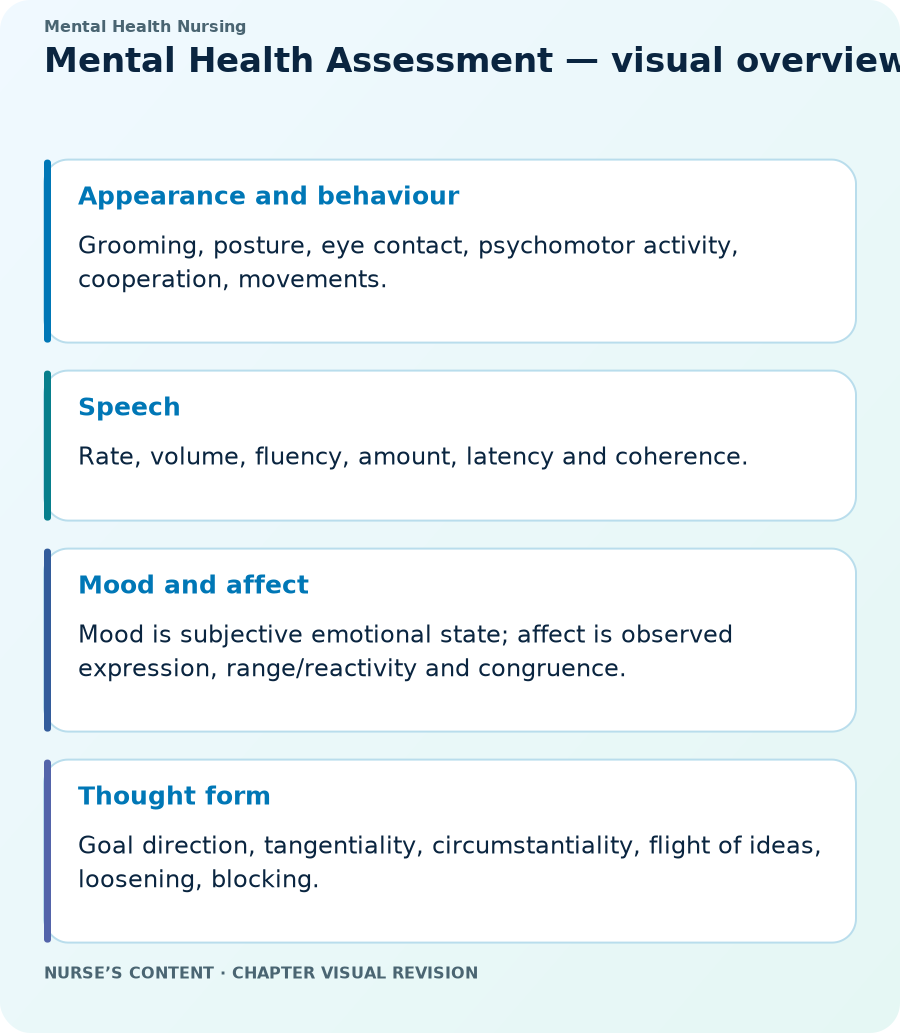
| Appearance and behaviour | Grooming, posture, eye contact, psychomotor activity, cooperation, movements. |
| Speech | Rate, volume, fluency, amount, latency and coherence. |
| Mood and affect | Mood is subjective emotional state; affect is observed expression, range/reactivity and congruence. |
| Thought form | Goal direction, tangentiality, circumstantiality, flight of ideas, loosening, blocking. |
| Thought content | Delusions, obsessions, preoccupations, hopelessness, self-harm or harm-to-others thoughts. |
| Perception | Hallucinations, illusions, depersonalization/derealization. |
| Cognition | Alertness, orientation, attention, memory, language and executive function as indicated. |
| Insight and judgment | Understanding of difficulties and ability to evaluate consequences; avoid absolute labels. |
3. Physical, psychological and diagnostic assessment
Vital signs, physical/neuro examination, medication adverse effects, sleep, nutrition, pain, elimination and functional status. CBC, electrolytes, glucose, thyroid/renal/liver tests, toxicology, ECG, imaging/EEG or infection tests as clinically indicated. PHQ-9, GAD-7, MMSE/MoCA or other validated tools support screening/monitoring, not standalone diagnosis; follow training and permissions.
4. Risk assessment
Ask directly and sensitively about suicidal thoughts, intent, plan, access to means, past attempts, recent losses, supports and reasons for living. Assess violence risk using specific behaviour/history, intoxication and immediate threats, not diagnosis alone. Assess self-neglect, vulnerability, abuse, withdrawal, delirium, falls and medication toxicity. Risk is dynamic; formulate current needs, protective factors, safety plan and level of observation, review after changes. Do not use a score alone to determine discharge or predict suicide.
5. Documentation example
Patient states “I have slept only two hours each night.” Speech rapid, frequently interrupts, attention easily diverted; orientation to person/place/time intact. Record relevant exact statements, observations, time, action and referrals without speculating about motives. Report new confusion, severe agitation, suicidal intent or altered consciousness promptly.
6. Important Examination Questions
Long Answer Questions
- 1. Define MSE and explain its domains, psychiatric history and risk assessment.
Short Answer Questions
- 1. Differentiate mood/affect, thought form/content and hallucination/illusion
- 2. describe investigations.
Very Short Answer Questions (with answers)
- 1. What does MSE stand for? — Mental status examination.
- 2. Is MSE a lifetime history? — No.
7. Quick Revision
- • History and MSE complement each other.
- • Assess medical mimics.
- • Record objective findings and dynamic risk.
8. Conclusion
History and MSE complement each other. Assess medical mimics. Record objective findings and dynamic risk.
Chapter reference images