Mental Health Nursing
Theories and Models of Mental Health Nursing
Psychoanalytic theory, behavioural theory, cognitive theory, humanistic theory, interpersonal theory, biological model and other approaches to understanding mental illness.
Open quizzes and study tools Download PDF
CHAPTER 02 / MENTAL HEALTH NURSING 02. Theories and Models of Mental Health Nursing
1. Biopsychosocial framework
Psychological disorders arise through interacting biological, psychological, social and environmental factors. Genetic susceptibility, neurobiology, physical disease, trauma, learned responses, cognition, poverty, discrimination and social support may be relevant. No single theory explains every presentation.
2. Major theories
| Model/theorist | Main concepts | Nursing application |
|---|---|---|
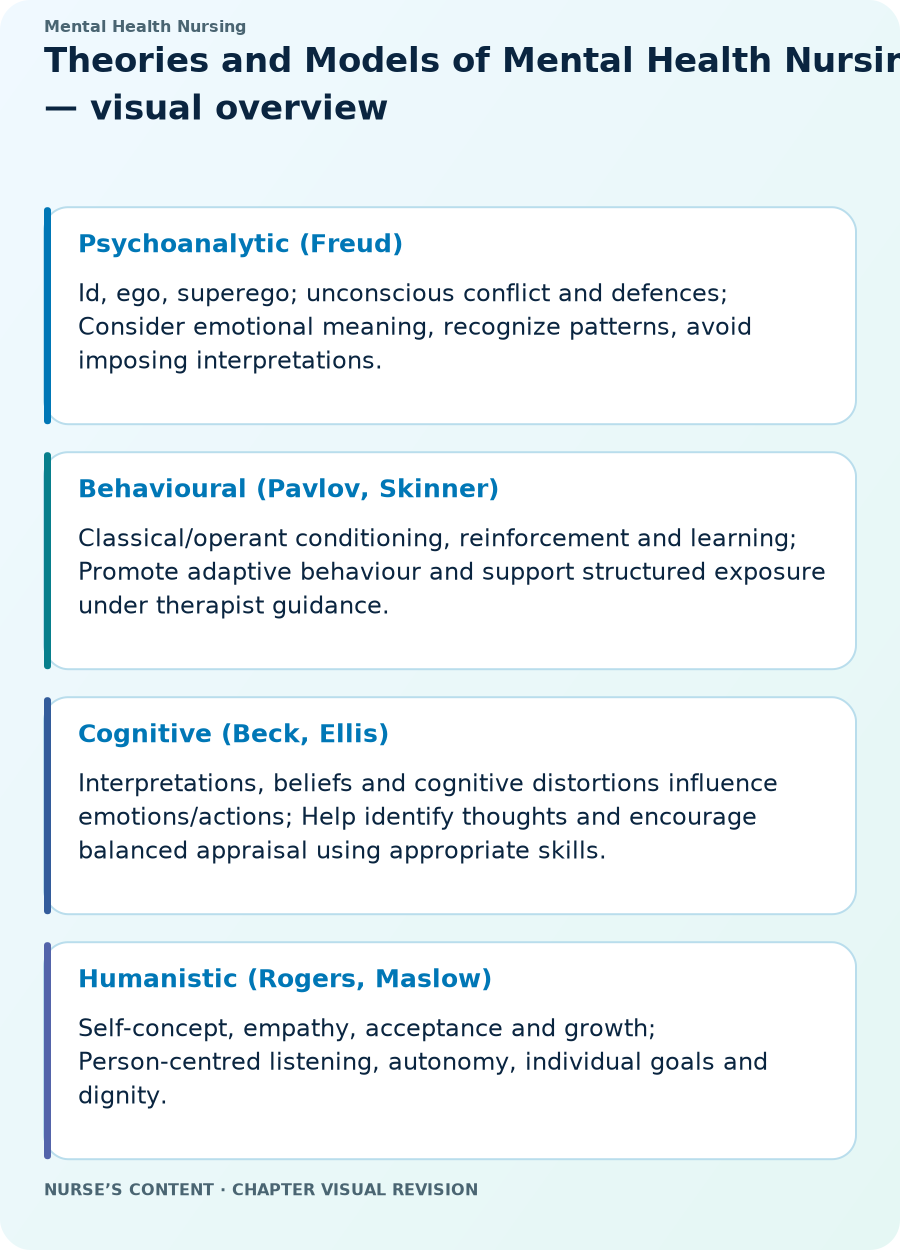
| Psychoanalytic (Freud) | Id, ego, superego; unconscious conflict and defences | Consider emotional meaning, recognize patterns, avoid imposing interpretations. |
| Behavioural (Pavlov, Skinner) | Classical/operant conditioning, reinforcement and learning | Promote adaptive behaviour and support structured exposure under therapist guidance. |
| Cognitive (Beck, Ellis) | Interpretations, beliefs and cognitive distortions influence emotions/actions | Help identify thoughts and encourage balanced appraisal using appropriate skills. |
| Humanistic (Rogers, Maslow) | Self-concept, empathy, acceptance and growth | Person-centred listening, autonomy, individual goals and dignity. |
| Interpersonal (Peplau, Sullivan) | Relationships affect well-being; therapeutic partnership | Establish rapport, clarify roles, work towards goals and therapeutic closure. |
| Biological | Genetic, neurochemical, hormonal and neural-system factors | Assess medical causes, administer prescribed treatment and monitor adverse effects. |
| Social and stress-vulnerability | Susceptibility interacts with stress, coping and support | Reduce stressors, connect resources, prevent relapse. |
3. Peplau's interpersonal relations theory
Original phases: orientation (identify need/relationship), identification (patient identifies with helpful resources), exploitation (use of therapeutic services), resolution (needs addressed and relationship concludes). Nursing teaching often uses pre-interaction, orientation, working and termination phases. Roles include teacher, resource person, counsellor, leader, stranger and surrogate. Maintain professional purpose and avoid dependency.
4. Defence mechanisms and coping
Largely unconscious defences reduce distress (denial, projection, displacement, repression, sublimation); suppression is conscious. Coping involves efforts to manage demands: problem-focused modifies stressor, emotion-focused manages responses. Encourage adaptive coping rather than confronting defences harshly. Historical models have explanatory limitations, and biological models should not be reduced to an unproven single chemical imbalance.
5. Important Examination Questions
Long Answer Questions
- 1. Explain major theories/models of mental illness with nursing applications.
Short Answer Questions
- 1. Describe Freud's personality structure
- 2. explain Peplau's phases
- 3. differentiate behavioural and cognitive theories.
Very Short Answer Questions (with answers)
- 1. Who proposed client-centred therapy? — Carl Rogers.
- 2. What is reinforcement? — A consequence that increases a behaviour.
6. Quick Revision
- • Theories guide different interventions.
- • Biopsychosocial assessment integrates multiple factors.
- • Peplau emphasizes the therapeutic relationship.
7. Conclusion
Theories guide different interventions. Biopsychosocial assessment integrates multiple factors. Peplau emphasizes the therapeutic relationship.
Chapter reference images