Mental Health Nursing
Introduction to Mental Health and Mental Health Nursing
Concepts of mental health and mental illness, characteristics of mentally healthy individuals, principles of mental health nursing, scope, history and development of psychiatric nursing.
Open quizzes and study tools Download PDF
CHAPTER 01 / MENTAL HEALTH NURSING 01. Introduction to Mental Health and Mental Health Nursing
1. Concepts and definitions
Mental health is a state of well-being that allows people to develop abilities, cope with stresses, learn, work and participate in their communities. Mental illness refers to clinically significant disturbances in cognition, emotional regulation or behaviour associated with dysfunction, distress or impairment. Mental health and illness are not simple opposites: people with a mental disorder may experience meaningful well-being. Normal grief, stress or cultural differences are not by themselves mental disorders.
2. Characteristics of positive mental health
Marie Jahoda's six theoretical criteria: positive attitudes towards self, growth/self-actualization, integration, autonomy, accurate perception of reality and environmental mastery. Other features include flexible coping, meaningful relationships, realistic goals, emotional awareness and help-seeking. These are educational concepts, not diagnostic tests.
3. Psychiatric nursing: definition, scope and objectives
Psychiatric-mental health nursing applies professional knowledge and therapeutic relationships to promote psychological health, prevent illness, assess responses, support treatment, facilitate recovery and protect rights. Settings include outpatient clinics, acute wards, liaison services, child/older adult services, substance-use programmes, community care, rehabilitation and crisis teams. Objectives are safety, comfort, autonomy, symptom relief, function, recovery and reduced stigma.
4. History and development
Early institutional care often involved confinement. In the eighteenth and nineteenth centuries moral treatment and more humane care were promoted by figures including Philippe Pinel and William Tuke. Linda Richards contributed to professional nurse training and psychiatric nursing in the United States. Hildegard Peplau's 1952 interpersonal relations work shaped modern psychiatric nursing. In India, historical asylums evolved into mental health hospitals and community services; NMHP began in 1982, DMHP in 1996 and Mental Healthcare Act 2017 emphasizes rights-based care.
5. Principles of psychiatric nursing
Accept the person without judgment; establish trust; maintain boundaries and confidentiality; individualize care; provide predictable therapeutic environment; use active listening; treat the whole person; assess physical and mental health together; prioritize safety and least restrictive care; promote participation and recovery. Nurses must never assume that all physical complaints are psychiatric or that people with mental illness are inherently dangerous.
6. Important Examination Questions
Long Answer Questions
- 1. Explain concepts, principles and scope of mental health nursing.
Short Answer Questions
- 1. Describe Jahoda's criteria
- 2. write a note on historical development
- 3. discuss recovery-oriented care.
Very Short Answer Questions (with answers)
- 1. Who developed interpersonal relations theory? — Hildegard Peplau.
- 2. In which year did India's NMHP begin? — 1982.
7. Quick Revision
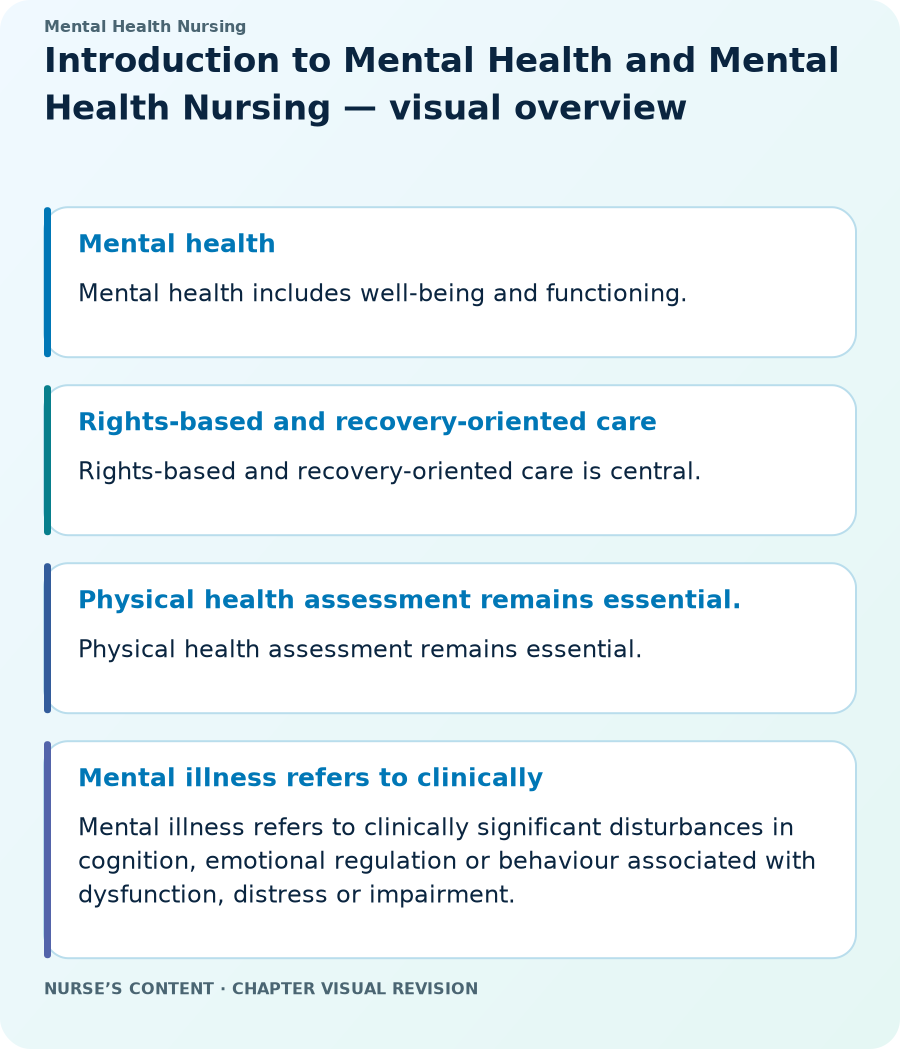
- • Mental health includes well-being and functioning.
- • Rights-based and recovery-oriented care is central.
- • Physical health assessment remains essential.
8. Conclusion
Mental health includes well-being and functioning. Rights-based and recovery-oriented care is central. Physical health assessment remains essential.
Chapter reference images