Medical Surgical Nursing
Nursing Management of Patients Requiring Advanced Medical and Surgical Therapies
Oxygen therapy, mechanical ventilation, dialysis, blood transfusion, chemotherapy, radiotherapy, organ transplantation and advanced wound management.
Open quizzes and study tools Download PDF
CHAPTER 22 / MEDICAL-SURGICAL NURSING 22. Nursing Management of Patients Requiring Advanced Medical and Surgical Therapies
1. Oxygen therapy and ventilation
Oxygen is titrated to prescribed saturation targets and clinical status. Devices include nasal cannula, simple mask, Venturi mask, reservoir mask and high-flow cannula. For many acutely ill adults 94–98% is commonly used; 88–92% may be appropriate for hypercapnia risk pending ABG. Mechanical ventilation supports oxygenation/CO2 removal; invasive via endotracheal/tracheostomy tube or non-invasive via mask. Check settings against order, alarms, airway security, cuff management per protocol, humidification and sedation. Elevate head when appropriate, oral care and readiness-to-wean evaluation; never silence an alarm without assessing patient and cause.
2. Dialysis and transfusion
Haemodialysis uses extracorporeal membrane, peritoneal dialysis uses peritoneal membrane. Verify prescription and access, assess pre/post weight, BP, electrolytes and infection. Protect fistula. Blood components: RBCs improve oxygen-carrying capacity, platelets support primary haemostasis, plasma supplies coagulation factors, cryoprecipitate provides fibrinogen. Verify compatibility and identity; stop suspected reaction, maintain appropriate access, notify team/blood bank.
3. Oncology therapies and transplantation
Chemotherapy requires trained preparation/administration, protocol checks, infection monitoring and extravasation response. Radiotherapy effects depend on area treated; assess skin, mucosa, fatigue and nutrition. Transplant care monitors organ function, rejection, immunosuppressive levels, infection, medication adherence and patient education. Do not equate all post-transplant fever with rejection.
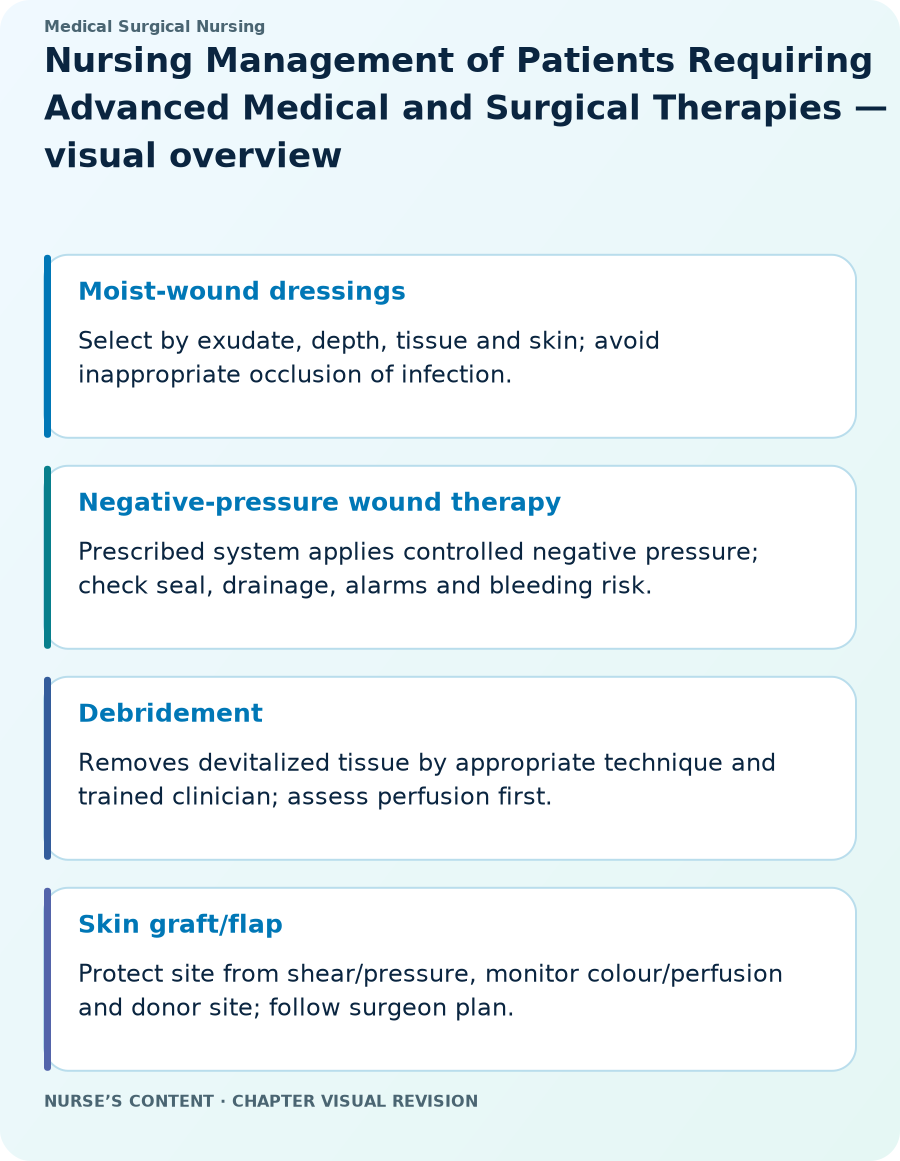
4. Advanced wound management
| Method | Key considerations |
|---|---|
| Moist-wound dressings | Select by exudate, depth, tissue and skin; avoid inappropriate occlusion of infection. |
| Negative-pressure wound therapy | Prescribed system applies controlled negative pressure; check seal, drainage, alarms and bleeding risk. |
| Debridement | Removes devitalized tissue by appropriate technique and trained clinician; assess perfusion first. |
| Skin graft/flap | Protect site from shear/pressure, monitor colour/perfusion and donor site; follow surgeon plan. |
5. Nursing responsibilities
Use trained staff and device-specific checklists; verify indication, consent, prescription, baseline assessment and emergency equipment. Monitor complications and response; document parameters, access, settings, output and adverse events. Communicate changes immediately and plan continuity.
6. Important Examination Questions
Long Answer Questions
- 1. Discuss nursing responsibilities in ventilation, dialysis and transfusion.
Short Answer Questions
- 1. Explain oxygen devices
- 2. describe negative-pressure wound therapy
- 3. list chemotherapy precautions.
Very Short Answer Questions (with answers)
- 1. What is NIV? — Non-invasive ventilation.
- 2. What component supplies fibrinogen? — Cryoprecipitate.
7. Quick Revision
- • Assess patient before device.
- • Verify therapy-specific orders.
- • Prevent device-related infection and injury.
8. Conclusion
Assess patient before device. Verify therapy-specific orders. Prevent device-related infection and injury.
Chapter reference images