Medical Surgical Nursing
Nursing Management of Patients with Disorders of the Ear, Nose, Throat and Head and Neck
Assessment and management of ENT conditions, tracheostomy care, airway obstruction, laryngectomy care and head and neck surgical conditions.
Open quizzes and study tools Download PDF
CHAPTER 20 / MEDICAL-SURGICAL NURSING 20. Nursing Management of Patients with Disorders of the Ear, Nose, Throat and Head and Neck
1. Focused assessment
Assess airway patency, stridor, breathing effort, secretions, voice, swallowing, oral/neck lesions and recent surgery. Inspect stoma, neck swelling, drains and bleeding. Patients after head/neck surgery may have altered communication and nutrition. Acute airway compromise requires immediate escalation.
2. Tracheostomy care
Tracheostomy provides an artificial airway through tracheal opening. Indications include prolonged ventilation, upper airway bypass and secretion management. Check tube type/size, cuff status if present, prescribed humidification, oxygenation, ties and skin. Suction only when indicated, using approved technique; monitor desaturation and bleeding. Keep emergency equipment and appropriate spare tubes per policy. Do not blindly replace a displaced fresh tracheostomy; call trained airway team urgently.
3. Laryngectomy distinction
Total laryngectomy permanently separates upper airway from lungs; the patient breathes exclusively through neck stoma. In respiratory emergency provide oxygen/ventilation via stoma, not face alone. Tracheostomy patients may retain upper-airway continuity depending anatomy. Postoperative care includes stoma humidification, secretion clearance, wound/drain assessment, swallowing rehabilitation and speech alternatives (electrolarynx, tracheoesophageal speech when appropriate).
4. Airway obstruction and head/neck cancer
| Condition | Nursing priorities |
|---|---|
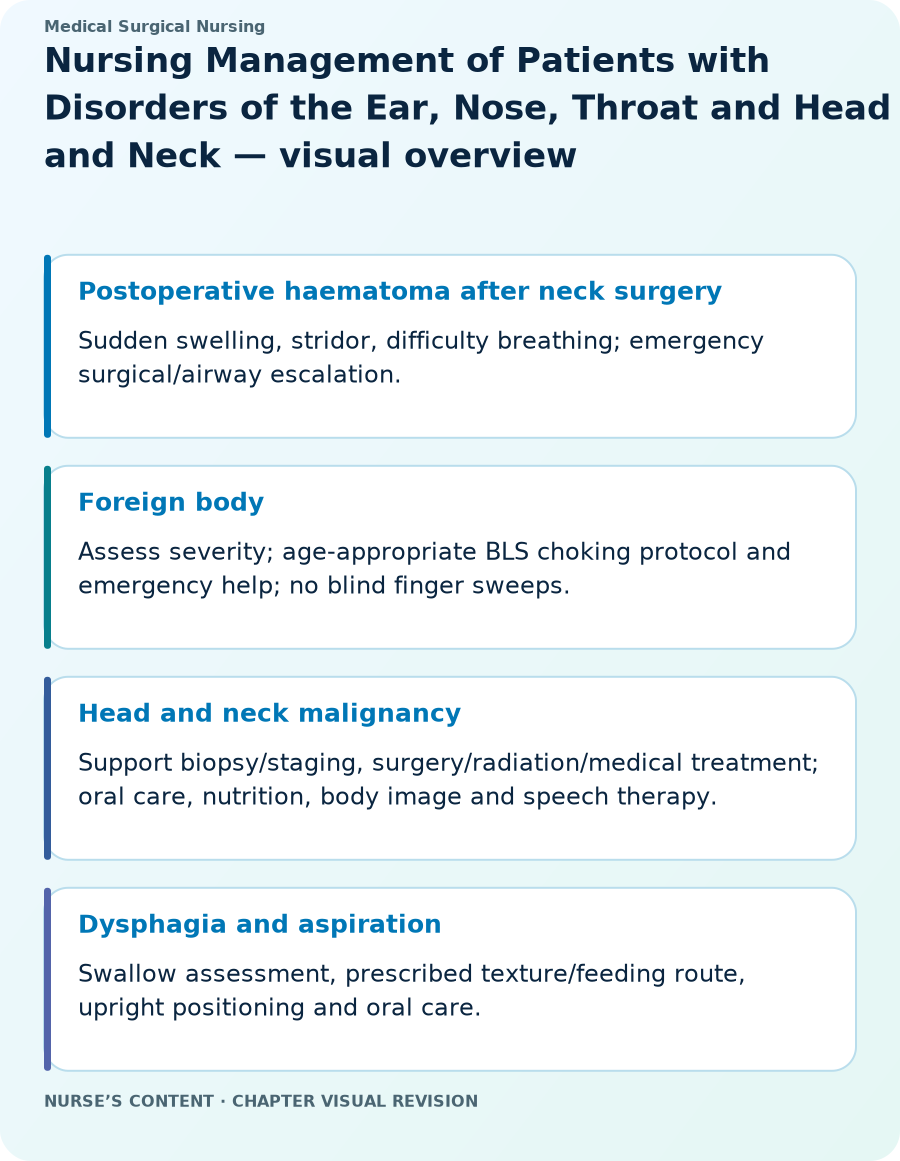
| Postoperative haematoma after neck surgery | Sudden swelling, stridor, difficulty breathing; emergency surgical/airway escalation. |
| Foreign body | Assess severity; age-appropriate BLS choking protocol and emergency help; no blind finger sweeps. |
| Head and neck malignancy | Support biopsy/staging, surgery/radiation/medical treatment; oral care, nutrition, body image and speech therapy. |
| Dysphagia and aspiration | Swallow assessment, prescribed texture/feeding route, upright positioning and oral care. |
5. Nursing checklist
Communicate airway anatomy on bedside sign/handover, assess respiratory status, keep prescribed suction/humidification and emergency items accessible, document secretions and stoma care. Teach family emergency plan and equipment use; confirm understanding with demonstration.
6. Important Examination Questions
Long Answer Questions
- 1. Explain tracheostomy and laryngectomy care and emergency airway management.
Short Answer Questions
- 1. Compare tracheostomy and laryngectomy
- 2. list postoperative neck complications
- 3. describe dysphagia precautions.
Very Short Answer Questions (with answers)
- 1. Where is oxygen delivered after total laryngectomy? — Neck stoma.
- 2. What is stridor? — High-pitched sound from upper airway narrowing.
7. Quick Revision
- • Know the patient's airway anatomy.
- • Never ignore new stridor.
- • Prioritize communication and swallowing safety.
8. Conclusion
Know the patient's airway anatomy. Never ignore new stridor. Prioritize communication and swallowing safety.
Chapter reference images