Medical Surgical Nursing
Nursing Management of Patients with Oncological Disorders
Cancer development, staging and grading, diagnostic procedures, chemotherapy, radiotherapy, immunotherapy, surgical management, oncological emergencies and palliative care.
Open quizzes and study tools Download PDF
CHAPTER 17 / MEDICAL-SURGICAL NURSING 17. Nursing Management of Patients with Oncological Disorders
1. Cancer biology
Cancer is uncontrolled proliferation of abnormal cells with potential invasion and metastasis. Carcinogenesis involves accumulated genetic/epigenetic changes affecting cell cycle, repair and apoptosis. Risk factors include tobacco, alcohol, UV/ionizing radiation, selected infections, hereditary susceptibility and age. Benign tumours do not invade/metastasize but can still cause harm.
2. Classification, diagnosis and staging
Carcinoma arises from epithelium, sarcoma from mesenchymal tissue, leukaemia from blood-forming tissues, lymphoma from lymphoid cells and myeloma from plasma cells. Diagnosis typically requires tissue/cell assessment; imaging, molecular testing and tumour markers guide selected decisions. Grade describes microscopic differentiation/aggressiveness; stage describes extent/spread. TNM = primary tumour, nodes, metastasis; not used for every cancer.
3. Treatment modalities
| Modality | Action and nursing considerations |
|---|---|
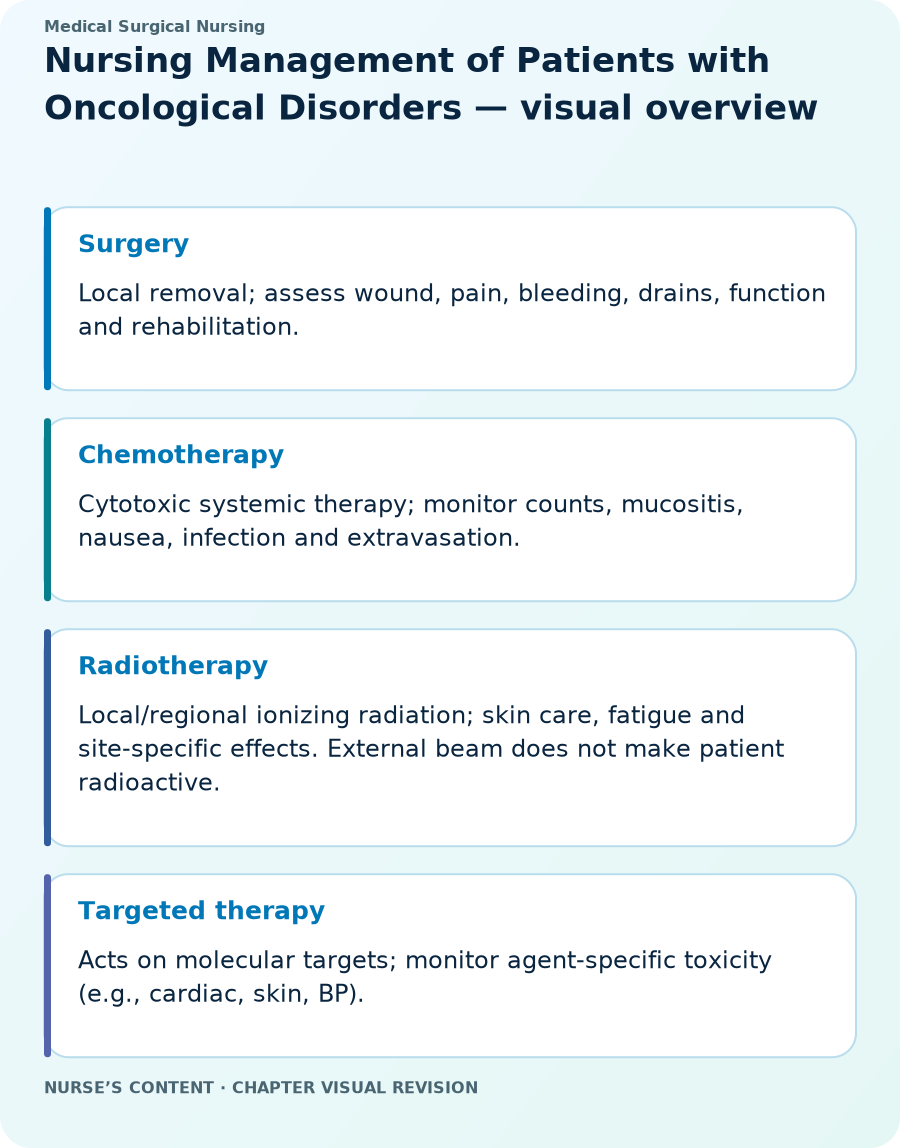
| Surgery | Local removal; assess wound, pain, bleeding, drains, function and rehabilitation. |
| Chemotherapy | Cytotoxic systemic therapy; monitor counts, mucositis, nausea, infection and extravasation. |
| Radiotherapy | Local/regional ionizing radiation; skin care, fatigue and site-specific effects. External beam does not make patient radioactive. |
| Targeted therapy | Acts on molecular targets; monitor agent-specific toxicity (e.g., cardiac, skin, BP). |
| Immunotherapy | Enhances immune attack; immune-related adverse effects may involve any organ and need early assessment. |
| Hormonal therapy | Reduces hormone-dependent growth; monitor agent-specific effects, bone health and adherence. |
4. Oncological emergencies
Febrile neutropenia
Definition and pathophysiology: Infection during reduced neutrophil count, potentially rapidly progressive.
Clinical features and investigations: Fever may be only sign; assess ANC, perfusion, cultures per protocol.
Management and nursing care: Immediate oncology/sepsis escalation, prompt prescribed empiric antimicrobials; avoid rectal procedures in severe neutropenia.
Tumour lysis syndrome
Definition and pathophysiology: Rapid cell breakdown releases potassium, phosphate and uric acid; calcium may fall.
Clinical features and investigations: Arrhythmia, AKI, seizure; serial electrolytes/uric acid/creatinine.
Management and nursing care: Risk-based prevention and prescribed hydration/urate-lowering treatment; ECG, fluid and lab monitoring.
Spinal cord compression, SVC syndrome and hypercalcaemia
Definition and pathophysiology: Tumour growth compresses spinal cord or superior vena cava; malignancy may raise calcium.
Clinical features and investigations: New back pain/weakness/bladder dysfunction; facial swelling/breathlessness; confusion, thirst, constipation respectively.
Management and nursing care: Urgent oncology assessment, appropriate imaging and specialist treatment; protect mobility/airway, monitor neurological and biochemical changes.
5. Nursing care during therapy
Verify protocol, consent and identity, drug checks and vascular access. Cytotoxic medicines require trained staff, hazardous drug PPE and spill procedures. For suspected vesicant extravasation stop infusion, leave cannula in place for aspiration/antidote per agent protocol, do not flush, notify team. Assess nutrition, oral care, fatigue, fertility concerns, body image and psychosocial distress. Discuss palliative care early alongside disease-directed treatment.
6. Important Examination Questions
Long Answer Questions
- 1. Discuss cancer staging, treatment modalities and nursing care during chemotherapy.
Short Answer Questions
- 1. Differentiate stage and grade
- 2. explain tumour lysis, febrile neutropenia and extravasation.
Very Short Answer Questions (with answers)
- 1. What does TNM mean? — Tumour, nodes, metastasis.
- 2. Is external beam radiotherapy itself a source of patient radioactivity? — No.
7. Quick Revision
- • Fever during neutropenia needs urgent treatment.
- • Treatment depends on cancer biology and stage.
- • Palliative care can coexist with active treatment.
8. Conclusion
Fever during neutropenia needs urgent treatment. Treatment depends on cancer biology and stage. Palliative care can coexist with active treatment.
Chapter reference images