Medical Surgical Nursing
Nursing Management of Patients with Disorders of the Reproductive System
Menstrual disorders, endometriosis, uterine fibroids, pelvic inflammatory disease, benign prostatic hyperplasia, prostatitis, prostate cancer and sexually transmitted infections.
Open quizzes and study tools Download PDF
CHAPTER 14 / MEDICAL-SURGICAL NURSING 14. Nursing Management of Patients with Disorders of the Reproductive System
1. Assessment
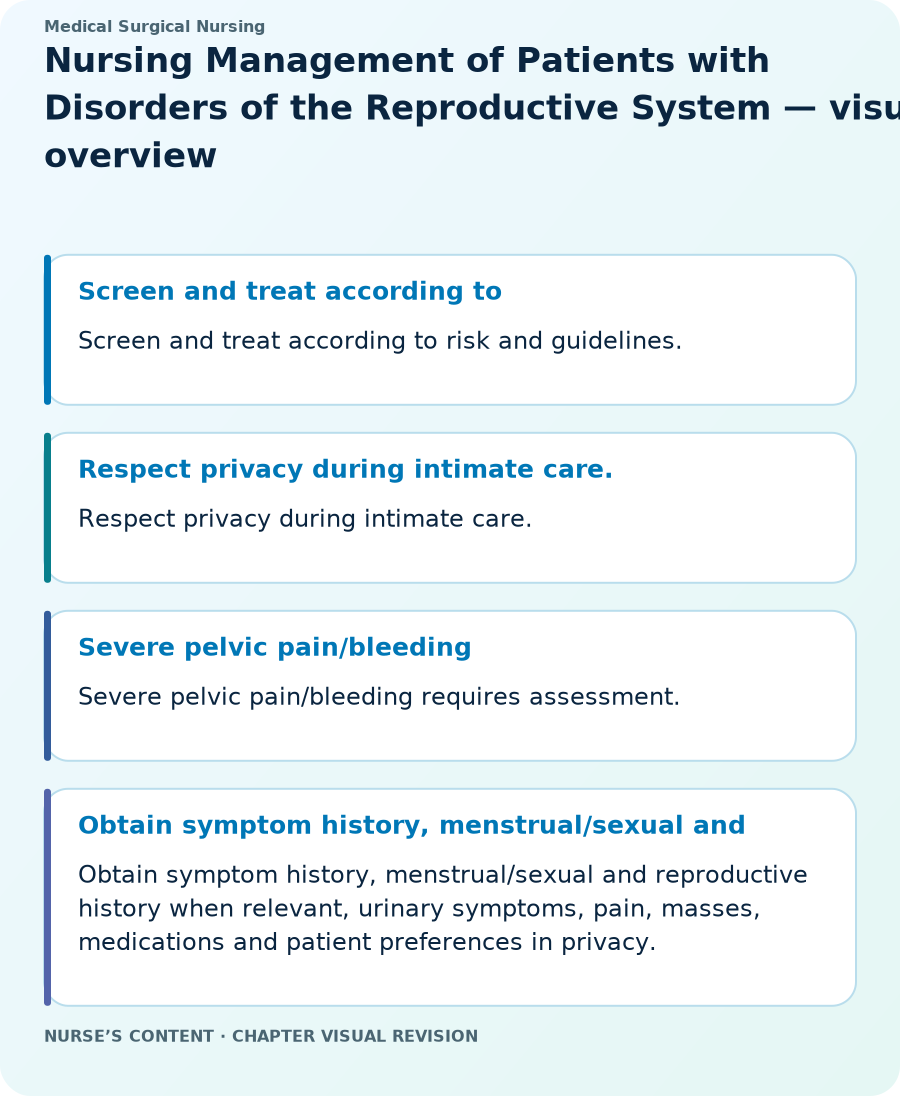
Obtain symptom history, menstrual/sexual and reproductive history when relevant, urinary symptoms, pain, masses, medications and patient preferences in privacy. Obtain consent and offer appropriate chaperone for intimate examinations. Investigations may include urinalysis, pregnancy testing, STI tests, ultrasound, cervical screening, mammography and biopsy.
Benign prostatic hyperplasia (BPH)
Definition and pathophysiology: Nonmalignant enlargement compresses prostatic urethra.
Clinical features and investigations: Hesitancy, weak stream, nocturia, incomplete emptying; exam, urinalysis, residual volume and selected PSA assessment.
Management and nursing care: Lifestyle adjustments, alpha blockers/5-alpha-reductase inhibitors or surgery as indicated; monitor retention and orthostasis. Post-TURP monitor catheter drainage, bleeding, fluid balance and irrigation as ordered.
Prostatitis
Definition and pathophysiology: Inflammatory condition of prostate, acute bacterial or chronic forms.
Clinical features and investigations: Pelvic pain, urinary symptoms, fever in acute infection; urine testing.
Management and nursing care: Prescribed antibiotics for bacterial disease, symptom care; monitor sepsis/retention and avoid vigorous prostate manipulation in acute illness.
Prostate cancer
Definition and pathophysiology: Malignancy of prostate, may be slowly or rapidly progressive.
Clinical features and investigations: Often asymptomatic early, urinary symptoms or bone pain later; PSA risk assessment, MRI/biopsy as indicated.
Management and nursing care: Active surveillance, surgery, radiotherapy or systemic therapy individualized; support urinary continence, sexual health, adverse effects and follow-up.
Menstrual disorders
Definition and pathophysiology: Abnormal bleeding, dysmenorrhoea or amenorrhoea from structural, endocrine, pregnancy-related or other causes.
Clinical features and investigations: Assess frequency, amount, pain, pregnancy possibility and anaemia; tests as indicated.
Management and nursing care: Treat cause, prescribed hormonal or other treatment, educate menstrual health; severe bleeding with instability or possible ectopic pregnancy needs urgent referral.
Pelvic inflammatory disease (PID)
Definition and pathophysiology: Ascending infection of upper female reproductive tract, often STI-related.
Clinical features and investigations: Lower abdominal pain, cervical motion/adnexal tenderness, discharge, fever; pregnancy and STI testing.
Management and nursing care: Timely prescribed broad antimicrobial therapy, partner assessment/treatment when appropriate, abstain until recommended completion, follow-up; monitor abscess and sepsis.
Uterine fibroids
Definition and pathophysiology: Benign smooth muscle tumours of uterus.
Clinical features and investigations: Heavy menstrual bleeding, pressure, dysmenorrhoea; pelvic ultrasound.
Management and nursing care: Monitor anaemia and bleeding; medical management or procedures depending symptoms and fertility goals.
Endometriosis
Definition and pathophysiology: Endometrial-like tissue outside uterus, chronic inflammatory disease.
Clinical features and investigations: Cyclic pelvic pain, dyspareunia, infertility; clinical/imaging assessment, laparoscopy in selected cases.
Management and nursing care: Analgesia, hormonal treatment or surgery, individualized fertility counselling and chronic pain support.
Cervical cancer
Definition and pathophysiology: Malignancy commonly associated with persistent high-risk HPV infection.
Clinical features and investigations: Postcoital or intermenstrual bleeding, discharge; screening detects precancer, biopsy establishes cancer.
Management and nursing care: HPV vaccination and approved screening; support surgery, radiotherapy/chemotherapy by stage, manage bleeding, urinary/bowel effects and psychosocial issues.
Breast cancer
Definition and pathophysiology: Malignant tumour of breast tissue.
Clinical features and investigations: Lump, nipple/skin change, abnormal imaging; mammography/ultrasound and biopsy, receptor testing.
Management and nursing care: Surgery, radiotherapy and systemic therapy guided by stage/biology; drain/wound care, shoulder exercises as prescribed, lymphoedema education and body-image support.
Sexually transmitted infections
Definition and pathophysiology: Includes syphilis, gonorrhoea, chlamydia, HIV, herpes and HPV.
Clinical features and investigations: Discharge, ulcers, dysuria, pelvic pain or asymptomatic; laboratory testing by exposure and symptoms.
Management and nursing care: Nonjudgmental care, prescribed treatment, partner services, condom education, vaccination where indicated, HIV testing/PEP or PrEP assessment and confidentiality.
2. Nursing management
Prioritize privacy, consent and explanation; provide inclusive information, pain control, follow-up and fertility/sexual health counselling as appropriate. Report severe bleeding, acute urinary retention, fever with pelvic pain or signs of sepsis.
3. Important Examination Questions
Long Answer Questions
- 1. Explain nursing care for BPH, PID and breast cancer.
Short Answer Questions
- 1. Describe fibroids and endometriosis
- 2. explain HPV prevention
- 3. list STI prevention strategies.
Very Short Answer Questions (with answers)
- 1. What is PID? — Pelvic inflammatory disease.
- 2. Are fibroids usually malignant? — No.
4. Quick Revision
- • Screen and treat according to risk and guidelines.
- • Respect privacy during intimate care.
- • Severe pelvic pain/bleeding requires assessment.
5. Conclusion
Screen and treat according to risk and guidelines. Respect privacy during intimate care. Severe pelvic pain/bleeding requires assessment.
Chapter reference images