Medical Surgical Nursing
Nursing Management of Patients with Ear, Nose and Throat Disorders
Otitis media, hearing loss, Ménière's disease, sinusitis, rhinitis, tonsillitis, pharyngitis, laryngitis and head and neck cancers.
Open quizzes and study tools Download PDF
CHAPTER 13 / MEDICAL-SURGICAL NURSING 13. Nursing Management of Patients with Ear, Nose and Throat Disorders
1. Assessment
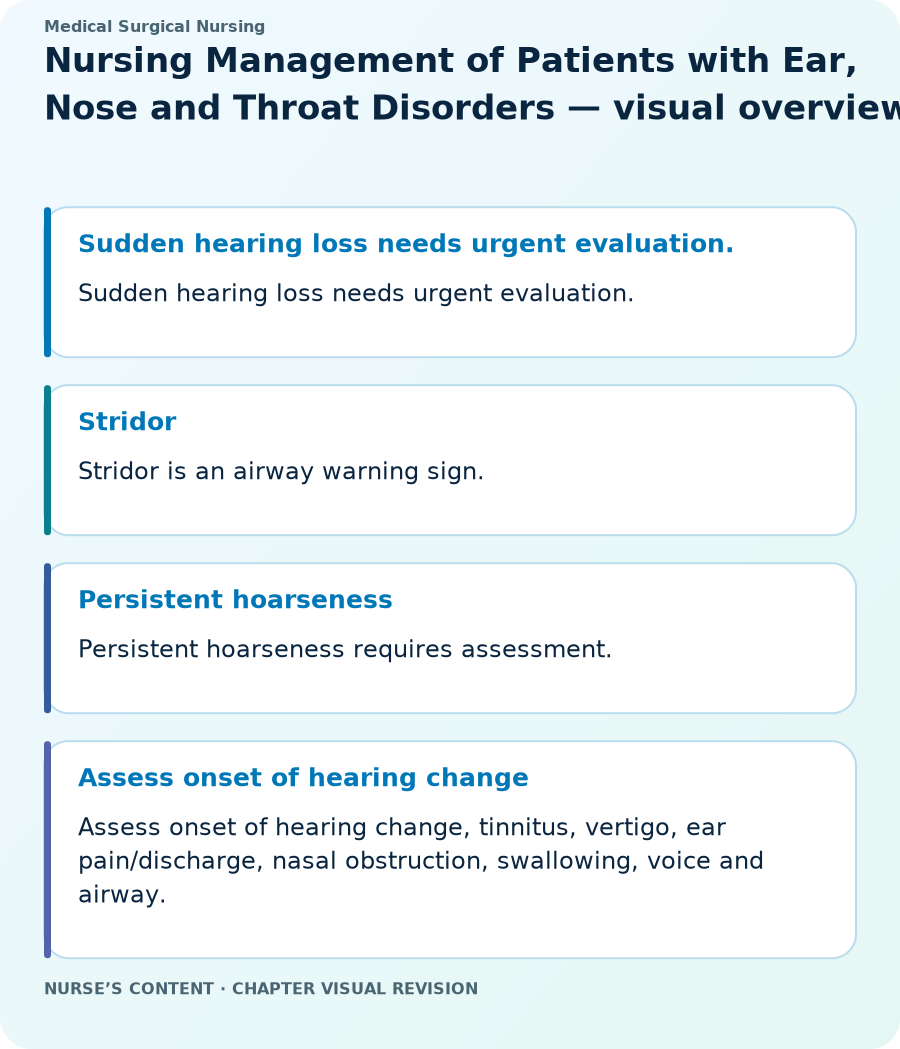
Assess onset of hearing change, tinnitus, vertigo, ear pain/discharge, nasal obstruction, swallowing, voice and airway. Otoscopy, audiometry, tympanometry, nasal examination and laryngoscopy are selected. Stridor, rapidly progressive swelling or inability to swallow saliva suggests airway risk.
Otitis media
Definition and pathophysiology: Middle-ear inflammation/infection, often after URTI.
Clinical features and investigations: Otalgia, fever, reduced hearing; bulging tympanic membrane supports acute middle-ear infection.
Management and nursing care: Analgesia, observation or antibiotics according to clinical criteria; monitor mastoid swelling and complications.
Otitis externa
Definition and pathophysiology: Inflammation of external canal, commonly bacterial after moisture/trauma.
Clinical features and investigations: Pain on tragus/pinna movement, canal swelling/discharge.
Management and nursing care: Prescribed topical therapy, keep ear dry and avoid instrumentation; diabetes/immunosuppression with severe pain warrants urgent evaluation.
Hearing loss
Definition and pathophysiology: Conductive (external/middle ear), sensorineural (cochlear/nerve) or mixed.
Clinical features and investigations: Difficulty hearing, tinnitus; audiometry and exam.
Management and nursing care: Treat reversible causes, hearing aids/cochlear implant assessment as indicated; face patient and reduce noise. Sudden sensorineural loss needs urgent ENT review.
Ménière disease
Definition and pathophysiology: Inner-ear disorder associated with episodic vertigo, fluctuating sensorineural hearing loss, tinnitus and fullness.
Clinical features and investigations: Recurrent episodes; audiometry and specialist exclusion of other causes.
Management and nursing care: Fall precautions, symptom treatment, individualized diet and specialist therapy; assess sudden neurological symptoms for stroke.
Sinusitis and rhinitis
Definition and pathophysiology: Sinus mucosal inflammation, often viral; rhinitis may be allergic or infectious.
Clinical features and investigations: Nasal congestion, facial pressure, discharge, sneezing/itching; eye swelling or neurological symptoms are alarms.
Management and nursing care: Saline irrigation using safe water, prescribed intranasal therapy, antibiotics only for indications. Teach trigger avoidance.
Tonsillitis and pharyngitis
Definition and pathophysiology: Inflammation due to virus or bacteria including group A strep.
Clinical features and investigations: Sore throat, fever, odynophagia; assess exudate and test when indicated.
Management and nursing care: Analgesia, fluids and appropriate antibiotics for confirmed/likely bacterial disease; drooling, trismus or muffled voice may indicate abscess/airway emergency.
Laryngitis and head/neck cancer
Definition and pathophysiology: Vocal cord inflammation causes hoarseness; malignancies may involve oral cavity, pharynx or larynx.
Clinical features and investigations: Persistent hoarseness, nonhealing ulcer, dysphagia, neck mass, weight loss; endoscopy and biopsy.
Management and nursing care: Voice rest/hydration for uncomplicated laryngitis; prompt specialist assessment of persistent symptoms, smoking/alcohol risk reduction, nutritional and speech support after cancer treatment.
2. Nursing responsibilities
Provide communication aids, safe ambulation for vertigo, oral hygiene and aspiration assessment. Avoid blind throat examination in suspected serious airway obstruction; escalate immediately. Observe for post-tonsillectomy bleeding, including frequent swallowing or fresh blood.
3. Important Examination Questions
Long Answer Questions
- 1. Describe otitis media and Ménière disease with nursing care.
Short Answer Questions
- 1. Compare conductive and sensorineural hearing loss
- 2. explain sinusitis
- 3. list signs of airway obstruction.
Very Short Answer Questions (with answers)
- 1. What is tinnitus? — Perception of sound without an external source.
- 2. What tool measures hearing thresholds? — Audiometry.
4. Quick Revision
- • Sudden hearing loss needs urgent evaluation.
- • Stridor is an airway warning sign.
- • Persistent hoarseness requires assessment.
5. Conclusion
Sudden hearing loss needs urgent evaluation. Stridor is an airway warning sign. Persistent hoarseness requires assessment.
Chapter reference images