Medical Surgical Nursing
Nursing Management of Patients with Disorders of the Gastrointestinal System
Gastritis, peptic ulcer disease, gastroenteritis, appendicitis, intestinal obstruction, inflammatory bowel disease, ulcerative colitis, Crohn's disease, haemorrhoids and gastrointestinal bleeding.
Open quizzes and study tools Download PDF
CHAPTER 05 / MEDICAL-SURGICAL NURSING 05. Nursing Management of Patients with Disorders of the Gastrointestinal System
1. Assessment
Assess pain, appetite, weight, nausea, vomiting, bowel pattern, stool colour, abdominal distension, hydration and nutrition. Inspect and auscultate before percussion and palpation. Tests: CBC, electrolytes, stool studies, liver/pancreatic tests, endoscopy and imaging as indicated. Peritonism, shock, haematemesis or severe pain warrants urgent review.
2. Upper GI and acute abdominal disorders
Gastritis
Definition and pathophysiology: Inflammation of gastric mucosa from H. pylori, NSAIDs, alcohol, autoimmunity or severe illness.
Clinical features and investigations: Epigastric discomfort, nausea, occasional bleeding; test for H. pylori, endoscopy for alarms.
Management and nursing care: Treat cause, prescribed acid suppression, avoid offending drugs where possible, monitor bleeding and teach medication adherence.
Peptic ulcer disease
Definition and pathophysiology: Mucosal ulceration in stomach or duodenum, commonly H. pylori or NSAIDs.
Clinical features and investigations: Epigastric pain, melena, haematemesis; endoscopy and H. pylori testing.
Management and nursing care: Acid suppression and appropriate eradication regimen if H. pylori positive; monitor for perforation, bleeding and obstruction. Confirm eradication as advised.
Gastroenteritis
Definition and pathophysiology: Inflammation due to infection or toxins, often transmitted faeco-orally.
Clinical features and investigations: Diarrhoea, vomiting, cramps, dehydration; stool testing for severe/bloody illness or outbreak as indicated.
Management and nursing care: Oral rehydration if safe, IV fluids when required, monitor output/electrolytes, infection control and nutrition; antibiotics only for appropriate indications.
Appendicitis
Definition and pathophysiology: Appendiceal obstruction/inflammation may progress to perforation.
Clinical features and investigations: Pain often migrates from periumbilical region to right lower quadrant, nausea, fever; CBC and imaging.
Management and nursing care: Urgent surgical evaluation, NPO as directed, analgesia, fluids and antibiotics as prescribed; monitor sepsis/peritonitis. Do not administer laxatives for suspected appendicitis.
Intestinal obstruction
Definition and pathophysiology: Mechanical blockage (adhesion, hernia, tumour) or functional ileus impedes bowel contents.
Clinical features and investigations: Colicky pain, vomiting, distension, reduced stool/flatus; imaging and electrolytes.
Management and nursing care: NPO, prescribed IV fluids, decompression when indicated, monitor NG drainage and perfusion; urgent surgery for strangulation/perforation.
3. Chronic inflammatory and anorectal disease
Inflammatory bowel disease
Definition and pathophysiology: Chronic immune-mediated inflammation; ulcerative colitis involves continuous colonic mucosa, Crohn's can involve any GI segment with transmural skip lesions.
Clinical features and investigations: Diarrhoea, abdominal pain, weight loss; bloody stool common in UC; fistula/stricture in Crohn's. Endoscopy with biopsy and stool tests.
Management and nursing care: Anti-inflammatory, immunomodulator or biologic therapy according to disease; support nutrition, monitor infection and bleeding. Severe colitis with distension or systemic toxicity needs urgent review.
Haemorrhoids
Definition and pathophysiology: Enlarged symptomatic anal vascular cushions, internal or external.
Clinical features and investigations: Bright red bleeding, itching, discomfort; examination to exclude other causes.
Management and nursing care: Fibre, appropriate fluid intake, stool regulation, avoid straining; prescribed topical or procedural therapy. Persistent rectal bleeding needs assessment.
GI bleeding
Definition and pathophysiology: Upper (e.g., ulcer, varices) or lower (e.g., diverticular disease, IBD, cancer).
Clinical features and investigations: Haematemesis, coffee-ground vomit, melena or haematochezia; tachycardia, shock; CBC, coagulation, endoscopy/imaging.
Management and nursing care: ABCDE, urgent escalation, IV access and ordered resuscitation, monitor output and Hb, prepare endoscopic or surgical haemostasis. Do not delay care for a normal initial Hb.
4. Comparison of IBD
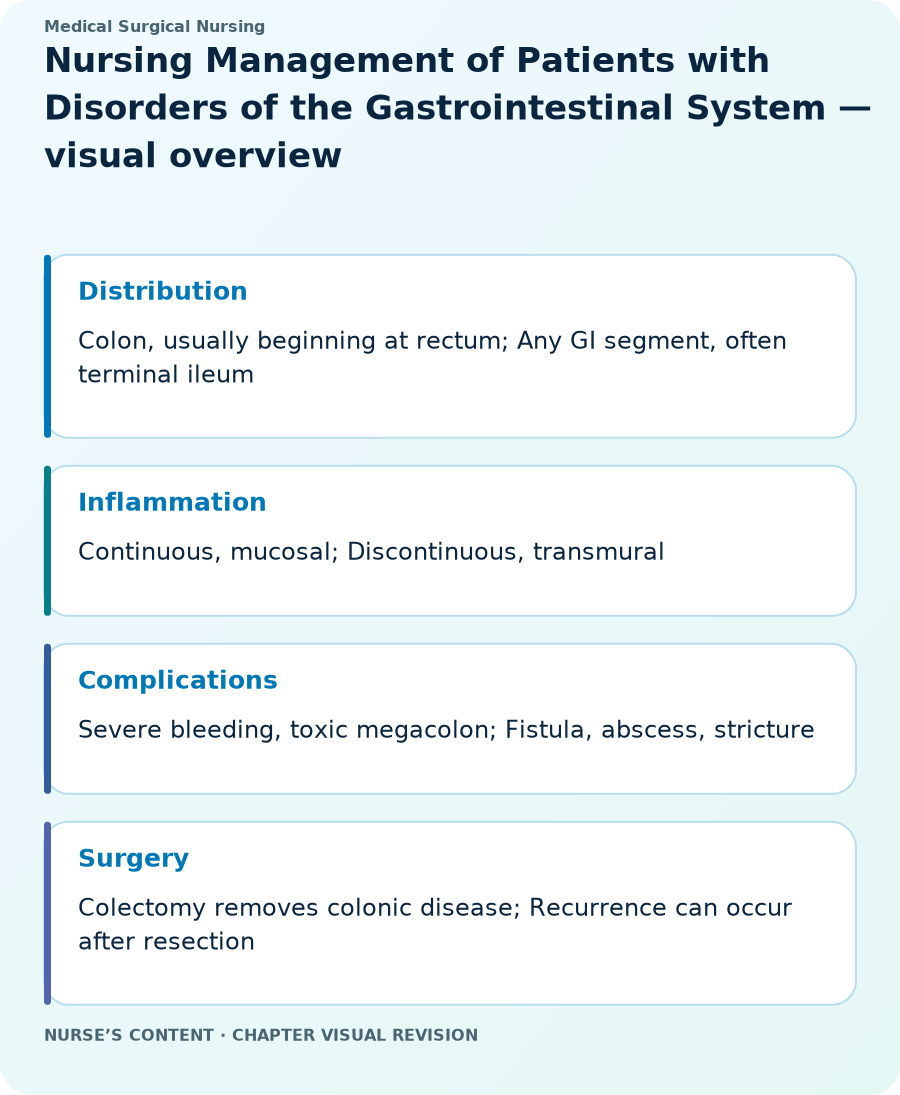
| Feature | Ulcerative colitis | Crohn's disease |
|---|---|---|
| Distribution | Colon, usually beginning at rectum | Any GI segment, often terminal ileum |
| Inflammation | Continuous, mucosal | Discontinuous, transmural |
| Complications | Severe bleeding, toxic megacolon | Fistula, abscess, stricture |
| Surgery | Colectomy removes colonic disease | Recurrence can occur after resection |
5. Nursing management
Maintain fluid balance, measure stool/emesis and monitor signs of dehydration or haemorrhage. Address nutrition and pain, maintain skin integrity and provide dignified toilet access. Inspect stoma colour and output after surgery, protect peristomal skin and teach self-care. Educate about food hygiene, alarm symptoms and follow-up.
6. Important Examination Questions
Long Answer Questions
- 1. Explain nursing management of peptic ulcer, intestinal obstruction or GI bleeding.
Short Answer Questions
- 1. Compare Crohn's and ulcerative colitis
- 2. explain appendicitis
- 3. list complications of GI bleeding.
Very Short Answer Questions (with answers)
- 1. What is melena? — Black tarry stool due to digested blood.
- 2. Which organism commonly causes peptic ulcers? — H. pylori.
7. Quick Revision
- • Acute abdomen needs timely evaluation.
- • IBD and infectious diarrhoea are distinct.
- • GI bleeding can be severe before Hb falls.
8. Conclusion
Acute abdomen needs timely evaluation. IBD and infectious diarrhoea are distinct. GI bleeding can be severe before Hb falls.
Chapter reference images