Medical Surgical Nursing
Introduction to Medical-Surgical Nursing
Concept, scope, principles, roles and responsibilities of medical-surgical nurses, patient-centred care and nursing process in medical-surgical settings.
Open quizzes and study tools Download PDF
CHAPTER 01 / MEDICAL-SURGICAL NURSING 01. Introduction to Medical-Surgical Nursing
1. Concept and definition
Adult health nursing is the specialized nursing care of adults experiencing actual or potential medical and surgical health problems. It extends from prevention and early diagnosis to acute treatment, rehabilitation and end-of-life support. Medical-surgical nursing applies this knowledge in wards, clinics, operation theatres, critical care and community follow-up.
2. Scope and objectives
- • Promote health, detect risk factors and prevent complications of illness or treatment.
- • Restore physiological stability, relieve suffering and promote independence in activities of daily living (ADLs).
- • Provide safe medication administration, perioperative preparation, wound care, monitoring and patient education.
- • Coordinate care with physicians, pharmacists, dietitians, physiotherapists, social workers and families.
3. Principles of patient-centred care
| Principle | Application in medical-surgical nursing |
|---|---|
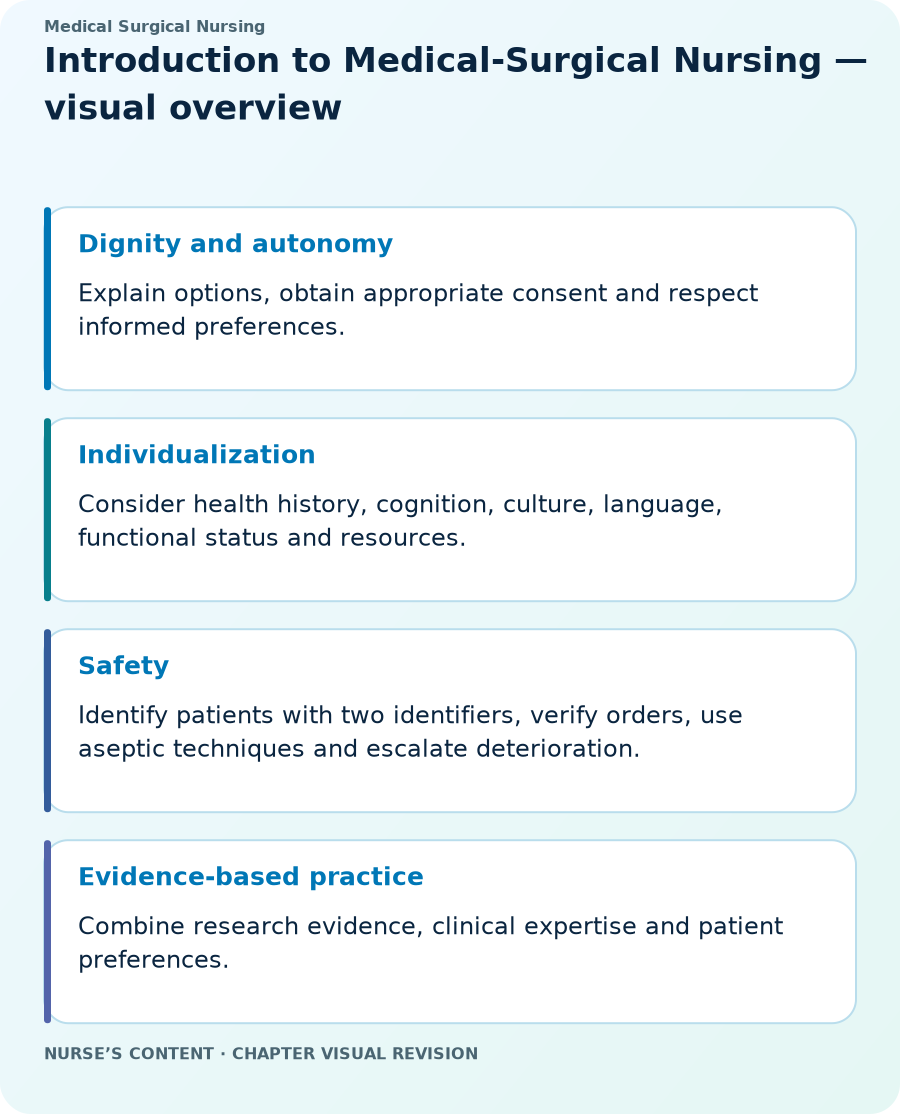
| Dignity and autonomy | Explain options, obtain appropriate consent and respect informed preferences. |
| Individualization | Consider health history, cognition, culture, language, functional status and resources. |
| Safety | Identify patients with two identifiers, verify orders, use aseptic techniques and escalate deterioration. |
| Evidence-based practice | Combine research evidence, clinical expertise and patient preferences. |
| Continuity | Coordinate transfer, medication reconciliation and discharge follow-up. |
4. Nursing process (ADPIE)
- 1. Assessment: collect subjective symptoms, objective vital signs, physical findings, medicines, allergies and psychosocial history.
- 2. Diagnosis: identify nursing responses to health conditions, such as acute pain or impaired gas exchange, rather than naming the disease as the nursing diagnosis.
- 3. Planning: prioritize life-threatening problems, then establish specific measurable patient-centred outcomes.
- 4. Implementation: deliver authorized independent, prescribed and collaborative interventions; document actions.
- 5. Evaluation: compare outcomes with the baseline and revise the plan.
5. Clinical reasoning and holistic care
Use ABCDE (airway, breathing, circulation, disability, exposure) for acute deterioration. Include sleep, nutrition, elimination, mobility, cognition, family support, spiritual needs and emotional distress in a comprehensive assessment. SBAR (situation, background, assessment, recommendation) structures escalation and handover. For a postoperative adult with increasing respiratory effort and confusion, first assess oxygenation and circulation, call for assistance, initiate indicated measures and reassess; routine paperwork can wait.
6. Important Examination Questions
Long Answer Questions
- 1. Explain the scope, principles and roles of an adult health nurse.
Short Answer Questions
- 1. Describe ADPIE
- 2. explain holistic care
- 3. write a note on SBAR.
Very Short Answer Questions (with answers)
- 1. What is ADPIE? — Assessment, diagnosis, planning, implementation, evaluation.
- 2. What does ABCDE prioritize? — Immediate threats to life.
7. Quick Revision
- • Adult health nursing spans the full continuum.
- • Nursing diagnoses describe human responses.
- • Reassessment and escalation are essential.
8. Conclusion
Adult health nursing spans the full continuum. Nursing diagnoses describe human responses. Reassessment and escalation are essential.
Chapter reference images