Community Health Nursing
Epidemiology
Definition, aims, principles and uses of epidemiology, epidemiological methods, disease distribution, determinants of disease, modes of transmission, surveillance, outbreak investigation and prevention and control of diseases.
Open quizzes and study tools Download PDF
CHAPTER 05 / COMMUNITY HEALTH NURSING 05. Epidemiology
1. Definition, aims and uses
Epidemiology studies distribution and determinants of health-related states in specified populations and applies that knowledge to control health problems. It measures burden, identifies risk factors, investigates outbreaks, evaluates interventions and informs resource allocation.
2. Distribution of disease
Descriptive epidemiology asks who, where and when: person (age, occupation, exposures), place (village, workplace, region), time (season, trend, outbreak curve). Analytical epidemiology examines why and how. Association is not automatically causation; evaluate bias, confounding, temporality and biological plausibility.
3. Epidemiological methods
| Design | Key feature | Typical measure |
|---|---|---|
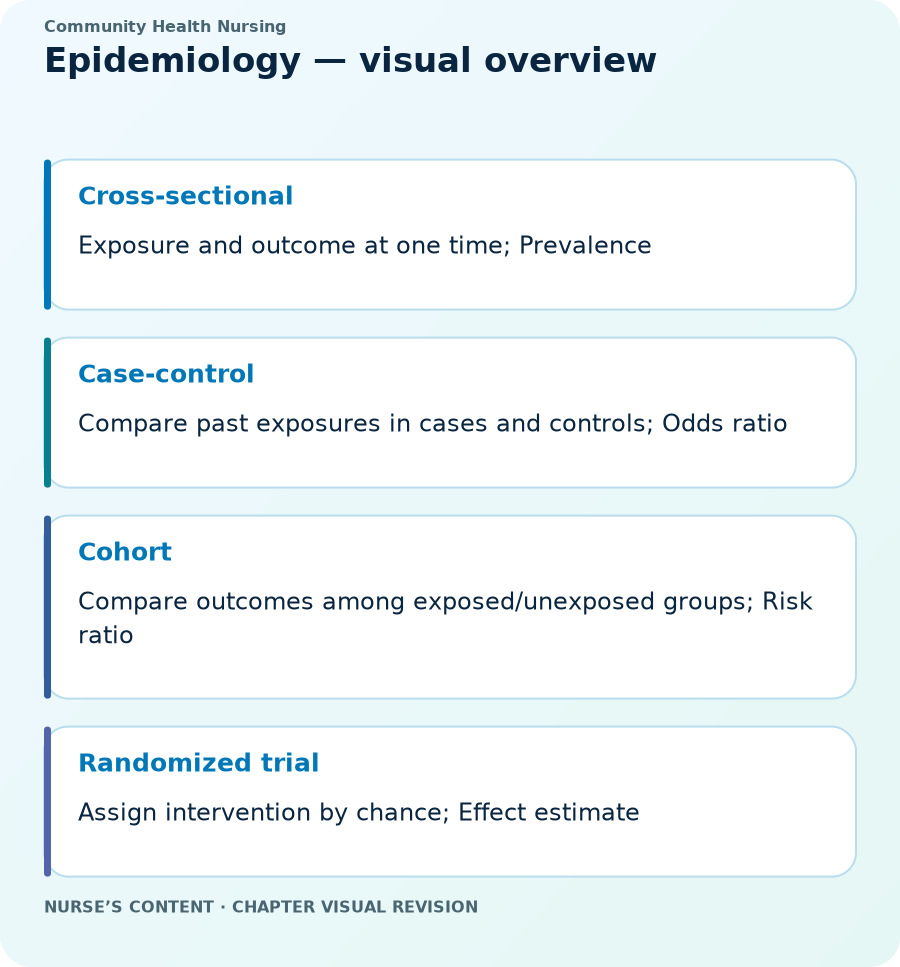
| Cross-sectional | Exposure and outcome at one time | Prevalence |
| Case-control | Compare past exposures in cases and controls | Odds ratio |
| Cohort | Compare outcomes among exposed/unexposed groups | Risk ratio |
| Randomized trial | Assign intervention by chance | Effect estimate |
| Ecological | Compare groups rather than individuals | Group-level association |
4. Measures of disease frequency
Incidence proportion = new cases during period / population initially at risk × multiplier. Incidence rate = new cases / person-time at risk. Prevalence = all existing cases / population assessed × multiplier. Attack proportion = new outbreak cases / exposed population at risk × 100. Case fatality proportion = deaths from disease / cases of that disease × 100.
Example: 40 of 200 attendees developed gastroenteritis; attack proportion = 20%. If 10 of 50 exposed and 5 of 100 unexposed become ill, risk ratio = 0.20 / 0.05 = 4. Compare like populations and defined periods.
5. Transmission and chain of infection
Agent → reservoir → exit portal → transmission → entry portal → susceptible host. Direct contact, droplets, airborne particles, contaminated food/water, blood, sexual contact, vectors and vertical transmission are important routes. Control the source, interrupt transmission and protect susceptible people.
6. Surveillance
Surveillance is continuous, systematic collection, analysis, interpretation and dissemination of health data for action. Passive surveillance uses routine reports; active surveillance searches for cases; sentinel surveillance uses selected reporting sites; syndromic surveillance uses symptom patterns. IDSP/IHIP supports surveillance and outbreak alerts in India. Notify suspected priority events promptly according to protocols.
7. Outbreak investigation
- 1. Verify report, confirm diagnosis and establish whether cases exceed expectation.
- 2. Define suspected/probable/confirmed cases by clinical, time, place and laboratory criteria.
- 3. Find cases and prepare a line list; collect appropriate samples.
- 4. Describe person, place and time; construct epidemic curve and map exposure patterns.
- 5. Develop and test hypotheses; compare exposure risks.
- 6. Implement control measures immediately when indicated, not only after final analysis.
- 7. Communicate findings, maintain surveillance and evaluate control.
8. Screening and prevention
Sensitivity = TP/(TP+FN); specificity = TN/(TN+FP). Positive predictive value depends on prevalence. Screening identifies people needing diagnostic confirmation; false positives and negatives are possible. Prevention includes vaccination, safe water, ventilation, vector control, early diagnosis and appropriate treatment.
9. Nursing importance
Recognize unusual case clusters, collect accurate data and specimens, educate without panic, coordinate isolation, contacts and referral according to disease guidance, maintain confidentiality, support outbreak teams and monitor outcomes.
10. Epidemiological study designs and measures of association
Cross-sectional study
Exposure and outcome are assessed at a defined time. It is useful for estimating prevalence and exploring associations, but temporal order may be uncertain.
Case-control and cohort studies
A case-control study compares prior exposure among people with and without an outcome. A cohort study compares occurrence of disease among groups defined by exposure and can estimate risk or incidence rates. Randomized studies allocate interventions to reduce confounding when ethical and feasible.
| Measure | Formula or interpretation |
|---|---|
| Risk ratio | Risk in exposed group ÷ risk in unexposed group. |
| Odds ratio | In a 2 × 2 table, ad ÷ bc (a and d diagonal cells). |
| Risk difference | Risk in exposed − risk in unexposed. |
| Sensitivity | True positives ÷ all people with the condition. |
| Specificity | True negatives ÷ all people without the condition. |
11. Worked outbreak example
At a community meal, 30 of 100 people who ate a particular food develop illness; 5 of 100 who did not eat it also develop illness. Attack proportions are 30% and 5%; risk ratio = 6. This suggests an association but does not prove the food is the cause. Review timing, other foods, specimen findings and potential confounding, and report findings to the outbreak team.
Bias and confounding
Selection bias occurs when inclusion or comparison groups differ systematically. Information bias results from inaccurate measurements. Confounding occurs when another factor is associated with exposure and outcome and distorts their relationship. Clear case definitions and appropriate comparison groups improve validity.
12. Important Examination Questions
Long Answer Questions
- 1. Explain epidemiological methods; describe outbreak investigation and surveillance.
- 2. Compare descriptive, analytical and experimental epidemiology.
- 3. Explain an outbreak investigation with a worked attack-rate example.
Short Answer Questions
- 1. Incidence vs prevalence
- 2. cohort vs case-control
- 3. sensitivity/specificity
- 4. epidemic curve
- 5. Selection bias.
- 6. Confounding.
- 7. Risk ratio and odds ratio.
- 8. Screening accuracy.
Very Short Answer Questions (with answers)
- 1. Case-control measure? Odds ratio.
- 2. New cases per person-time? Incidence rate.
- 3. IDSP? Integrated Disease Surveillance Programme.
- 4. What is the denominator of sensitivity? — All people who truly have the condition.
- 5. What is an epidemic curve? — A graph of cases by onset time.
13. Quick Revision
- • Epidemiology studies distribution and determinants.
- • Person, place and time describe disease patterns.
- • Incidence measures new disease; prevalence measures existing disease.
- • An association is not automatically causal.
Conclusion
Epidemiology converts population observations into preventive action.
Chapter reference images