Community Health Nursing
Primary Health Care and Healthcare Delivery System
Principles and elements of primary healthcare, healthcare delivery system in India, levels of healthcare, referral system, sub-centres, Ayushman Arogya Mandirs, Primary Health Centres (PHCs), Community Health Centres (CHCs) and district hospitals.
Open quizzes and study tools Download PDF
CHAPTER 03 / COMMUNITY HEALTH NURSING 03. Primary Health Care and Healthcare Delivery System
1. Introduction and definition
Primary health care (PHC) is an inclusive approach to health that combines accessible first-contact clinical services, public health, community empowerment and action across sectors. Primary care is the clinical service component; PHC is the broader approach. Alma-Ata (1978) and Astana (2018) are key milestones.
2. Principles and classical elements
Principles: equitable distribution, community participation, intersectoral coordination and appropriate technology, supported by prevention, affordability and continuity.
The eight classical Alma-Ata elements are education about major health problems; food supply and nutrition; safe water and basic sanitation; maternal and child care including family planning; immunisation; control of endemic diseases; appropriate treatment of common diseases and injuries; and access to essential medicines.
3. Levels of care in India
| Level | Facilities | Core function |
|---|---|---|
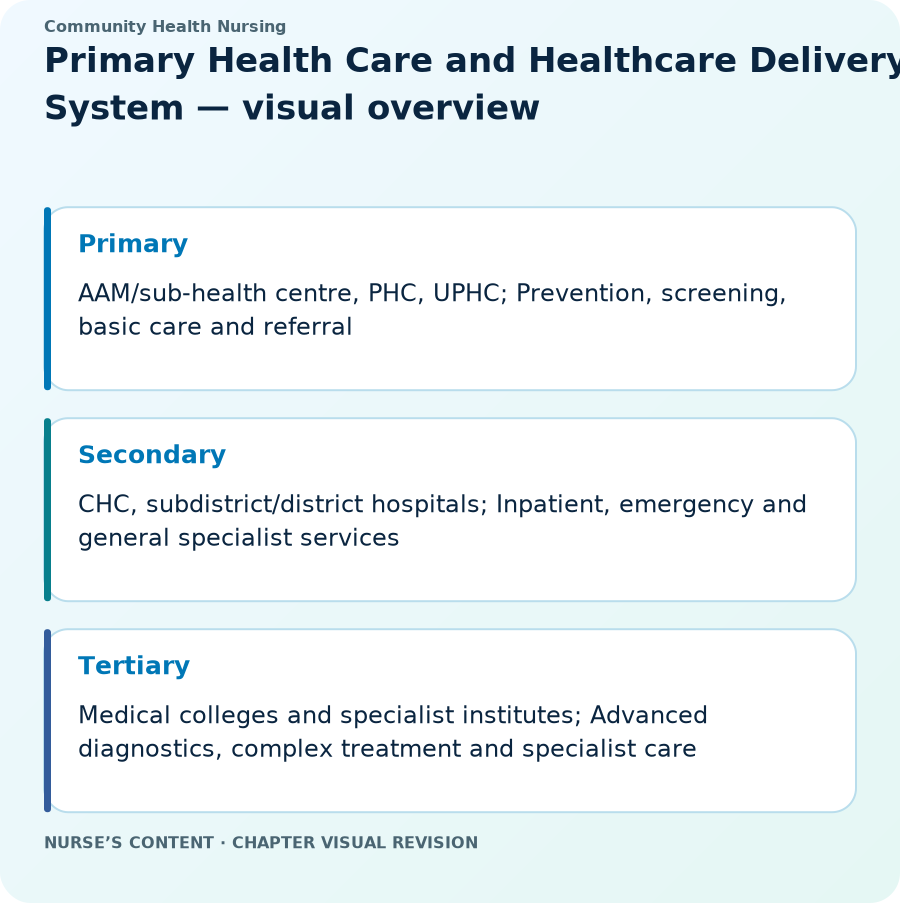
| Primary | AAM/sub-health centre, PHC, UPHC | Prevention, screening, basic care and referral |
| Secondary | CHC, subdistrict/district hospitals | Inpatient, emergency and general specialist services |
| Tertiary | Medical colleges and specialist institutes | Advanced diagnostics, complex treatment and specialist care |
Public services operate through central and state authorities, district administration, blocks and community facilities. Private, charitable and AYUSH services also contribute. A patient with an emergency may bypass a lower facility if necessary.
4. Rural population norms (IPHS 2022)
| Facility | Plains | Hilly/tribal/difficult areas |
|---|---|---|
| Sub-health centre | 5,000 | 3,000 |
| PHC | 30,000 | 20,000 |
| CHC | 120,000 | 80,000 |
These are planning norms, not guaranteed patient loads. Geography, travel time and state policy can modify facility planning. [1]
5. Functions and staffing
Sub-health centre/AAM: Household registration, MCH, immunisation, screening, first aid, follow-up, health education and referral; ANM/MPW, CHO and ASHA link services according to staffing model.
PHC: Medical assessment, treatment, basic laboratory care, preventive services, supervision of linked centres and referral. Some PHCs operate around the clock according to designation.
CHC: Referral-level inpatient and emergency care, laboratory and specialist services where available. A First Referral Unit (FRU) must meet defined emergency obstetric/newborn care capabilities; not every CHC is an FRU.
District hospital: Secondary and sometimes advanced specialist care, diagnostics and district clinical support.
6. Ayushman Bharat and comprehensive PHC
Ayushman Arogya Mandirs (formerly Health and Wellness Centres) extend primary care beyond traditional MCH and infections to NCDs, mental health, palliative and elderly care, oral/eye/ENT care and basic emergencies. PM-JAY is a separate financial-protection component for eligible covered hospital care; it is not a substitute for primary care. [19]
7. Referral and back-referral
Assess urgency; stabilize within competence; contact receiving team; arrange safe transport; send concise clinical history, findings, treatment and reason; confirm receipt; obtain follow-up advice. Back-referral returns ongoing care to the local team. Example: a pregnant woman with bleeding requires emergency referral, not routine appointment scheduling.
8. Role of nurses
Deliver approved preventive and primary services, maintain drug and vaccine stocks, supervise outreach, track missed care, screen and refer, maintain records, ensure infection prevention, coordinate with community workers and monitor service quality.
9. Comprehensive primary care service packages
Primary care is not limited to minor illness. The Indian comprehensive primary healthcare model includes reproductive and maternal care, neonatal and infant care, childhood and adolescent care, family planning, communicable diseases, outpatient care for common illnesses, non-communicable diseases, oral health, eye and ENT care, elderly and palliative care, emergency care and mental healthcare. Exact facility capacity and referral arrangements depend on the current IPHS and state implementation.
Village-to-district service coordination
| Worker or service | Key contribution |
|---|---|
| ASHA | Community mobilization, health education, due-list tracking and linkage to care. |
| ANM | Maternal-child services, vaccination, outreach and authorized primary care. |
| CHO | Team-based comprehensive primary healthcare and continuity at designated facilities. |
| Medical officer | Clinical assessment, treatment, referral, supervision and programme coordination. |
| Anganwadi worker | Nutrition, early childhood services and coordination with health staff. |
10. Referral case study
A pregnant woman with severe headache and visual changes presents to an outreach session. The nurse checks immediate condition, recognizes a potential obstetric emergency, alerts the medical team, arranges safe transport to an appropriate facility and sends a concise referral note. The receiving institution provides definitive assessment; back-referral communicates ongoing medicines, follow-up dates and warning signs. The nurse checks whether care was actually received. Routine paperwork must not delay urgent referral.
11. Important Examination Questions
Long Answer Questions
- 1. Describe PHC principles and elements; explain Indian healthcare delivery and referral facilities.
- 2. Describe the comprehensive primary healthcare service packages and the referral continuum.
- 3. Explain the roles of frontline workers in rural primary care.
Short Answer Questions
- 1. AAM
- 2. PHC vs CHC
- 3. referral system
- 4. roles of ASHA, ANM and CHO
- 5. Back-referral.
- 6. Comprehensive primary healthcare versus primary medical care.
- 7. First referral unit.
Very Short Answer Questions (with answers)
- 1. Alma-Ata? 1978.
- 2. Rural PHC plains norm? 30,000.
- 3. CHC difficult-area norm? 80,000.
- 4. What does CHO stand for? — Community Health Officer.
- 5. What is back-referral? — Communication returning the patient to appropriate follow-up care.
12. Quick Revision
- • Alma-Ata emphasized equity and participation.
- • Arogya Mandirs provide comprehensive primary care according to facility capacity.
- • IPHS specifies service and infrastructure standards.
- • Referral includes transport, handover and follow-up.
Conclusion
Comprehensive PHC is the foundation for equitable, continuous healthcare. [1,2]
Chapter reference images