Community Health Nursing
Occupational Health Nursing
Occupational health concepts, occupational hazards, occupational diseases, workplace safety, ergonomics, industrial hygiene, prevention of occupational injuries and occupational health services.
Open quizzes and study tools Download PDF
CHAPTER 16 / COMMUNITY HEALTH NURSING 16. Occupational Health Nursing
1. Definition and aims
Occupational health nursing promotes and protects workers' health, prevents work-related illness and injury, facilitates timely treatment and supports safe return to work. It addresses the interaction between people, tasks, equipment, workplace exposures and organizational conditions.
2. Occupational hazards
| Category | Examples | Possible outcomes |
|---|---|---|
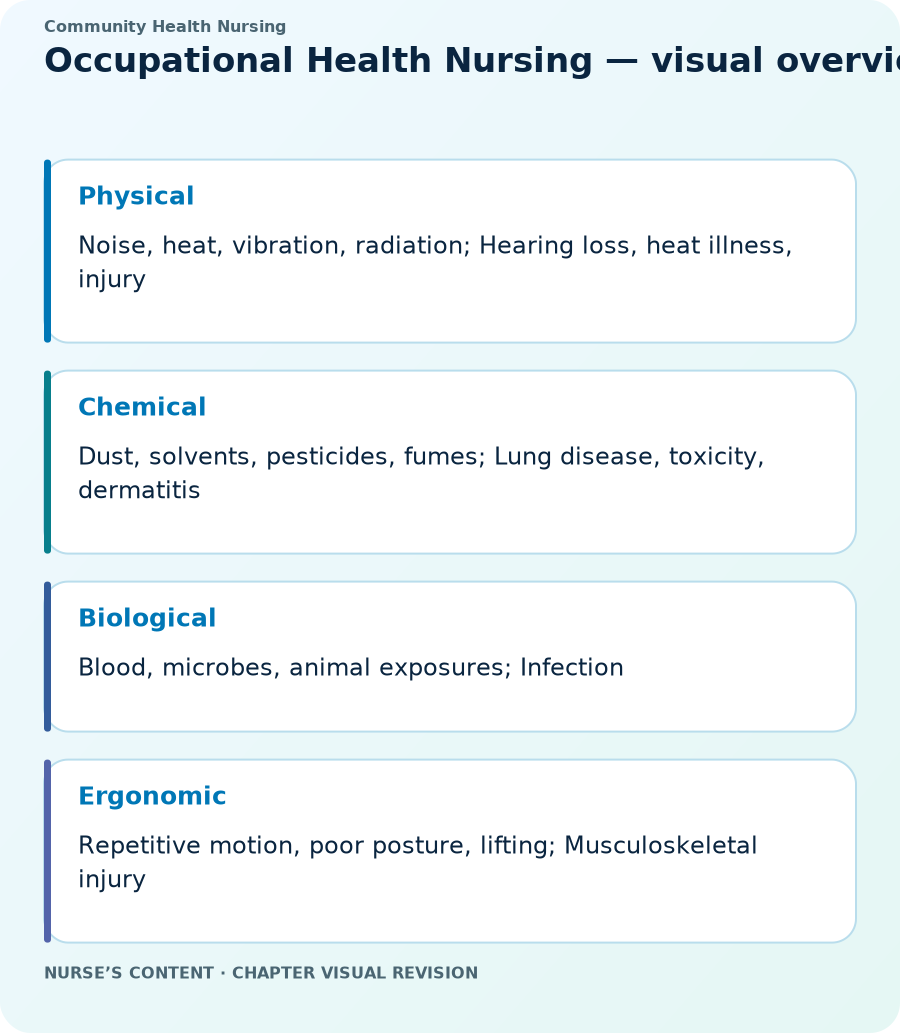
| Physical | Noise, heat, vibration, radiation | Hearing loss, heat illness, injury |
| Chemical | Dust, solvents, pesticides, fumes | Lung disease, toxicity, dermatitis |
| Biological | Blood, microbes, animal exposures | Infection |
| Ergonomic | Repetitive motion, poor posture, lifting | Musculoskeletal injury |
| Psychosocial | Overwork, harassment, shift work | Stress, burnout, sleep disruption |
| Safety/mechanical | Unprotected machines, electrical hazards | Trauma, burns |
3. Common occupational diseases
Silicosis results from respirable crystalline silica exposure; asbestosis from asbestos fibres; occupational asthma from selected workplace sensitizers/irritants; noise-induced hearing loss from prolonged excessive noise; contact dermatitis from irritant or allergenic exposures; musculoskeletal disorders from combined physical and organizational risks. Exposure history is essential; symptoms alone do not establish work-related causation.
4. Hierarchy of controls
Elimination removes the hazard; substitution replaces it; engineering controls isolate workers (local exhaust ventilation, guards); administrative controls change work practices (training, rotation where appropriate); PPE provides a final barrier. Prioritize controls at the source over reliance on PPE alone.
5. Ergonomics and industrial hygiene
Ergonomics adapts work to human capabilities: adjustable workspaces, neutral posture, safe handling equipment, appropriate breaks and task redesign. Industrial hygiene anticipates, recognizes, evaluates and controls exposures through workplace assessments, monitoring, ventilation and safe processes. Nurses collaborate with safety professionals and occupational physicians.
6. Occupational health services
Pre-placement assessment appropriate to job risks, periodic health surveillance, vaccination where indicated, first aid, exposure and injury reporting, workplace education, rehabilitation and return-to-work planning. Medical information should be confidential; communicate functional restrictions rather than unnecessary diagnoses to management.
7. Clinical safety and nursing role
For sharps or blood exposure, wash skin/flush mucosa, report immediately, and seek urgent assessment for HIV/HBV prophylaxis and follow-up. In chemical exposure, ensure scene safety, remove exposure when safe and follow chemical-specific decontamination and referral instructions. Never enter an unsafe confined space without qualified rescue procedures. Nurses identify hazards, monitor trends, educate workers, support safety committees and advocate for non-punitive reporting.
8. Hierarchy of occupational hazard controls
The preferred approach is to remove or reduce the hazard at its source instead of relying only on worker behaviour.
| Control | Example |
|---|---|
| Elimination | Remove an unnecessary hazardous process. |
| Substitution | Replace a harmful chemical with a safer alternative. |
| Engineering | Enclose machinery, improve ventilation or install guards. |
| Administrative | Safe work procedures, shift planning and training. |
| PPE | Suitable protection for residual exposure after higher-level controls. |
Occupational health assessment
Take a work history: job tasks, exposure duration, materials, protective measures, injury history and symptoms during work versus time away. Record objective findings and refer for appropriate evaluation. Clinical surveillance should be based on relevant exposure hazards and authorized protocols; it does not replace hazard reduction.
9. Workplace scenario
Several workers report back discomfort during repetitive lifting. Assess lifting frequency, loads, workstation height and access to mechanical aids. Coordinate redesign of tasks and workstations, training and suitable referral. Evaluate whether exposure and new injuries decline. Merely asking workers to maintain correct posture is inadequate when the task itself is unsafe.
Industrial hygiene
Anticipate, recognize, evaluate and control chemical, physical, biological and ergonomic exposures. Work with qualified occupational hygiene personnel for environmental measurements and control plans.
10. Important Examination Questions
Long Answer Questions
- 1. Describe occupational hazards, diseases and preventive measures.
- 2. Explain occupational health services.
- 3. Explain workplace hazards and the hierarchy of controls with nursing examples.
- 4. Describe an occupational health assessment and prevention plan.
Short Answer Questions
- 1. Ergonomics
- 2. hierarchy of controls
- 3. industrial hygiene
- 4. occupational exposure management
- 5. Ergonomics.
- 6. Industrial hygiene.
- 7. Occupational health surveillance.
- 8. PPE limitations.
Very Short Answer Questions (with answers)
- 1. Silicosis exposure? Crystalline silica.
- 2. Most effective hazard control? Elimination.
- 3. PPE? Personal protective equipment.
- 4. Which control is generally preferred first? — Elimination.
- 5. What is ergonomics? — Fitting tasks and work environments to human abilities.
11. Quick Revision
- • Occupational illness prevention begins with hazard control.
- • A detailed exposure history supports assessment.
- • PPE is the last line in the hierarchy of controls.
- • Report and investigate injuries without blame.
Conclusion
Healthy workplaces require source control, worker participation, surveillance and timely care.
Chapter reference images