Community Health Nursing
National Health Programmes
Objectives, strategies, implementation and nursing responsibilities in major national health programmes, including tuberculosis, HIV/AIDS, malaria, vector-borne diseases, leprosy, blindness, non-communicable diseases and immunisation.
Open quizzes and study tools Download PDF
CHAPTER 19 / COMMUNITY HEALTH NURSING 19. National Health Programmes
1. Introduction
National health programmes coordinate prevention, detection, treatment, surveillance, rehabilitation and quality improvement for priority health issues. Implementation is shared by central, state, district and local teams. Names, targets, treatment regimens and reporting platforms can change; older examination texts may use previous names.
2. Major communicable disease programmes
| Programme | Core objective and strategies | Community nursing role |
|---|---|---|
| NTEP | National Tuberculosis Elimination Programme (formerly RNTCP): detect TB, test for resistance, provide appropriate treatment, contact management and prevention | Identify symptoms, support samples/referral, adherence, side-effect reporting and contact follow-up |
| NACP | National AIDS Control Programme, managed by NACO: prevention, testing, ART, STI services, prevention of vertical transmission | Confidential counselling, testing linkage, ART support and stigma reduction |
| NCVBDC | National Center for Vector Borne Diseases Control: national technical/programme coordination for malaria, dengue, chikungunya, JE, kala-azar and lymphatic filariasis | Fever surveillance, testing/referral, mosquito control, community education and programme activities |
| NLEP | National Leprosy Eradication Programme: early case detection, multidrug therapy, disability prevention | Detect sensory-loss patches, refer, support treatment and protective self-care |
| IDSP/IHIP | Integrated Disease Surveillance Programme / Integrated Health Information Platform: early detection and response | Notify cases and clusters, maintain line lists, support investigation |
3. Tuberculosis control: key nursing actions
Suspect pulmonary TB in people with relevant symptoms/risk; arrange programme-directed testing, preferably molecular diagnostics as available. TB treatment is regimen-specific and depends on drug susceptibility and clinical factors; do not apply historical category regimens as current universal treatment. Support treatment completion, nutritional support and prevention, monitor adverse effects, protect privacy and coordinate eligible contact evaluation/TB preventive treatment. Ni-kshay supports case tracking. India's historical 2025 elimination target should not be interpreted as proof that elimination has occurred.
4. HIV/AIDS control
Promote safer sex, condoms, sterile injection equipment, blood safety and voluntary confidential testing. Link confirmed HIV-positive people to antiretroviral therapy (ART), monitor adherence and support prevention of mother-to-child transmission. Occupational or sexual exposure may require urgent post-exposure assessment. Do not impose isolation because of HIV status alone.
5. Vector-borne disease control
Malaria: prompt testing, appropriate treatment, nets and targeted vector control. Dengue/chikungunya: source reduction, fever surveillance and referral for danger signs. Lymphatic filariasis: programme-based mass drug administration in eligible areas, morbidity management and disability prevention. Kala-azar: early detection/treatment and sandfly control. JE: vaccination in designated endemic areas and vector protection.
6. Major NCD and other programmes
| Programme | Objective and key actions |
|---|---|
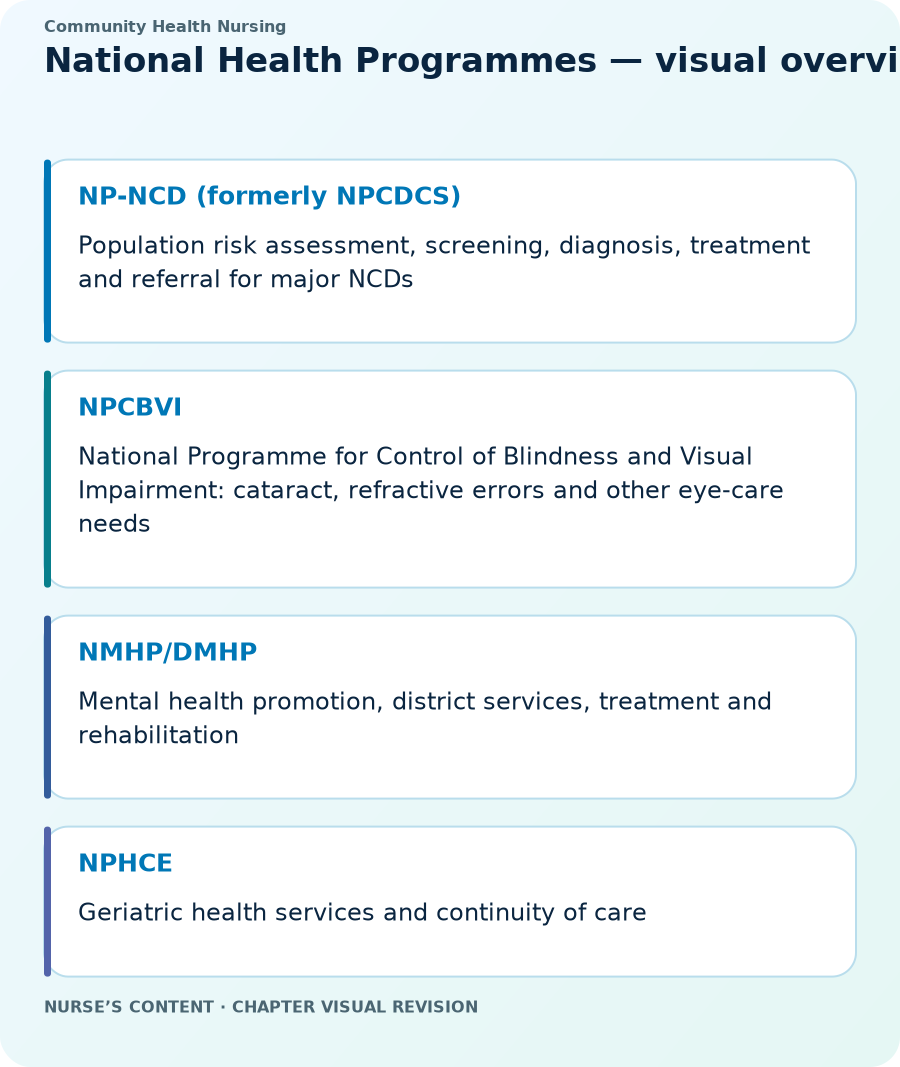
| NP-NCD (formerly NPCDCS) | Population risk assessment, screening, diagnosis, treatment and referral for major NCDs |
| NPCBVI | National Programme for Control of Blindness and Visual Impairment: cataract, refractive errors and other eye-care needs |
| NMHP/DMHP | Mental health promotion, district services, treatment and rehabilitation |
| NPHCE | Geriatric health services and continuity of care |
| NTCP | National Tobacco Control Programme: prevention, cessation and tobacco-control measures |
| NIDDCP | National Iodine Deficiency Disorders Control Programme: iodised salt and monitoring |
| UIP | Universal Immunization Programme: routine vaccination, cold chain, outreach and surveillance |
Mission Indradhanush strengthens vaccination of missed and underserved beneficiaries; it complements routine immunisation. The 2026 HPV campaign adds targeted cervical cancer prevention. [8,9,11]
7. Implementation and monitoring
Microplanning identifies eligible populations, geographic gaps, supplies, staff and outreach sessions. Monitor inputs (staff and supplies), processes (sessions held), outputs (people assessed), outcomes (treatment completion or coverage) and impact (reduced morbidity/mortality). Ensure denominator accuracy, data verification, referral completion and patient rights. Do not treat service contacts as confirmed cases or claim programme goals are achieved without data.
8. Programme implementation at peripheral level
National programmes establish policy, technical guidance, funding and indicators; state and district teams adapt delivery to their settings. Frontline workers identify eligible people, provide authorized services, track referrals, maintain supplies and report data. Supportive supervision compares performance with agreed standards and helps solve barriers.
Programme comparison by intervention strategy
| Strategy | Examples |
|---|---|
| Case detection and treatment | NTEP, leprosy programme and malaria case management. |
| Vaccination and outreach | UIP and Mission Indradhanush; targeted HPV vaccination services. |
| Population screening | NP-NCD and selected eye-care services. |
| Community/environmental action | Vector control, tobacco control and sanitation linkage. |
| Long-term support | HIV treatment support, chronic disease follow-up and disability prevention. |
9. Programme monitoring example
A facility's TB treatment register lists patients receiving treatment, but some transferred or moved. Reconcile records with the responsible programme team, check follow-up and avoid double counting. Notify clinical staff of possible adverse reactions or interruption and coordinate support without disclosing diagnoses to unauthorized people. Evaluate treatment outcomes using programme definitions rather than counting the number of tablets dispensed.
Distinguishing control, elimination and eradication
Control reduces disease burden to an acceptable level with continuing measures. Elimination may refer to zero transmission in a defined area or achievement of a specified public health threshold, depending on the condition and programme. Eradication means permanent worldwide reduction to zero incidence of infection through deliberate efforts. A programme's elimination target is not evidence that it has been achieved.
10. Important Examination Questions
Long Answer Questions
- 1. Describe NTEP, NACP, vector-borne disease control, NP-NCD and nursing responsibilities.
- 2. Explain national programme implementation.
- 3. Discuss how national health programmes are implemented and monitored at community level.
- 4. Compare tuberculosis, vector-borne disease and NCD programme strategies.
Short Answer Questions
- 1. Ni-kshay
- 2. IDSP
- 3. NLEP
- 4. NPCBVI
- 5. Mission Indradhanush
- 6. Control, elimination and eradication.
- 7. Programme indicators.
- 8. Treatment support.
- 9. Supportive supervision.
Very Short Answer Questions (with answers)
- 1. Former RNTCP name now? NTEP.
- 2. NACO? National AIDS Control Organisation.
- 3. Former NPCDCS? NP-NCD.
- 4. What is the primary purpose of Ni-kshay? — TB case management and programme tracking.
- 5. Does an elimination target prove elimination? — No.
11. Quick Revision
- • Programme names and strategies can change.
- • Refer to current official protocols for treatment and eligibility.
- • Link screening to confirmation, treatment and follow-up.
- • Measure coverage with reliable denominators.
Conclusion
Programme success depends on timely services, evidence-based care, community trust, accurate reporting and follow-up.
Chapter reference images