Community Health Nursing
Maternal and Child Health Services
Antenatal care, intranatal care, postnatal care, essential newborn care, growth and development monitoring, child health services, high-risk pregnancy identification and maternal and child health programmes.
Open quizzes and study tools Download PDF
CHAPTER 07 / COMMUNITY HEALTH NURSING 07. Maternal and Child Health Services
1. Introduction and objectives
Maternal and child health (MCH) services promote safe pregnancy, childbirth, postpartum recovery, newborn survival and optimal child development. Care begins before conception and continues through pregnancy, delivery, infancy and childhood. Objectives include reducing preventable deaths, detecting high-risk conditions early, promoting nutrition and breastfeeding, immunisation and family support.
2. Antenatal care (ANC)
ANC is systematic care during pregnancy. Register early, ideally in the first trimester. The traditional Indian programme minimum is four visits, including early registration; PMSMA provides additional specialist ANC in the second and third trimesters, on the 9th of each month at designated facilities. WHO recommends at least eight contacts at about 12, 20, 26, 30, 34, 36, 38 and 40 weeks. Later 2026 SSBSK guidance describes five ANC visits for normal pregnancy (including PMSMA) and eight for high-risk pregnancy (including extra e-PMSMA visits). Risk-based follow-up and updated local protocols take precedence. [3,4,6,21]
Components of ANC
- • History: LMP, expected date of delivery (EDD), obstetric history, illness, medications, allergies and psychosocial concerns.
- • Examination: BP, weight, pallor, oedema, fundal height and fetal assessment appropriate to gestation.
- • Investigations: Hb, blood group/Rh, urine testing, blood glucose, HIV/syphilis and other tests according to guidance; offer ultrasound as indicated.
- • Nutrition counselling, prescribed iron-folic acid and calcium, Td vaccination, birth preparedness, breastfeeding and family planning counselling.
EDD: Naegele's rule for a regular 28-day cycle = LMP + 7 days − 3 months + 1 year; ultrasound dating may supersede uncertain LMP.
3. High-risk pregnancy and warning signs
| Finding | Nursing response |
|---|---|
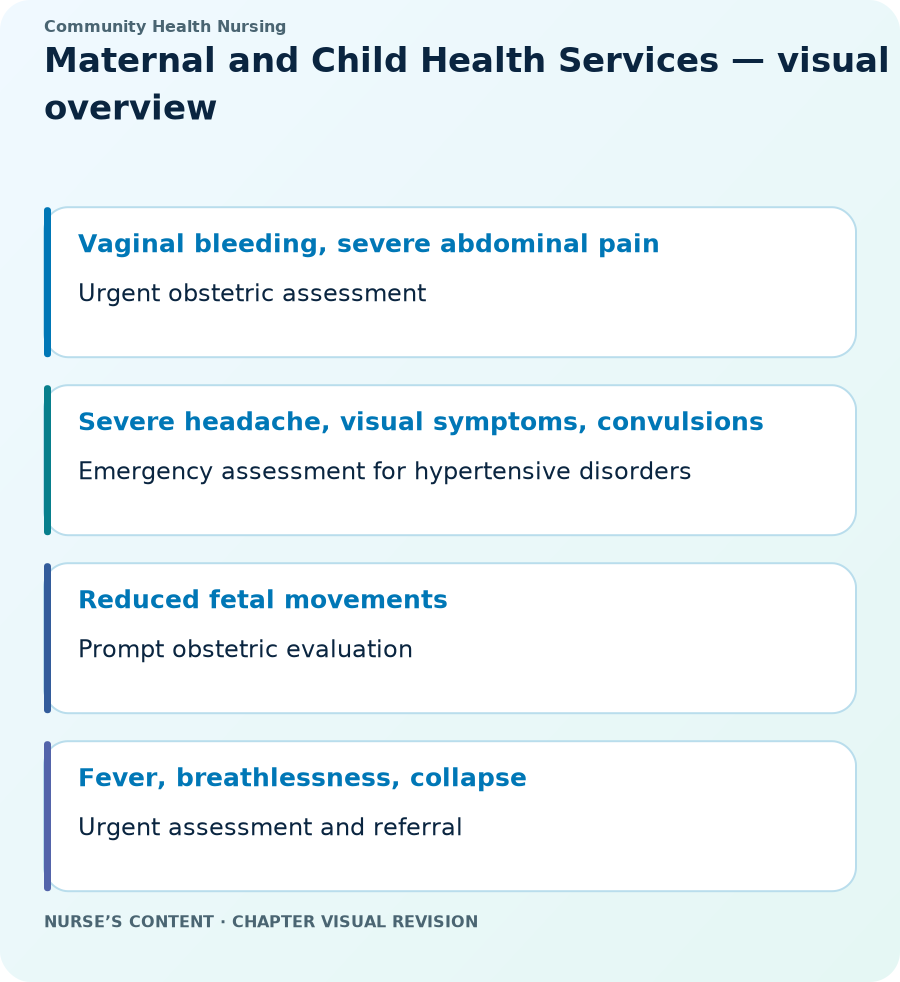
| Vaginal bleeding, severe abdominal pain | Urgent obstetric assessment |
| Severe headache, visual symptoms, convulsions | Emergency assessment for hypertensive disorders |
| Reduced fetal movements | Prompt obstetric evaluation |
| Fever, breathlessness, collapse | Urgent assessment and referral |
| Severe anaemia, multiple gestation, previous serious complication | Risk classification and planned higher-level care |
Do not delay emergency referral to complete routine tests or paperwork. Establish transport and receiving-facility contact.
4. Intranatal care
Intranatal care is care during labour and birth. Promote skilled birth attendance, respectful maternity care, infection prevention, monitoring of maternal and fetal status and labour progress using an approved tool. Recognize prolonged or obstructed labour, fetal compromise, haemorrhage and eclampsia. Ensure readiness for emergency obstetric and newborn care. Routine interventions without indication should be avoided.
5. Postnatal care
Assess bleeding, uterine involution, BP, pulse, temperature, pain, wounds, breastfeeding, mental health and thromboembolism risk. WHO recommends care in the first 24 hours and further contacts at 48–72 hours, 7–14 days and six weeks. Heavy bleeding, severe headache, chest pain, breathlessness, fever or thoughts of self-harm require urgent assessment. [5]
6. Essential newborn care
- • Immediately dry, provide warmth, assess breathing and initiate resuscitation if indicated by a trained provider.
- • Skin-to-skin contact and early breastfeeding within the first hour when stable; delayed cord clamping for stable newborns per protocol.
- • Clean, dry cord care; vitamin K per protocol; birth immunisation; assess weight, temperature, jaundice and feeding.
- • Exclusive breastfeeding for six months; complementary foods introduced at six months with continued breastfeeding to two years or beyond.
Danger signs: inability to feed, convulsions, lethargy, respiratory distress, abnormal temperature, jaundice in first 24 hours or severe jaundice. Arrange urgent evaluation.
7. Growth and development monitoring
Plot age- and sex-appropriate weight, length/height and other measures on approved growth charts. Assess trends, developmental milestones, feeding, immunisation and caregiver concerns. Screen for developmental delay; refer rather than diagnose from one missed milestone alone.
8. Programmes and nursing role
JSY promotes institutional delivery; JSSK provides defined entitlements for eligible public facility maternity and sick infant care; PMSMA strengthens ANC; SUMAN supports assured respectful maternity/newborn care. RBSK screens children for the four Ds. HBNC and HBYC are being integrated through SSBSK, launched in 2026, for a continuum from birth to three years. [6] Nurses register pregnancies, screen risk, counsel, ensure timely referral, support breastfeeding, follow up and record outcomes.
9. Antenatal assessment and birth preparedness
Routine assessment checklist
- • Confirm registration, gestational age and relevant obstetric history.
- • Measure blood pressure and weight; assess symptoms and relevant physical findings.
- • Review screening results, immunisation, prescribed supplements and medication adherence.
- • Discuss balanced nutrition, rest, fetal movement awareness and facility-based birth planning.
- • Agree on next contact, transport, emergency contacts and accompanying support person where preferred.
Birth preparedness means planning routine childbirth; complication readiness means knowing warning signs, suitable emergency facilities and how to reach them. Explain danger signs using language understood by the woman and family.
10. Newborn and child follow-up
| Area | Assessment and support |
|---|---|
| Temperature | Check warmth and avoid unnecessary exposure. |
| Feeding | Observe effective attachment and feeding; assess poor feeding urgently. |
| Cord and skin | Observe for redness, discharge or other signs of infection. |
| Growth | Plot measurements on an appropriate chart and examine the trend. |
| Development | Review caregiver concerns, play, hearing, vision and milestone progression. |
| Family support | Discuss rest, postpartum mental health, contraception and safe caregiving. |
Clinical example
A newborn is lethargic and refuses feeds. Arrange urgent newborn assessment; protect warmth, assess breathing and circulation, and do not delay referral to complete routine home-visit documentation. An apparently normal previous weight does not exclude acute infection or hypoglycaemia.
11. Important Examination Questions
Long Answer Questions
- 1. Explain ANC, high-risk assessment, postnatal care and essential newborn care.
- 2. Discuss MCH programmes.
- 3. Describe ANC assessment and birth preparedness with danger signs.
- 4. Explain essential newborn care and postnatal follow-up.
Short Answer Questions
- 1. EDD
- 2. PMSMA
- 3. newborn danger signs
- 4. growth monitoring
- 5. Birth preparedness and complication readiness.
- 6. Growth monitoring versus developmental screening.
- 7. Postpartum danger signs.
Very Short Answer Questions (with answers)
- 1. Exclusive breastfeeding duration? Six months.
- 2. WHO ANC contacts? Eight.
- 3. PMSMA day? Ninth of each month.
- 4. How long is the neonatal period? — First 28 days after birth.
- 5. When should complementary feeding begin? — At six months.
12. Quick Revision
- • ANC starts early and continues according to risk and approved guidance.
- • Maintain respectful, consent-based maternity care.
- • Heavy bleeding and convulsions are emergencies.
- • Poor newborn feeding or respiratory distress requires prompt assessment.
Conclusion
Continuity of respectful maternal and newborn care prevents avoidable complications.
Chapter reference images