Community Health Nursing
Maternal and Child Health and Family Welfare Programmes
Family planning methods, contraceptives, reproductive health services, maternal health initiatives, child health programmes, adolescent health services and reproductive, maternal, newborn, child and adolescent health (RMNCH+A).
Open quizzes and study tools Download PDF
CHAPTER 20 / COMMUNITY HEALTH NURSING 20. Maternal and Child Health and Family Welfare Programmes
1. Concept and objectives
Family welfare integrates voluntary family planning, reproductive health, safe motherhood, newborn and child health, adolescent services and equitable access. Objectives include preventing unintended pregnancy where desired, supporting healthy intervals between births, reducing avoidable morbidity and mortality and ensuring reproductive rights.
2. Contraceptive methods
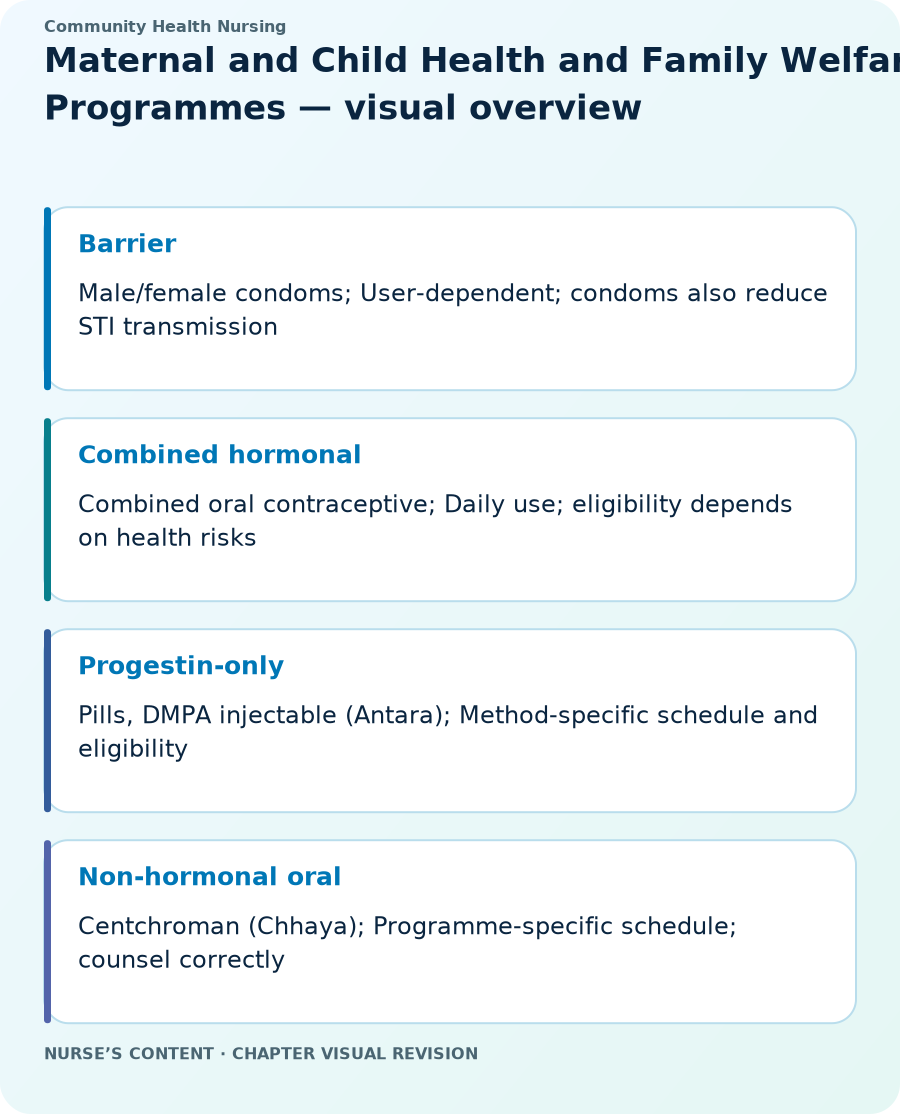
| Method | Examples | Key features |
|---|---|---|
| Barrier | Male/female condoms | User-dependent; condoms also reduce STI transmission |
| Combined hormonal | Combined oral contraceptive | Daily use; eligibility depends on health risks |
| Progestin-only | Pills, DMPA injectable (Antara) | Method-specific schedule and eligibility |
| Non-hormonal oral | Centchroman (Chhaya) | Programme-specific schedule; counsel correctly |
| Intrauterine | Cu-IUD; hormonal IUS where available | Long-acting reversible; trained provider insertion |
| Implant | Progestin implant where available | Long-acting reversible; trained provider |
| Permanent | Vasectomy, tubal sterilisation | Intended permanent; informed voluntary decision |
| Fertility awareness/withdrawal | Cycle tracking, withdrawal | Higher typical-use failure; requires correct use |
Counselling includes effectiveness, side effects, contraindications, reversibility, STI protection and preferences. Use medical eligibility criteria; avoid recommending one method to everyone. [17]
3. Emergency contraception and LAM
Emergency contraception can help prevent pregnancy after unprotected intercourse; oral options are time-sensitive, and a copper IUD may be an option within five days where eligible. Seek timely clinical or pharmacy advice; it does not terminate an established pregnancy. Lactational amenorrhoea method (LAM) requires all three: infant younger than six months, no return of menstruation and exclusive or near-exclusive breastfeeding with frequent feeds. If any condition changes, discuss another method.
4. Reproductive health services
Provide contraceptive counselling and access, STI testing/referral, infertility counselling, cervical cancer prevention, menstrual health, adolescent-friendly services, safe abortion referral within legal requirements, and respectful care after pregnancy loss. Respect consent, confidentiality and non-discrimination; avoid coercive targets or spousal permission assumptions for competent adults.
5. Maternal and child health initiatives
| Initiative | Purpose |
|---|---|
| JSY | Promote institutional delivery through eligible benefits |
| JSSK | Specified free services/entitlements for eligible mothers and sick infants in public facilities |
| PMSMA/e-PMSMA | Quality ANC and additional tracking of high-risk pregnancy |
| SUMAN | Assured, respectful maternal and newborn services |
| LaQshya | Improve quality of labour room and maternity operation theatre care |
| RBSK | Screening and referral for child health conditions (four Ds) |
| HBNC/HBYC/SSBSK | Home-based newborn and early-childhood care, integrating into SSBSK in 2026 |
| UIP | Routine immunisation and outreach |
| PMMVY | Maternity benefit support under defined eligibility rules |
6. Adolescent health
RKSK (Rashtriya Kishor Swasthya Karyakram) addresses nutrition, sexual/reproductive health, mental health, injury/violence, substance misuse and NCD prevention for adolescents aged 10–19. Services include adolescent-friendly health clinics, peer education and menstrual health support where available. Maintain appropriate privacy while following consent and safeguarding laws for minors. [18]
7. RMNCH+A continuum
RMNCH+A integrates reproductive, maternal, newborn, child and adolescent health across life stages and across home, community and facility levels. Nutrition is also explicitly emphasized in RMNCAH+N terminology. Integrated referral, risk tracking, outreach and service quality help prevent missed care. Programmes evolve; verify state-specific implementation and eligibility. [3,6,10]
8. Nursing responsibilities
Provide non-directive counselling, assess eligibility, obtain consent, provide authorized services, support method follow-up and referral, monitor ANC/PNC and infant health, coordinate ASHA/ANM/Anganwadi services, maintain records and advocate for reproductive autonomy.
9. Rights-based contraceptive counselling
Begin with the individual's reproductive goals, preferences, relevant health history and previous method experience. Explain available methods neutrally, including benefits, limitations, reversibility, possible adverse effects, STI protection and access requirements. Choose methods using medical eligibility guidance and appropriate provider assessment. Never coerce a person to accept contraception or sterilisation to meet programme targets.
| Contraceptive category | Counselling emphasis |
|---|---|
| Barrier | Correct and consistent use; STI protection with condoms. |
| Oral hormonal or non-hormonal | Correct method-specific schedule; missed-dose guidance from approved instructions. |
| Injectable | Return schedule, bleeding changes and method-specific counselling. |
| Intrauterine or implant | Insertion and removal by trained providers; review warning signs and follow-up. |
| Permanent | Voluntary informed decision; intended permanence and limitations. |
10. RMNCH+A service pathway example
A couple seeks spacing after childbirth. Assess whether the woman desires contraception, feeding pattern, timing of delivery, clinical history and method preferences. Explain LAM only if all criteria are satisfied and offer suitable alternatives through the authorized provider. Link the infant to immunisation and growth monitoring, assess postpartum needs, and arrange follow-up. The same household may also include adolescents requiring confidential age-appropriate health services.
Indicators of programme quality
Track access, informed choice, respectful care, appropriate follow-up, referral completion and clinical outcomes. Raw acceptor numbers do not demonstrate that consent was voluntary or care was appropriate.
11. Important Examination Questions
Long Answer Questions
- 1. Classify contraceptives and explain family welfare programmes; discuss RMNCH+A and MCH initiatives.
- 2. Describe rights-based family planning counselling and the RMNCH+A continuum.
- 3. Compare major maternal and child welfare initiatives with their nursing applications.
Short Answer Questions
- 1. LAM
- 2. Antara
- 3. Chhaya
- 4. JSY vs JSSK
- 5. RKSK
- 6. PMSMA
- 7. Informed contraceptive choice.
- 8. Postpartum family planning.
- 9. Emergency contraception.
- 10. Adolescent-friendly health services.
Very Short Answer Questions (with answers)
- 1. LAM age limit? Under six months.
- 2. Condoms benefit? STI and pregnancy risk reduction.
- 3. RKSK age? 10–19 years.
- 4. Which contraceptive method also reduces STI risk? — Condoms.
- 5. Is sterilisation intended to be permanent? — Yes.
12. Quick Revision
- • Family welfare is more than population control.
- • Method selection depends on preference and medical eligibility.
- • LAM requires all three criteria.
- • Link reproductive care with maternal, newborn and adolescent services.
Conclusion
Family welfare is rights-based, voluntary and integrated across the life course.
Chapter reference images