Community Health Nursing
Introduction to Community Health Nursing
Definition, concepts, aims, objectives, principles, scope, philosophy and historical development of community health nursing.
Open quizzes and study tools Download PDF
CHAPTER 01 / COMMUNITY HEALTH NURSING 01. Introduction to Community Health Nursing
1. Introduction and definition
Community health nursing (CHN) integrates nursing practice and public health to improve the health of people in their own living environments. It serves individuals, families, groups and whole communities, including people who do not currently have an illness. Its central concern is equitable access, prevention and continuity of care.
Community: People connected by a locality, common interests, identity or shared needs. Public health: Organized societal efforts to protect and improve population health. CHN combines direct care with population-level action.
2. Aims and objectives
- • Promote physical, mental and social well-being and improve quality of life.
- • Prevent disease, injury and avoidable disability; identify health problems early.
- • Provide basic treatment and follow-up within authorized nursing competence.
- • Improve maternal, newborn, child, adolescent and older people's health.
- • Strengthen self-care, health literacy, community participation and referral continuity.
- • Identify inequalities and help underserved households obtain appropriate services.
3. Philosophy and principles
The philosophy of CHN recognizes health as a human right, values dignity and self-determination, regards families and communities as partners, and prioritizes prevention without neglecting treatment or rehabilitation.
| Principle | Application |
|---|---|
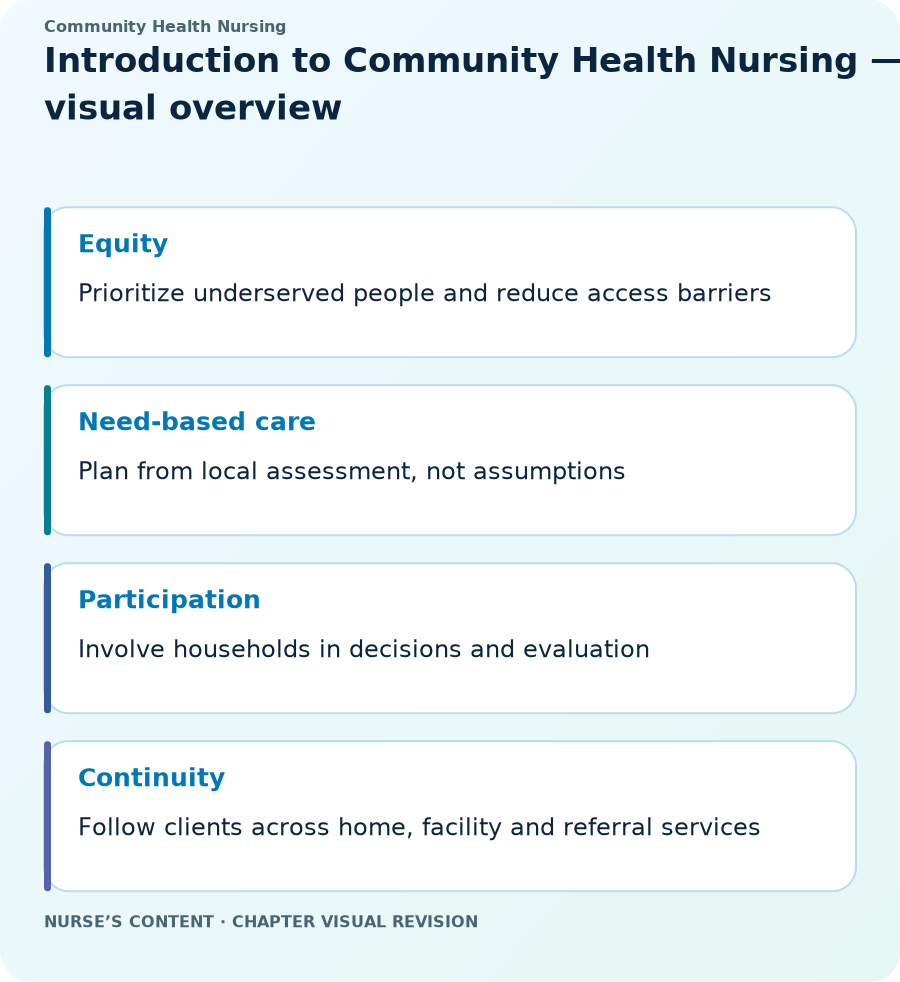
| Equity | Prioritize underserved people and reduce access barriers |
| Need-based care | Plan from local assessment, not assumptions |
| Participation | Involve households in decisions and evaluation |
| Continuity | Follow clients across home, facility and referral services |
| Evidence and safety | Use proven interventions and approved protocols |
| Intersectoral work | Coordinate health, education, water and nutrition sectors |
| Confidentiality | Protect individual information during community work |
4. Scope and functions
CHN covers home-based and primary care, immunisation, nutrition, sanitation, communicable disease surveillance, chronic disease screening, family welfare, occupational and school health, mental health, disability care, disaster response, health education, research and records. Services may be delivered at homes, outreach sessions, schools, workplaces or health facilities.
| Community nursing | Hospital nursing |
|---|---|
| Population and family focus | Mainly individual patient focus |
| Prevention and promotion central | Acute treatment and recovery often central |
| Community nursing | Hospital nursing |
|---|---|
| Homes, outreach and primary facilities | Wards and specialized facilities |
| Long-term follow-up and participation | Care during admission and transition |
Both require clinical skills, patient safety, ethics and communication.
5. Historical development
- • 1859: William Rathbone organized district nursing in Liverpool with Mary Robinson; Florence Nightingale supported district nurse training.
- • 1893: Lillian Wald and Mary Brewster began settlement-based nursing in New York; public health nursing developed around social conditions and access.
- • 1946: Bhore Committee advocated integrated preventive and curative services in India.
- • 1952: Community Development Programme strengthened rural development; India's national family planning programme began in the same year.
- • 1978: Alma-Ata emphasized primary health care; 2005: National Rural Health Mission (NRHM) strengthened rural services.
- • 2013: National Health Mission (NHM) brought rural and urban missions together; 2018: Ayushman Bharat expanded comprehensive primary care. Health and Wellness Centres are now commonly called Ayushman Arogya Mandirs.
6. Nursing process and practical application
Assess the community and household; identify health needs and strengths; prioritize with residents; set measurable objectives; implement education, clinical services and referral; evaluate coverage and outcomes. Example: in a village with missed vaccinations, prepare a due list, identify transport or information barriers, arrange outreach and confirm actual vaccine receipt rather than merely counting invitations.
7. Nursing responsibilities
Maintain family records; conduct respectful home visits; provide authorized services; coordinate with ANM, ASHA, CHO, medical officer, Anganwadi workers and local bodies; report unusual disease events; respect consent; evaluate the effect of interventions.
8. Community health nursing approaches
Population-based approach
The unit of concern is a defined population rather than only people who seek treatment. The nurse identifies the denominator (eligible households or people), measures coverage, and locates those who have not received services. For example, a vaccination register must be reconciled with births, migration and deaths so that missed children are not overlooked.
Family-centred and community-oriented approaches
Family-centred care evaluates the household's needs, strengths, resources and preferences. Community-oriented care considers shared problems such as unsafe drinking water, poor transport and limited access to medicines. The two approaches complement individual clinical care.
| Approach | Practical application |
|---|---|
| Promotive | Organize participatory nutrition education and link families to food resources. |
| Preventive | Identify unvaccinated children and offer appropriate services. |
| Curative | Support prescribed treatment and recognize complications. |
| Approach | Practical application |
|---|---|
| Rehabilitative | Help a person with stroke regain daily functioning and access assistive devices. |
| Palliative | Assess symptom burden and coordinate comfort-focused home care. |
9. Community practice example
A village has frequent diarrhoeal illness following monsoon rains. The nurse identifies affected households, assesses water sources, informs the surveillance team, teaches safe water handling and handwashing, facilitates clinical assessment and monitors recurrence. Improvement should be assessed through new illness reports and verified water-safety measures, not just attendance at education sessions.
10. Important Examination Questions
Long Answer Questions
- 1. Define CHN and discuss its philosophy, principles, scope and history.
- 2. Explain the community nursing process with a practical example.
- 3. Explain the relationship between individual, family and population-based nursing care.
- 4. Describe the role of a community nurse in a village with repeated diarrhoeal illness.
Short Answer Questions
- 1. Differentiate community and hospital nursing
- 2. explain equity, continuity and community participation
- 3. Principles of equitable service delivery.
- 4. Promotive and preventive care.
- 5. Community participation.
Very Short Answer Questions (with answers)
- 1. Alma-Ata year? 1978.
- 2. NHM? National Health Mission.
- 3. Core unit of family nursing? Family.
- 4. What is intersectoral coordination? — Joint action between health and other sectors.
- 5. What is continuity of care? — Coordinated follow-up across settings and time.
11. Quick Revision
- • Community nursing works with both well and ill people.
- • Family and community participation are essential.
- • Coverage requires a reliable eligible-population denominator.
- • Prevention, treatment, rehabilitation and palliative care form a continuum.
Conclusion
CHN = nursing + public health. Its focus is population health with person-centred care, prevention, equity and continuity. Community participation and coordination make interventions sustainable.
Chapter reference images