Community Health Nursing
Immunisation and Cold Chain
National Immunization Schedule, vaccines, types of immunity, routes of vaccine administration, cold chain equipment, vaccine storage, vaccine management, adverse events following immunisation and nursing responsibilities.
Open quizzes and study tools Download PDF
CHAPTER 14 / COMMUNITY HEALTH NURSING 14. Immunisation and Cold Chain
1. Definitions and immunity
Immunisation is the process of developing protection against a disease; vaccination administers a vaccine to induce immune responses. Innate immunity is present without prior exposure. Adaptive immunity includes active immunity (own immune response after infection or vaccination) and passive immunity (received antibodies, such as maternal antibodies or immunoglobulin). Passive protection is usually temporary; vaccines develop immunological memory to varying degrees.
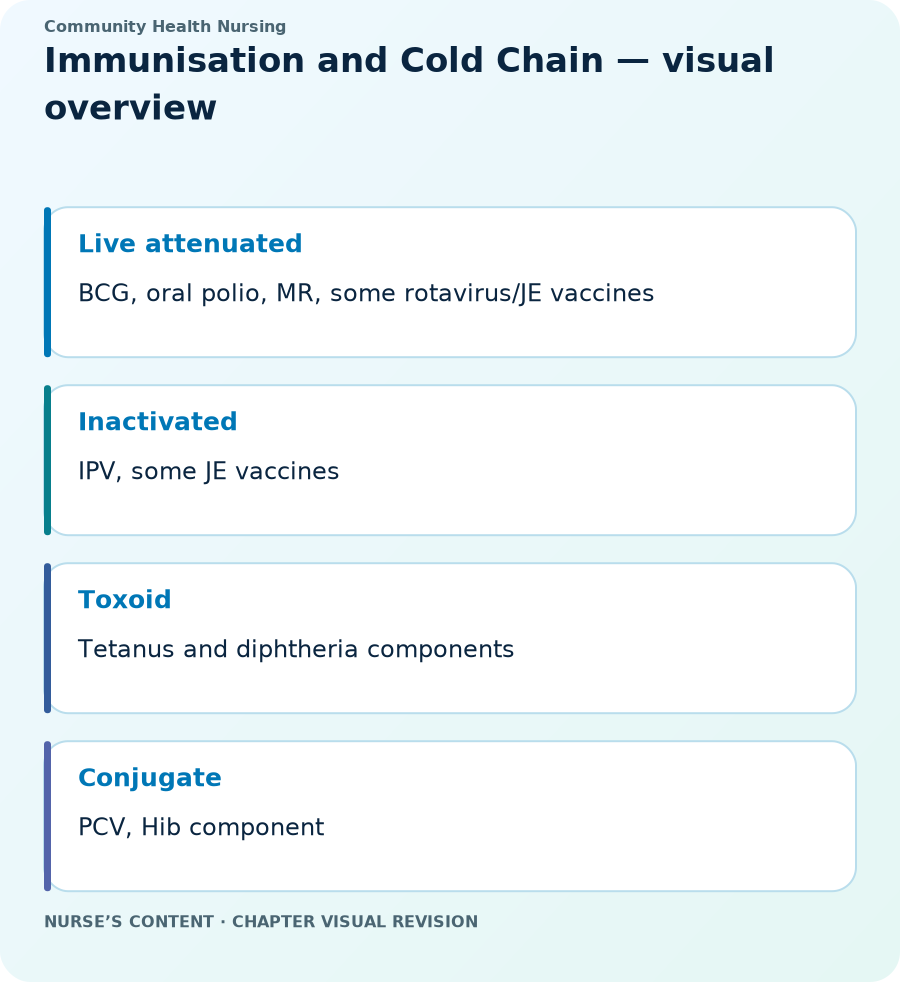
2. Types of vaccines
| Type | Examples |
|---|---|
| Live attenuated | BCG, oral polio, MR, some rotavirus/JE vaccines |
| Inactivated | IPV, some JE vaccines |
| Toxoid | Tetanus and diphtheria components |
| Recombinant/subunit | Hepatitis B, HPV |
| Conjugate | PCV, Hib component |
Pentavalent vaccine protects against diphtheria, pertussis, tetanus, hepatitis B and Hib disease. Live vaccines may be contraindicated in certain pregnancy or immunosuppression settings; check product and programme guidance.
3. National Immunization Schedule — India
The following age-based study table reflects the MoHFW routine immunisation manual and 2025–26 programme reporting. [20] Completed-month terminology: 9–11 completed months means from 9 months until the first birthday; 16–23 completed months means from 16 months until the second birthday. [8]
| Age | UIP vaccines and supplements |
|---|---|
| Birth | BCG, OPV-0, hepatitis B birth dose within 24 hours |
| 6 weeks | OPV-1, pentavalent-1, rotavirus-1, fIPV-1, PCV-1 |
| 10 weeks | OPV-2, pentavalent-2, rotavirus-2 |
| 14 weeks | OPV-3, pentavalent-3, rotavirus-3, fIPV-2, PCV-2 |
| 9–11 completed months | MR-1, PCV booster, fIPV-3, JE-1 where designated, vitamin A first dose |
| 16–23 completed months | MR-2, DPT booster-1, OPV booster, JE-2 where designated, vitamin A second dose |
| 5–6 years | DPT booster-2 |
| 10 and 16 years | Td |
| Pregnancy | Td-1 early in pregnancy; Td-2 at least 4 weeks later; booster if two appropriate doses received in pregnancy within previous 3 years |
Vitamin A is a supplement, not a vaccine: first dose 100,000 IU at 9 months; subsequent doses 200,000 IU per programme, with 6-month intervals after the second dose to age five (nine doses total). JE applies to designated endemic districts.
2026 HPV update: India's nationwide free voluntary single-dose HPV campaign for eligible 14-year-old girls began on 28 February 2026, using quadrivalent Gardasil-4 at designated government facilities. Confirm local session arrangements and current eligibility. [9]
4. Dose, route and site — routine UIP examples
| Product | Dose and route | Site |
|---|---|---|
| BCG | 0.05 mL ID up to 1 month; 0.1 mL thereafter up to 1 year | Left upper arm |
| OPV | 2 drops oral | Mouth |
| Hepatitis B birth | 0.5 mL IM | Left anterolateral thigh |
| Pentavalent | 0.5 mL IM | Left anterolateral thigh |
| Rotavirus | Oral; quantity depends on formulation | Mouth |
| fIPV | 0.1 mL ID | Right upper arm for doses 1/2; left for dose 3 |
| PCV | 0.5 mL IM | Right anterolateral thigh |
| MR | 0.5 mL SC | Right upper arm |
| JE | 0.5 mL; SC for live, IM for killed product | Product and dose-specific site |
| DPT booster | 0.5 mL IM | First: left thigh; second: left upper arm |
| Td | 0.5 mL IM | Upper arm |
Use official product-specific instructions and latest local job aid before administration. [8]
5. Cold chain system
Cold chain maintains vaccine potency from manufacture to administration. Most vaccines at service-level storage points are kept between +2°C and +8°C. Equipment includes walk-in coolers/freezers at appropriate levels, ice-lined refrigerators (ILRs), deep freezers used according to programme, cold boxes, vaccine carriers, temperature loggers and ice packs. Never freeze freeze-sensitive vaccines such as pentavalent, hepatitis B, PCV, IPV and Td/DPT. OPV may be stored frozen at designated higher levels; follow programme instructions.
6. Vaccine management and session safety
Check expiry, lot, vaccine vial monitor (VVM), storage history and integrity. VVM indicates cumulative heat exposure, not freezing. Use FEFO (first expiry, first out), correct diluent, appropriate reconstitution and separate sterile equipment. Follow open-vial policy only for eligible vaccines meeting all conditions; reconstituted BCG/MR and live JE must be discarded within the applicable time limit (typically four hours or session end, whichever comes first, under UIP). Never reuse syringes. Track temperature excursions; quarantine affected stock and consult cold chain supervisor before use.
7. AEFI and contraindications
An adverse event following immunisation (AEFI) is an untoward medical occurrence after vaccination, not necessarily caused by the vaccine. Mild local soreness or fever may occur. Anaphylaxis can present with airway swelling, respiratory difficulty or circulatory compromise; activate emergency response and administer IM adrenaline under approved protocol promptly. Observe beneficiaries for the recommended period (commonly 30 minutes), have an emergency kit, record events and notify serious AEFI immediately. Severe allergy to a previous dose/component is a major contraindication; minor illness alone is generally not a reason to delay.
8. Nursing responsibilities
Prepare due list and microplan; assess vaccine eligibility; obtain appropriate consent; verify identity, product, route and dose; educate about expected reactions, danger signs and next visit; record accurately in card/register/U-WIN; manage waste; track missed doses and coverage. Never restart an interrupted series unless specific guidance requires it.
9. Immunisation session microplanning
Prepare a reconciled beneficiary due list, calculate vaccine and supply needs, identify the session site, arrange trained staff, confirm cold chain and prepare emergency response resources. Include hard-to-reach households and previously missed children. Check actual vaccination records before assigning due doses; use current catch-up guidance rather than restarting a series automatically.
Vaccine handling checkpoints
| Check | Why it matters |
|---|---|
| Label, expiry and batch | Prevents incorrect product use and supports traceability. |
| Vaccine vial monitor | Indicates cumulative heat exposure; it does not detect freezing. |
| Cold-chain records | Identifies temperature excursions and potential potency loss. |
| Diluent and reconstitution | Correct product-specific preparation reduces errors. |
| Injection safety | Appropriate route, site, sterile single-use equipment and immediate sharps disposal. |
| Documentation | Records administration and next due dose. |
10. AEFI response and session close
Explain expected minor reactions and warning signs before the family leaves. Observe recipients for the period required by current UIP guidance. If anaphylaxis is suspected, activate emergency response immediately and provide protocol-directed treatment by trained staff. Document and report the event; an event occurring after vaccination is not automatically caused by the vaccine.
After the session reconcile doses and wastage, dispose of used articles safely, return eligible vaccine vials according to the open-vial policy, review cold-chain records and update due lists. Recheck missed beneficiaries. Do not discard or use suspected temperature-damaged stock without authorized assessment.
11. Important Examination Questions
Long Answer Questions
- 1. Explain NIS with doses/routes, cold chain and AEFI management.
- 2. Describe the preparation, conduct and evaluation of an immunisation session.
- 3. Explain cold-chain management and AEFI response.
Short Answer Questions
- 1. Active vs passive immunity
- 2. VVM
- 3. ILR
- 4. open vial policy
- 5. HPV campaign
- 6. Vaccine vial monitor.
- 7. Open-vial policy.
- 8. FEFO.
- 9. Catch-up vaccination.
Very Short Answer Questions (with answers)
- 1. fIPV third dose age? 9–11 completed months.
- 2. BCG route? Intradermal.
- 3. Typical ILR range? +2°C to +8°C.
- 4. Does VVM detect freezing? — No.
- 5. Does AEFI prove a causal vaccine reaction? — No.
12. Quick Revision
- • Read the National Immunization Schedule with its age and product-specific notes.
- • Most service-level vaccine storage is +2°C to +8°C.
- • Freeze-sensitive vaccines must not be frozen.
- • Vaccination safety includes emergency readiness and traceable records.
Conclusion
Timely vaccination plus safe storage, administration and follow-up protects communities.
Chapter reference images