Community Health Nursing
Health Planning and Management
Concepts of health planning, national health policies, health committees, health administration, management principles, budgeting, supervision, monitoring, evaluation and health services organisation.
Open quizzes and study tools Download PDF
CHAPTER 24 / COMMUNITY HEALTH NURSING 24. Health Planning and Management
1. Definition and objectives
Health planning is the systematic process of identifying needs, setting priorities, allocating resources, implementing actions and evaluating outcomes. Management coordinates people, funds, materials and information to achieve objectives efficiently, equitably and safely.
2. Health planning cycle
- 1. Analyze the situation and identify priority needs.
- 2. Set measurable objectives and indicators.
- 3. Assess resources and alternatives; select feasible strategies.
- 4. Prepare an action plan, responsibilities, timeline and budget.
- 5. Implement activities and coordinate partners.
- 6. Monitor progress, evaluate outcomes and revise the plan.
3. Important Indian health committees
| Committee (report/period) | Major contribution |
|---|---|
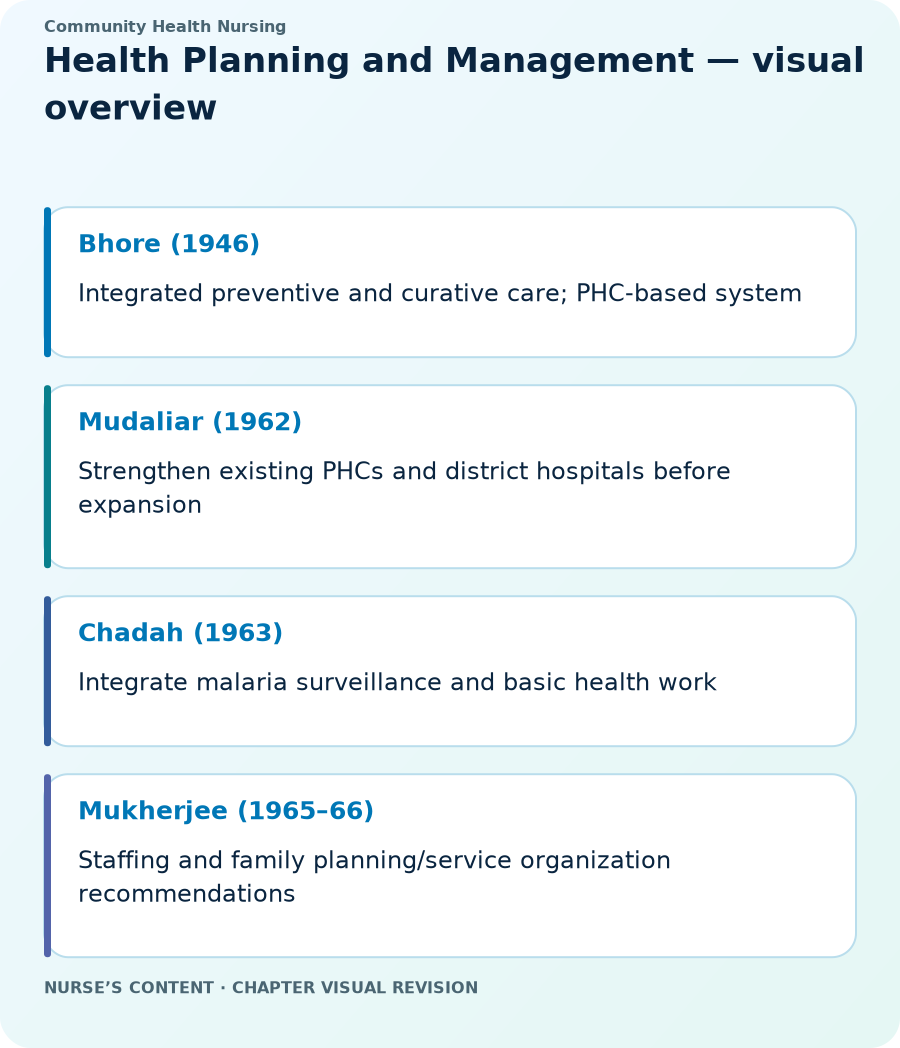
| Bhore (1946) | Integrated preventive and curative care; PHC-based system |
| Mudaliar (1962) | Strengthen existing PHCs and district hospitals before expansion |
| Chadah (1963) | Integrate malaria surveillance and basic health work |
| Mukherjee (1965–66) | Staffing and family planning/service organization recommendations |
| Jungalwalla (1967) | Integration of health services and unified cadre principles |
| Kartar Singh (1973) | Multipurpose health workers and supervisory arrangements |
| Srivastava (1975) | Community-level health workers and referral links |
| Bajaj (1986) | Health manpower planning and education |
These are historical recommendations, not the current legal staffing requirements.
4. National health policies and organisation
National Health Policy 1983 emphasized primary care; NHP 2002 addressed equity and communicable/noncommunicable disease needs; NHP 2017 emphasized preventive/promotive care, access, quality, financial protection and universal health coverage. NHM supports implementation with states. Central and state health authorities, district health administration and block/primary facilities coordinate programmes; local self-government and community committees support participation. Use current IPHS and state norms for actual staffing and services. [1,14]
5. Management principles and functions
Planning sets goals; organizing defines roles/resources; staffing recruits and deploys personnel; directing guides and motivates; coordinating integrates work; controlling compares actual performance with standards. POSDCORB is a traditional framework: planning, organizing, staffing, directing, coordinating, reporting and budgeting. Apply delegation with clear authority, competence and accountability.
6. Budgeting and material management
A budget estimates income and expenditure for a defined period. Common types: line-item, programme, performance and zero-based budgeting. Identify needs, estimate costs, prioritize, obtain approval, track actual spending and investigate variances. Inventory uses stock registers, FEFO for expiring supplies, physical verification, reorder planning and safe storage. Protect vaccine and emergency stocks against shortages and wastage.
7. Supervision, monitoring and evaluation
Supportive supervision uses observation, coaching, feedback and joint problem-solving. Monitoring tracks routine progress; evaluation assesses relevance, effectiveness, efficiency, equity and outcomes. Indicators: input (staff), process (sessions), output (people served), outcome (coverage/treatment completion), impact (population health). Use audits to improve services, not punish honest reporting.
8. Example management plan
Problem: missed immunisation in remote hamlets. Objective: improve verified age-appropriate coverage over a defined quarter. Actions: map households, arrange outreach, ensure cold chain, allocate team and transport, notify caregivers, track missed doses. Budget: transport, consumables and communication; monitoring: sessions held, stock-outs and coverage; evaluate with denominator-corrected records and feedback.
9. Nursing responsibilities
Participate in local planning, microplans, duty rosters, stock management, supervision, quality audits and referral coordination. Maintain professional accountability and escalate resource gaps.
10. Planning tools for community health services
A situation analysis identifies needs, existing resources and gaps. Set priorities based on burden, urgency, feasibility, equity and community preferences. Develop measurable objectives, choose strategies, assign responsibility and resources, implement and periodically review. A plan must specify who will do what, when and how results will be measured.
| Tool | Purpose |
|---|---|
| SWOT analysis | Identify strengths, weaknesses, opportunities and threats. |
| Work plan | List activities, deadlines, responsible staff and resources. |
| Budget | Estimate required expenditure and available funding. |
| Monitoring indicators | Track implementation and identify gaps. |
| Evaluation | Assess relevance, effectiveness and equity of outcomes. |
11. Example of microplanning and budgeting
A primary care team wants to improve hypertension follow-up in a remote locality. Identify registered patients who missed review, discuss travel barriers, plan an outreach or referral arrangement, allocate personnel, equipment and transport and set a review date. Estimate costs by multiplying required quantities by unit costs and adding necessary operating expenses; follow approved budgeting rules. Track people assessed, referred and completing review. If the target is not met, investigate the reason before blaming staff or patients.
Supportive supervision
Observe practice, compare against agreed standards, discuss challenges, provide constructive feedback and jointly plan improvements. Supervision emphasizes safety, learning and accountability rather than fault-finding alone.
12. Important Examination Questions
Long Answer Questions
- 1. Explain health planning cycle, Indian health committees and management functions.
- 2. Explain health planning and budgeting with a primary care example.
- 3. Describe health administration, supervision, monitoring and evaluation.
Short Answer Questions
- 1. Bhore Committee
- 2. NHP 2017
- 3. POSDCORB
- 4. supervision vs evaluation
- 5. budgeting
- 6. SWOT analysis.
- 7. Work plan.
- 8. Supportive supervision.
- 9. Input, output and outcome indicators.
Very Short Answer Questions (with answers)
- 1. Bhore report? 1946.
- 2. Multipurpose workers committee? Kartar Singh.
- 3. FEFO? First expiry, first out.
- 4. What does SWOT stand for? — Strengths, weaknesses, opportunities and threats.
- 5. What does evaluation assess? — The performance and results of an activity or programme.
13. Quick Revision
- • Planning starts with need assessment.
- • Use realistic objectives and clear responsibilities.
- • Budget for actual resources and constraints.
- • Monitoring guides improvement; evaluation assesses results.
Conclusion
Effective planning links community needs to feasible resources, measurable outcomes and continuous improvement.
Chapter reference images