Community Health Nursing
Health Education and Communication
Definition, principles, objectives and methods of health education, individual and group teaching, mass communication, audio-visual aids, behaviour change communication and evaluation of health education.
Open quizzes and study tools Download PDF
CHAPTER 18 / COMMUNITY HEALTH NURSING 18. Health Education and Communication
1. Definition and aims
Health education is a planned learning process enabling individuals and communities to understand health information and develop skills for informed decisions. Health promotion is broader and includes policies, supportive environments and community action. Education does not guarantee behaviour change when practical barriers remain.
2. Principles of health education
Begin with assessed needs and existing knowledge; use credible and accurate information, appropriate language, meaningful examples and active participation. Proceed from known to unknown and simple to complex. Use repetition, reinforcement and demonstration; respect culture and individual autonomy; evaluate understanding and outcomes. Avoid fear-based or stigmatizing messages.
3. Methods of health education
| Method | Examples | Strength |
|---|---|---|
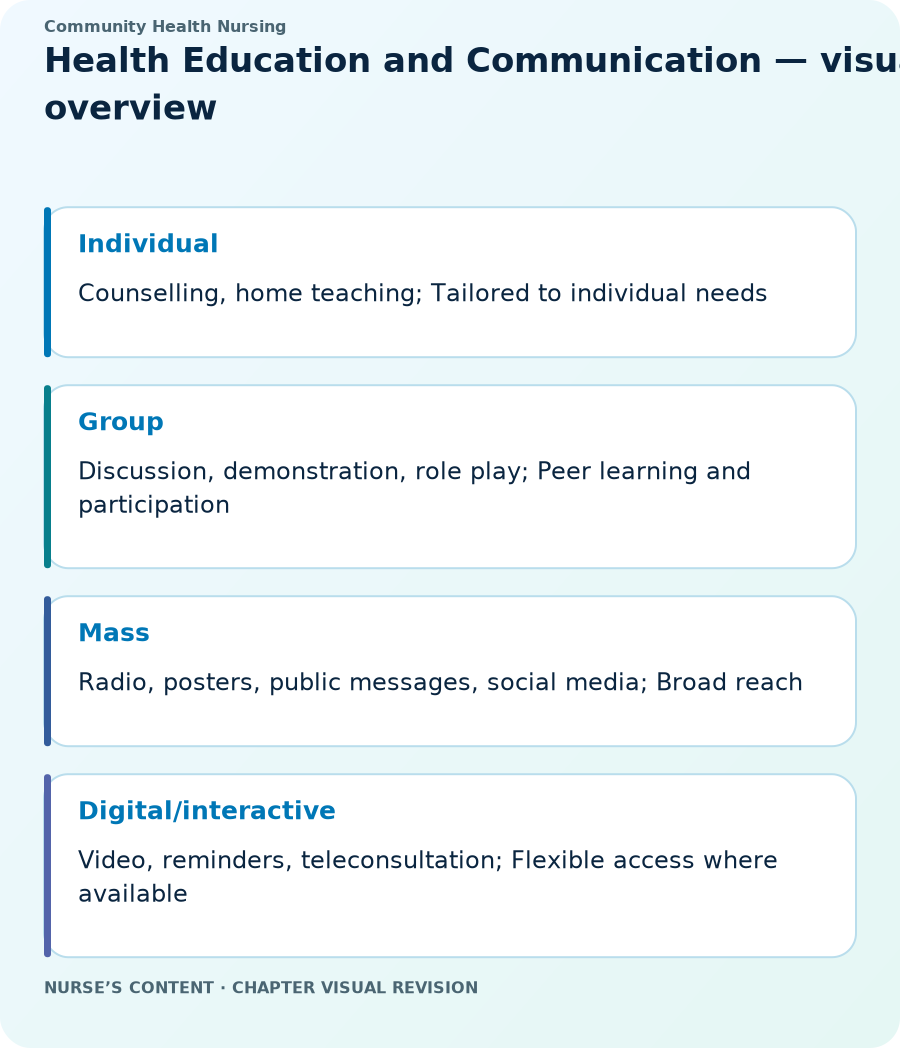
| Individual | Counselling, home teaching | Tailored to individual needs |
| Group | Discussion, demonstration, role play | Peer learning and participation |
| Mass | Radio, posters, public messages, social media | Broad reach |
| Digital/interactive | Video, reminders, teleconsultation | Flexible access where available |
Choose methods based on audience, literacy, language, accessibility, cost, objectives and opportunities for feedback.
4. Communication process and barriers
Sender → encoding → message → channel → receiver → decoding → feedback. Noise may interfere at any stage. Barriers include language, jargon, fear, low health literacy, hearing/vision impairment, misinformation, cultural differences and lack of privacy. Use simple language, qualified interpretation, accessible visual aids and teach-back.
5. Audio-visual aids
| Aid | Use |
|---|---|
| Poster/chart | Short messages and visual comparison |
| Flip chart/flashcards | Sequential small-group teaching |
| Models | Demonstration of anatomy or practical skills |
| Video/audio | Show procedures or illustrate events |
| Leaflet | Reinforcement and take-home reference |
Keep materials readable, accurate, uncluttered and appropriate for language and literacy. Demonstrate practical skills with supervised return demonstration.
6. Behaviour change communication
IEC (information, education and communication) builds understanding; BCC (behaviour change communication) focuses on targeted behaviour; SBCC (social and behaviour change communication) also addresses social norms and environmental barriers. Use audience segmentation, locally relevant messages, trusted messengers, feedback and access to services. Example: improve handwashing by teaching technique, ensuring soap/water availability and reinforcing at key times.
7. Planning a health education session
- 1. Assess audience needs and baseline knowledge.
- 2. Establish SMART learning objectives.
- 3. Select content, methods, materials and venue.
- 4. Deliver in understandable language with questions and participation.
- 5. Evaluate understanding through teach-back or demonstration.
- 6. Follow up and assess behaviour and health outcomes.
Example objective: by session end, caregivers demonstrate correct preparation of ORS using the exact water volume on the packet. Do not use a generic volume for every formulation.
8. Evaluation and nursing role
Process measures include attendance, delivery quality and reach; immediate outcomes include knowledge and demonstration; later outcomes include behaviour and health effects. Use pre/post questions carefully, recognizing they do not prove long-term behaviour change. Nurses plan, teach, counsel, advocate for resources, correct misinformation respectfully and adapt education based on feedback.
9. Teaching methods and selection of media
Select teaching methods according to objectives, language, literacy, available time and group size. A demonstration is useful for a practical skill; discussion helps explore beliefs and barriers; individual counselling supports confidential decisions; mass communication raises awareness but cannot ensure individual understanding.
| Method | Suitable use | Evaluation |
|---|---|---|
| Individual counselling | Medication or contraceptive decisions | Teach-back and follow-up |
| Group discussion | Exploring common barriers to healthy behaviour | Participation and agreed actions |
| Demonstration | Handwashing or other practical skills | Return demonstration |
| Posters and flipcharts | Visual reminders and structured teaching | Comprehension and recall |
| Radio or digital media | Reaching a larger population | Reach, feedback and behaviour indicators |
10. Sample community health education session
Topic: Prevention of diarrhoeal disease. Audience: Caregivers of young children. Objective: By the end of a short session, caregivers will identify two safe-water practices, demonstrate handwashing and explain when an unwell child needs urgent assessment. Begin by asking about existing practices; demonstrate using local resources; invite questions and return demonstration. Arrange follow-up to identify barriers such as limited water or soap. In a practical ORS demonstration, use the specified volume of safe water stated on the packet rather than an assumed standard volume.
Evaluation levels
Immediate evaluation assesses comprehension and demonstration. Later evaluation assesses adoption of feasible behaviours and service use. Population outcomes require longer observation and consideration of other influences. Counting participants is an output, not proof of behaviour change.
11. Important Examination Questions
Long Answer Questions
- 1. Define health education, explain principles, methods and steps of planning and evaluation.
- 2. Describe how to plan, conduct and evaluate a community health education session.
- 3. Compare individual, group and mass methods of health education.
Short Answer Questions
- 1. IEC vs BCC
- 2. AV aids
- 3. barriers
- 4. teach-back
- 5. Return demonstration.
- 6. Audio-visual aids.
- 7. Teach-back.
- 8. Behaviour change communication.
Very Short Answer Questions (with answers)
- 1. IEC? Information, education and communication.
- 2. Return demonstration? Learner performs taught skill.
- 3. SMART? Specific, measurable, achievable, relevant, time-bound.
- 4. Which method checks performance of a taught skill? — Return demonstration.
- 5. What is feedback? — Information about whether the message was received and understood.
12. Quick Revision
- • Use methods suited to audience and objectives.
- • Health education is a two-way process.
- • Evaluate understanding and practical behaviour separately.
- • Address barriers, not merely knowledge gaps.
Conclusion
Effective health education is participatory and linked to practical opportunities for healthier behaviour.
Chapter reference images