Community Health Nursing
Health and Disease
Concepts of health, illness and disease, dimensions of health, determinants of health, natural history of disease, epidemiological triad, levels of prevention and health–illness continuum.
Open quizzes and study tools Download PDF
CHAPTER 02 / COMMUNITY HEALTH NURSING 02. Health and Disease
1. Concepts and definitions
Health encompasses physical, mental and social well-being, not simply freedom from disease. Wellness is the active pursuit of well-being. Disease refers to pathological disturbance; illness is the person's experience of being unwell; sickness includes its social meaning. A patient may have a disease without symptoms or experience illness without an immediately identified disease.
2. Dimensions and determinants of health
| Dimension | Examples |
|---|---|
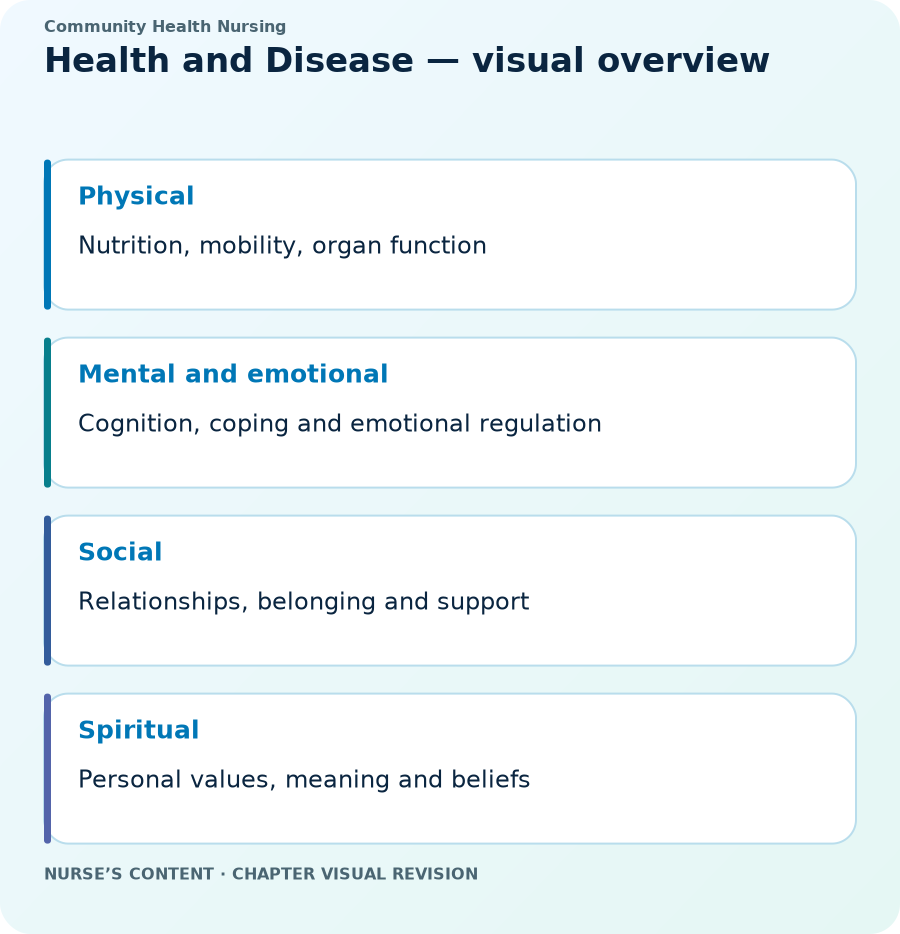
| Physical | Nutrition, mobility, organ function |
| Mental and emotional | Cognition, coping and emotional regulation |
| Social | Relationships, belonging and support |
| Spiritual | Personal values, meaning and beliefs |
| Occupational/environmental | Safe work, housing and surroundings |
Determinants include age and genetics, lifestyle, education, income, gender-related barriers, working conditions, food security, sanitation, housing, social support and accessible healthcare. Health inequalities are often rooted in unequal resources rather than individual choices alone.
3. Models of health
Biomedical model focuses on pathological causes; ecological model emphasizes interaction with the environment; psychosocial model includes stress and social circumstances; holistic/biopsychosocial model combines biological, psychological and social influences. Example: diabetes requires metabolic treatment plus attention to diet affordability, stress and access to follow-up.
4. Natural history of disease
Natural history describes the course of disease without intervention. Prepathogenesis occurs before disease begins, when host and environmental factors create susceptibility. Pathogenesis begins with biological changes, passes through a subclinical phase and may progress to symptoms, complications, disability, recovery or death.
Sequence: Susceptibility → exposure → subclinical disease → clinical disease → outcome. The incubation period is the interval between infection and symptoms; a latent period has different definitions depending on context (e.g., infection to infectiousness).
5. Epidemiological triad
| Component | Meaning and examples |
|---|---|
| Agent | Biological organism, chemical or physical exposure |
| Host | Susceptibility, immunity, age, nutrition, genetics |
| Environment | Climate, water, sanitation, crowding, vectors |
In malaria, Plasmodium is the agent, humans are hosts and Anopheles mosquitoes transmit infection in a suitable environment. Chronic diseases often require a multifactorial web of causation rather than one agent.
6. Levels of prevention
| Level | Aim | Example |
|---|---|---|
| Primordial | Prevent emergence of risk factors | Tobacco-free environments |
| Primary | Prevent disease onset | Vaccination, mosquito protection |
| Secondary | Early detection and treatment | BP screening with confirmation |
| Tertiary | Reduce impairment and complications | Stroke rehabilitation |
| Quaternary | Prevent unnecessary healthcare harm | Avoid unindicated antibiotics/tests |
Health promotion and specific protection are primary prevention; screening is secondary only when linked to confirmation and effective care.
7. Health–illness continuum
Well-being changes with time, resources and disease control. A person with a chronic illness can have good functioning and quality of life. The continuum is not a rigid linear score: assess the patient's physical function, symptoms, psychosocial needs and goals.
8. Clinical and community significance
Acute illness develops over a relatively short time; chronic illness persists. Communicable disease spreads through infectious agents; non-communicable disease is not transmitted between people in the usual infectious sense. Endemic describes expected ongoing occurrence, epidemic an excess above expectation, pandemic extensive international spread. Prevention must target both exposures and structural barriers.
9. Nursing importance
Assess risk, promote preventive behaviour, recognize warning signs, provide screening and treatment support, coordinate rehabilitation and monitor continuity. Evaluate whether care reaches people with the highest need rather than relying only on total service numbers.
10. Host resistance and disease causation
Susceptibility is influenced by prior immunity, nutrition, age, underlying disease and exposure. Risk factors increase the probability of disease but are not necessarily sufficient causes. A causal pathway may involve several interacting social and biological factors. The iceberg phenomenon describes how identified clinical cases can represent only a portion of all cases, because asymptomatic, undiagnosed or unreported disease may remain hidden.
| Concept | Example |
|---|---|
| Reservoir | Human or animal source in which an infectious agent normally lives. |
| Source of infection | Person, object or material from which a particular infection is acquired. |
| Carrier | Infected person who can transmit an agent, sometimes without symptoms. |
| Risk factor | Tobacco exposure increasing the likelihood of several chronic diseases. |
11. Application of prevention to one condition
For hypertension, primordial prevention includes creating supportive environments for active living and healthy foods. Primary prevention includes reducing excess salt intake and promoting physical activity. Secondary prevention includes measuring BP and confirming persistent abnormal readings. Tertiary prevention includes treatment adherence, complication prevention and rehabilitation after stroke. Quaternary prevention avoids unnecessary investigations or harmful overtreatment.
Nursing assessment
Do not classify a patient as healthy merely because no disease has been diagnosed. Assess function, symptoms, living conditions, access to care and the individual's priorities. Distinguish a screening finding from a confirmed diagnosis, and arrange appropriate follow-up.
12. Important Examination Questions
Long Answer Questions
- 1. Describe natural history of disease with levels of prevention.
- 2. Explain the epidemiological triad and determinants of health.
- 3. Explain the iceberg phenomenon and its significance in disease surveillance.
- 4. Apply levels of prevention to hypertension or diabetes mellitus.
Short Answer Questions
- 1. Dimensions of health
- 2. health–illness continuum
- 3. primordial prevention
- 4. disease versus illness
- 5. Agent, reservoir and source of infection.
- 6. Risk factor versus cause.
- 7. Subclinical disease.
Very Short Answer Questions (with answers)
- 1. Early detection? Secondary prevention.
- 2. Immunisation? Primary prevention.
- 3. Rehabilitation? Tertiary prevention.
- 4. What is a carrier? — A person harbouring an infectious agent who may transmit it.
- 5. Which prevention level prevents risk factors from emerging? — Primordial.
13. Quick Revision
- • Disease and illness are related but not identical.
- • Natural history describes disease progression without intervention.
- • The epidemiological triad consists of agent, host and environment.
- • Health promotion must address social and environmental determinants.
Conclusion
Health is multidimensional and dynamic; prevention can interrupt disease progression at multiple stages.
Chapter reference images