Community Health Nursing
Family Health Nursing
Concepts and functions of family, family health assessment, family health nursing process, home visits, family health records, family welfare and nursing responsibilities in family care.
Open quizzes and study tools Download PDF
CHAPTER 08 / COMMUNITY HEALTH NURSING 08. Family Health Nursing
1. Definition and concept of family
A family is a group connected by kinship, partnership, caregiving or shared commitments. Family health nursing provides holistic care to the family as a unit while respecting individual members' rights and preferences. The family can influence nutrition, illness recognition, adherence, emotional support and access to care.
2. Types and functions
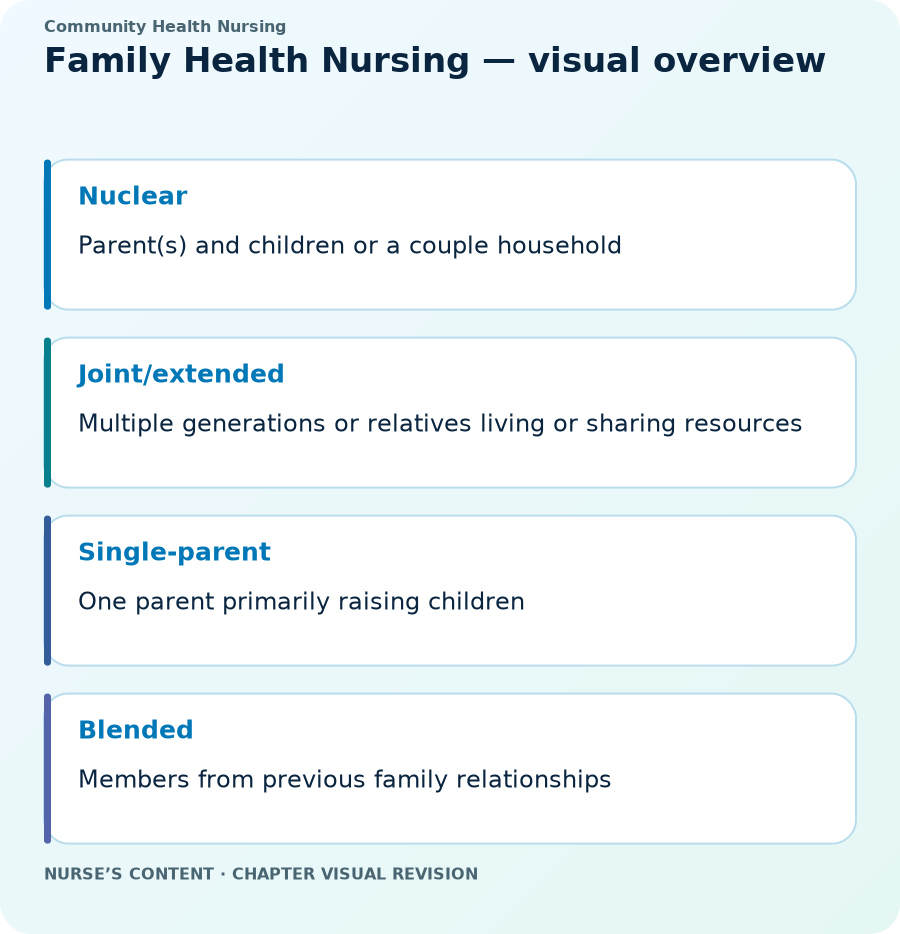
| Family type | Meaning |
|---|---|
| Nuclear | Parent(s) and children or a couple household |
| Joint/extended | Multiple generations or relatives living or sharing resources |
| Single-parent | One parent primarily raising children |
| Blended | Members from previous family relationships |
| Other household arrangements | Chosen family, caregiving or shared households |
Functions: reproduction and caregiving; socialization; emotional support; economic cooperation; protection; transmission of values; support during illness. Avoid assumptions about family decision-makers or capacity.
3. Family health assessment
Collect demographic and medical history, family structure, developmental stage, housing, sanitation, nutrition, immunisation, reproductive health, medicines, disability, mental health, caregiver burden, income, transport and social support. A genogram depicts family relationships and relevant health history; an ecomap depicts links with external resources. Assess strengths as well as problems.
4. Family nursing process
- 1. Assessment: verify household and individual needs with consent.
- 2. Diagnosis: identify actual and potential family health problems, not simply medical diagnoses.
- 3. Planning: prioritize severity, preventability, family preferences and resources; set SMART goals.
- 4. Implementation: education, home care, referrals, follow-up and coordination.
- 5. Evaluation: compare outcomes and revise the plan.
5. Sample family care plan
| Component | Example: child with incomplete immunisation |
|---|---|
| Assessment | Due doses documented; caregiver cannot reach facility during work hours |
| Nursing problem | Interrupted preventive care related to access barriers |
| Goal | Child receives eligible due doses within agreed follow-up period |
| Intervention | Verify schedule; arrange accessible session; counsel caregiver; send reminder with consent |
| Evaluation | Check vaccine record and next due date; review barriers if missed |
A single family may have several priorities; never impose a goal without consultation.
6. Home visits and family records
Home visits allow direct assessment of household conditions, continuity of treatment, newborn care, health education and support for people unable to travel. Plan visits, seek permission, protect privacy, use clean equipment and document findings. Family folders contain household details, risk assessments, services, referrals and follow-up; retain only necessary information under approved access controls.
7. Family welfare and nursing responsibilities
Family welfare supports voluntary contraception, healthy birth spacing, maternal and child care, reproductive health, nutrition and psychosocial well-being. Nurses provide non-directive counselling, identify safeguarding issues, educate on prevention, support chronic illness care and refer complex needs. Where family wishes conflict with an adult patient's informed choice, respect the individual's rights.
8. Family assessment tools and family life cycle
A genogram depicts family relationships across generations, while an ecomap shows links between a household and external resources such as school, employment, healthcare and social support. Use these tools only with consent, and avoid making assumptions from family structure.
Domains of family nursing assessment
| Domain | Information to assess |
|---|---|
| Structure | Household members, ages, caregiving arrangements and relationships. |
| Function | Decision-making, support, communication and division of responsibilities. |
| Development | Current life transitions, such as childbirth, adolescence or retirement. |
| Environment | Housing, sanitation, income constraints and transport access. |
| Health | Current conditions, immunisation, nutrition, treatment and risk factors. |
9. Example of a family nursing care plan
A household includes an older adult with hypertension who frequently misses follow-up because transport is difficult. Assessment identifies the access barrier, available family support and the patient's own goals. Plan a convenient follow-up, reconcile prescriptions with authorized staff, discuss home monitoring if appropriate, and coordinate local primary care. Evaluate actual follow-up attendance and documented BP review, not simply whether counselling was provided.
Prioritization of family problems
Consider urgency, potential for harm, ability to modify the problem, family preferences and available resources. Address immediate danger first; avoid imposing a professional goal that conflicts with a capable patient's informed decision.
10. Important Examination Questions
Long Answer Questions
- 1. Explain family assessment and family nursing process with a care plan.
- 2. Explain family assessment tools and their application to nursing care.
- 3. Develop a care plan for a household facing barriers to chronic disease follow-up.
Short Answer Questions
- 1. Types and functions of family
- 2. genogram and ecomap
- 3. family folder
- 4. family welfare
- 5. Genogram and ecomap.
- 6. Family nursing diagnosis.
- 7. Family life cycle.
Very Short Answer Questions (with answers)
- 1. Family relationship diagram? Genogram.
- 2. Measurable goal mnemonic? SMART.
- 3. Final nursing process step? Evaluation.
- 4. What is an ecomap? — Diagram of relationships with external support systems.
- 5. What is the first nursing-process step? — Assessment.
11. Quick Revision
- • The family is an important unit of community nursing.
- • Assess family structure, function, environment and health.
- • Goals should be agreed with the patient and family.
- • Evaluation measures actual outcomes.
Conclusion
Family-centred care strengthens household capacity and continuity while preserving autonomy.
Chapter reference images