Community Health Nursing
Environmental Health and Sanitation
Safe water supply, water purification, disposal of waste, sewage disposal, food sanitation, housing, ventilation, air pollution, noise pollution, vector control and environmental hygiene.
Open quizzes and study tools Download PDF
CHAPTER 10 / COMMUNITY HEALTH NURSING 10. Environmental Health and Sanitation
1. Definition and importance
Environmental health concerns physical, chemical, biological and social conditions that affect health. Sanitation is safe management of excreta, waste and hygiene conditions. Contaminated water, unsafe food, poor housing, air pollution and vectors contribute to preventable disease.
2. Safe water supply and purification
A safe water supply should be adequate, accessible and free from harmful microbial and chemical contamination. Sources include protected wells, piped supplies, treated surface water and rainwater systems. Protect catchments, prevent cross-connections and test water quality. E. coli should not be detectable in a 100 mL drinking-water sample under WHO guidance. [16]
Purification methods
| Method | Principle/limitation |
|---|---|
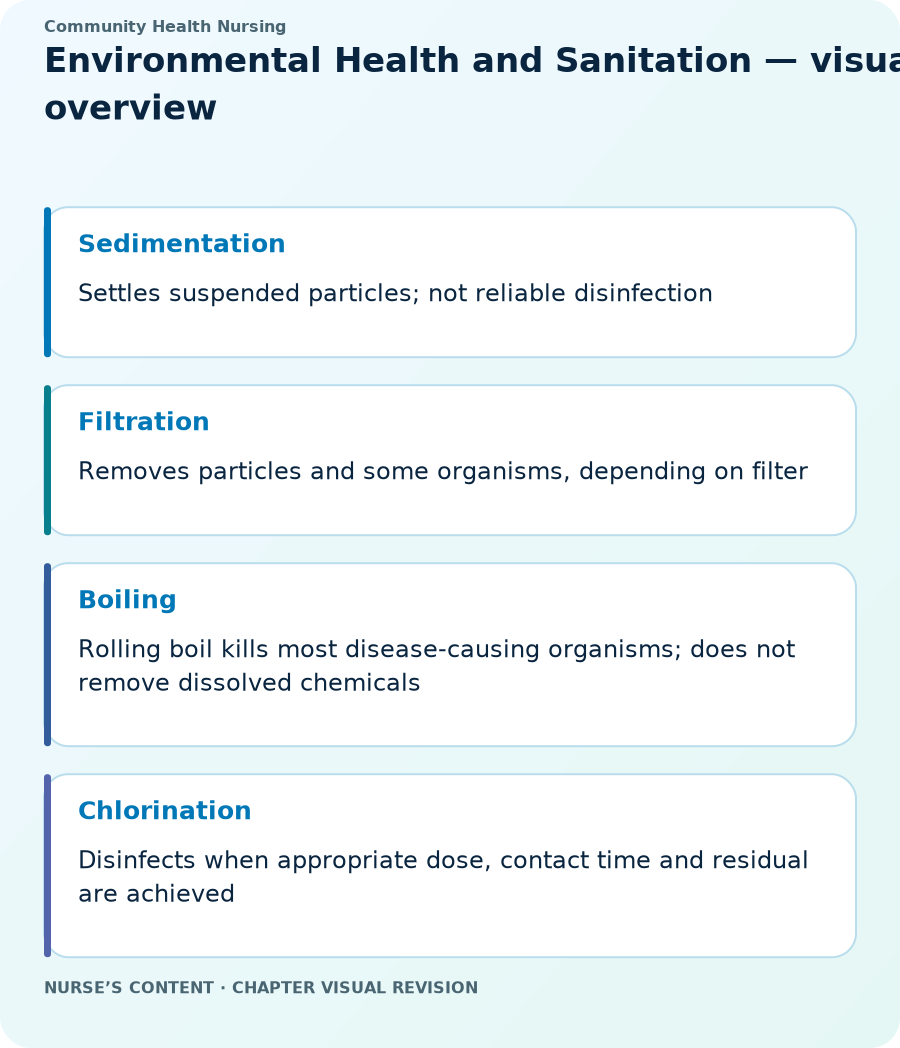
| Sedimentation | Settles suspended particles; not reliable disinfection |
| Filtration | Removes particles and some organisms, depending on filter |
| Boiling | Rolling boil kills most disease-causing organisms; does not remove dissolved chemicals |
| Chlorination | Disinfects when appropriate dose, contact time and residual are achieved |
| Reverse osmosis | Removes selected dissolved contaminants; maintenance required |
Chlorine dose depends on product, water quality and demand; use public health instructions rather than improvised dosing. Store treated water in clean covered containers and avoid dipping contaminated hands or cups.
3. Excreta and sewage disposal
Safe toilets, septic tanks with appropriate treatment, sewers and sewage treatment prevent faecal contamination. Sewage treatment typically includes screening, primary settling, biological secondary treatment and further treatment/disinfection when required. Avoid untreated discharge, unsafe manual cleaning and open defecation; arrange safe maintenance by trained services.
4. Solid and biomedical waste
Segregate organic, recyclable and residual waste according to local rules; compost suitable organic material and use authorized disposal. Healthcare waste must not enter household recycling. Indian biomedical colour categories: yellow for specified anatomical/soiled waste; red for contaminated recyclable plastics; white translucent for sharps; blue for designated contaminated glass and metal implants. Follow current biomedical waste rules and local collection arrangements.
5. Food sanitation
Keep hands, surfaces and utensils clean; separate raw and cooked food; cook thoroughly; maintain safe temperatures; use safe water and ingredients. Protect food from insects and rodents. Suspected foodborne outbreaks need notification, samples and investigation rather than indiscriminate antibiotics.
6. Housing, ventilation and pollution
Adequate ventilation, daylight, drainage, safe cooking fuel, structural safety and reduced overcrowding improve health. Air pollutants include particulate matter, smoke, carbon monoxide and gases. Reduce exposure through clean fuels, source control and ventilation; monitor air-quality advisories. Noise may cause hearing loss, sleep disruption and stress; reduce at source and use occupational protection when appropriate.
7. Vector and rodent control
| Vector | Prevention |
|---|---|
| Anopheles (malaria) | Insecticide-treated nets, spraying where indicated, larval source management |
| Aedes (dengue/chikungunya) | Weekly removal of standing water, covered tanks, daytime bite protection |
| Culex (filariasis/JE in relevant settings) | Environmental management, bite protection and programme measures |
| Flies | Food protection, waste removal and sanitation |
Integrated vector management combines environmental, biological, chemical and personal measures; avoid indiscriminate insecticide use.
8. Nursing importance
Assess water and sanitation, promote handwashing, educate on water storage and food safety, identify vector habitats, report contamination or clusters, coordinate local authorities and evaluate behavior and service improvements.
9. Water, sanitation and hygiene assessment
Assess water source, collection, transport, treatment, storage and household access. A safe source can become contaminated during collection or storage. Store treated water in a clean covered container, preferably with a safe dispensing method. Chlorination must follow an approved dose for the product, water quality and contact time; do not rely on a universal number of drops. Turbid water may need settling or filtration before disinfection.
| Environmental problem | Preventive action |
|---|---|
| Faecal contamination | Safe toilets, sewage management, handwashing and protected water sources. |
| Food contamination | Clean preparation, separation of raw and cooked food, thorough cooking and safe storage. |
| Mosquito breeding | Empty, cover and clean water containers; targeted vector control. |
| Indoor smoke | Clean cooking fuels and effective ventilation where available. |
| Noise exposure | Control noise at source, limit exposure and use suitable protection. |
10. Community sanitation survey
Walk through the locality with permission and residents' participation. Identify open drains, contaminated water points, waste accumulation, stagnant water and housing barriers. Prioritize hazards by probable health impact and feasibility. Coordinate repair or removal with local authorities and reassess the sites. Avoid blaming residents when sanitation infrastructure is inadequate.
Waste hierarchy
Prevent or reduce waste at source; reuse or recycle safe materials; treat and dispose of residual waste through authorized systems. Infectious healthcare waste must be segregated separately from general household waste.
11. Important Examination Questions
Long Answer Questions
- 1. Explain water purification, sewage disposal and environmental sanitation.
- 2. Discuss vector control.
- 3. Describe safe water handling from source to point of consumption.
- 4. Explain an environmental sanitation survey and corrective measures.
Short Answer Questions
- 1. Food hygiene
- 2. ventilation
- 3. air/noise pollution
- 4. biomedical segregation
- 5. Water storage safety.
- 6. Waste hierarchy.
- 7. Food cross-contamination.
- 8. Integrated vector management.
Very Short Answer Questions (with answers)
- 1. Aedes breeding prevention? Remove standing water.
- 2. E. coli drinking-water target? None detectable in 100 mL.
- 3. Sharps bin? White translucent.
- 4. What does WASH stand for? — Water, sanitation and hygiene.
- 5. Which mosquito commonly breeds in containers? — Aedes.
12. Quick Revision
- • Safe water requires safe collection, treatment and storage.
- • Sanitation breaks faecal-oral transmission.
- • Control vectors at breeding and exposure points.
- • Environmental problems require intersectoral action.
Conclusion
Environmental protection interrupts disease transmission and promotes sustainable community health.
Chapter reference images