Community Health Nursing
Disaster Management and Emergency Preparedness
Types of disasters, disaster management cycle, preparedness, mitigation, response, recovery, triage, emergency nursing, community participation and rehabilitation.
Open quizzes and study tools Download PDF
CHAPTER 22 / COMMUNITY HEALTH NURSING 22. Disaster Management and Emergency Preparedness
1. Definitions and classification
A disaster is a serious disruption that causes widespread losses or impacts exceeding affected communities' capacity to cope using their own resources. Hazard is a potentially harmful event or condition; vulnerability increases susceptibility; capacity refers to resources and abilities to reduce risk. Disaster risk arises from interaction of hazards, exposure, vulnerability and capacity.
| Type | Examples |
|---|---|
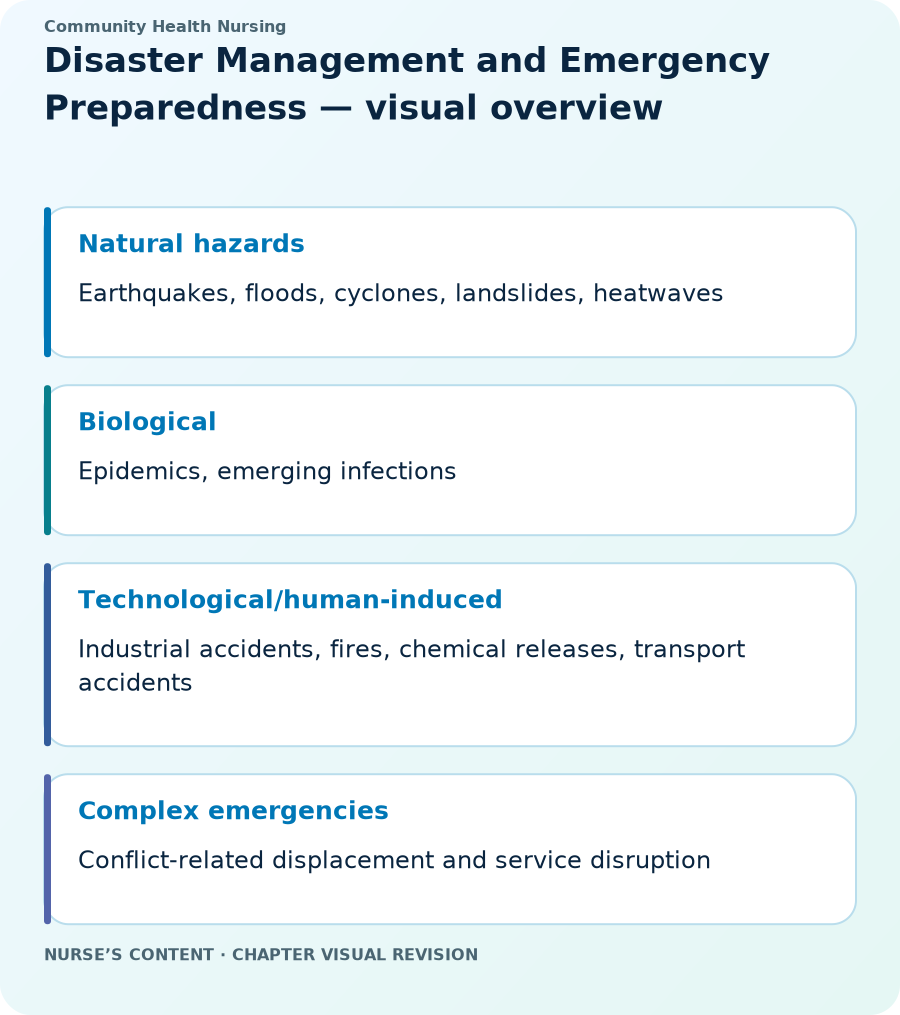
| Natural hazards | Earthquakes, floods, cyclones, landslides, heatwaves |
| Biological | Epidemics, emerging infections |
| Technological/human-induced | Industrial accidents, fires, chemical releases, transport accidents |
| Complex emergencies | Conflict-related displacement and service disruption |
2. Disaster management cycle
| Phase | Main actions |
|---|---|
| Mitigation/prevention | Hazard mapping, safer buildings, drainage, risk reduction |
| Preparedness | Emergency plans, drills, stockpiles, warning systems and training |
| Response | Search/rescue by trained teams, triage, emergency care, shelter and surveillance |
| Recovery | Restore services, rehabilitation, psychosocial care and safer reconstruction |
Phases overlap. Build-back-better principles aim to reduce future vulnerability during recovery.
3. Community emergency preparedness
Prepare hazard maps, vulnerable-person lists with protected access, evacuation routes, shelter plans, emergency contact lists and equipment inventories. Conduct drills and train staff in incident coordination, first aid and communication. Plans should include people with disabilities, pregnant women, children, older adults and patients dependent on essential medicines or equipment.
4. Triage and emergency care
Triage prioritizes patients based on urgency and available resources. Common mass-casualty systems use colour categories, but algorithms differ by agency and age group.
| Category | Common meaning |
|---|---|
| Red | Immediate life-threatening condition requiring priority care |
| Yellow | Delayed but significant injury/illness |
| Green | Minor injury; can often wait |
| Black/grey | Deceased or expectant according to the specific adopted system |
Use the locally adopted triage method (e.g., START or SALT when applicable), reassess regularly and do not use colour alone to determine definitive care. Scene safety is first. Assess airway, breathing, circulation, severe bleeding and neurological status; provide authorized lifesaving actions and arrange
transfer. Do not enter collapsed buildings, floodwater or contaminated zones without trained rescue support.
5. Public health measures in relief settings
Ensure safe water, sanitation, shelter, food safety, waste disposal, infection prevention and continuity of essential drugs and maternal/child care. Establish syndromic surveillance, rapid referral and vector control. Protect vulnerable residents from violence and exploitation; provide clear accessible risk messages and reunification support. Avoid inappropriate mass vaccination unless a public health assessment indicates it.
6. Indian disaster management structure
National Disaster Management Authority (NDMA) provides national direction; state and district authorities coordinate implementation. National Disaster Response Force (NDRF) undertakes specialized response. Health facilities maintain emergency plans and surge arrangements; nurses work under incident command and authorized roles. Follow current disaster management law and state plans. [13]
7. Nursing responsibilities
Participate in preparedness drills, inventory supplies, conduct assigned triage, provide first aid and safe transfer, maintain records, support infection prevention and family communication, assess psychosocial needs, monitor recovery and review lessons learned.
8. Community disaster risk assessment
Disaster risk depends on the hazard, exposure, vulnerability and capacity to respond. A flood-prone locality may have greater risk when homes are near rivers, evacuation routes are limited and residents need mobility assistance. Map vulnerable households, available shelters, safe routes, communication systems, health facilities and transport resources with local authorities.
| Preparedness activity | Practical purpose |
|---|---|
| Hazard map | Identify exposed locations and safe evacuation routes. |
| Emergency contact tree | Communicate warnings and coordinate response. |
| Stock and equipment plan | Ensure appropriate essential supplies and monitoring. |
| Training and drills | Practise safe evacuation, triage and communication. |
| Continuity plan | Maintain access to essential medicines, maternal care and referral. |
9. Relief camp nursing example
Following a flood, assess the safety of the site and immediate medical needs, support triage under the incident command system, identify people requiring urgent referral and establish a confidential registration and follow-up system. Coordinate safe water, sanitation, food hygiene, disease surveillance, maternal and child services, continuity of chronic treatment and psychosocial support. Monitor for clusters of diarrhoea and other relevant health threats and notify the public health team.
Triage principles
Triage prioritizes care according to urgency, available resources and applicable disaster protocol. Reassess patients as conditions and resources change. Do not rely solely on a single colour label; use the designated system and document changes. Protect responders from unsafe environments.
10. Important Examination Questions
Long Answer Questions
- 1. Explain disaster types, disaster cycle, triage and nursing responsibilities.
- 2. Explain disaster risk assessment, mitigation and preparedness at community level.
- 3. Describe nursing activities in a relief camp, including surveillance and triage.
Short Answer Questions
- 1. Mitigation vs preparedness
- 2. colour-coded triage
- 3. relief camp sanitation
- 4. recovery
- 5. Hazard versus vulnerability.
- 6. Disaster drills.
- 7. Reassessment during triage.
- 8. Continuity of essential health services.
Very Short Answer Questions (with answers)
- 1. Red triage? Immediate.
- 2. NDMA? National Disaster Management Authority.
- 3. NDRF? National Disaster Response Force.
- 4. What does mitigation aim to do? — Reduce disaster risk and potential harm.
- 5. Why reassess triage status? — Clinical condition and resources may change.
11. Quick Revision
- • Preparedness begins before disaster occurrence.
- • Responder and scene safety come first.
- • Triage is dynamic and protocol-based.
- • Recovery includes rehabilitation and restoration of essential services.
Conclusion
Preparedness, organized response, public health protection and equitable recovery reduce disaster-related harm.
Chapter reference images