Community Health Nursing
Community Health Nursing Records and Reports
Types of community health records, family folders, registers, home visit records, immunisation records, reports, health information systems, documentation and confidentiality.
Open quizzes and study tools Download PDF
CHAPTER 25 / COMMUNITY HEALTH NURSING 25. Community Health Nursing Records and Reports
1. Definitions and purposes
A record is a documented account of assessment, care, findings and follow-up; a report summarizes information for communication, surveillance, management or evaluation. Accurate records ensure continuity, accountability, programme monitoring, legal evidence and service improvement.
2. Types of records
| Record | Contents |
|---|---|
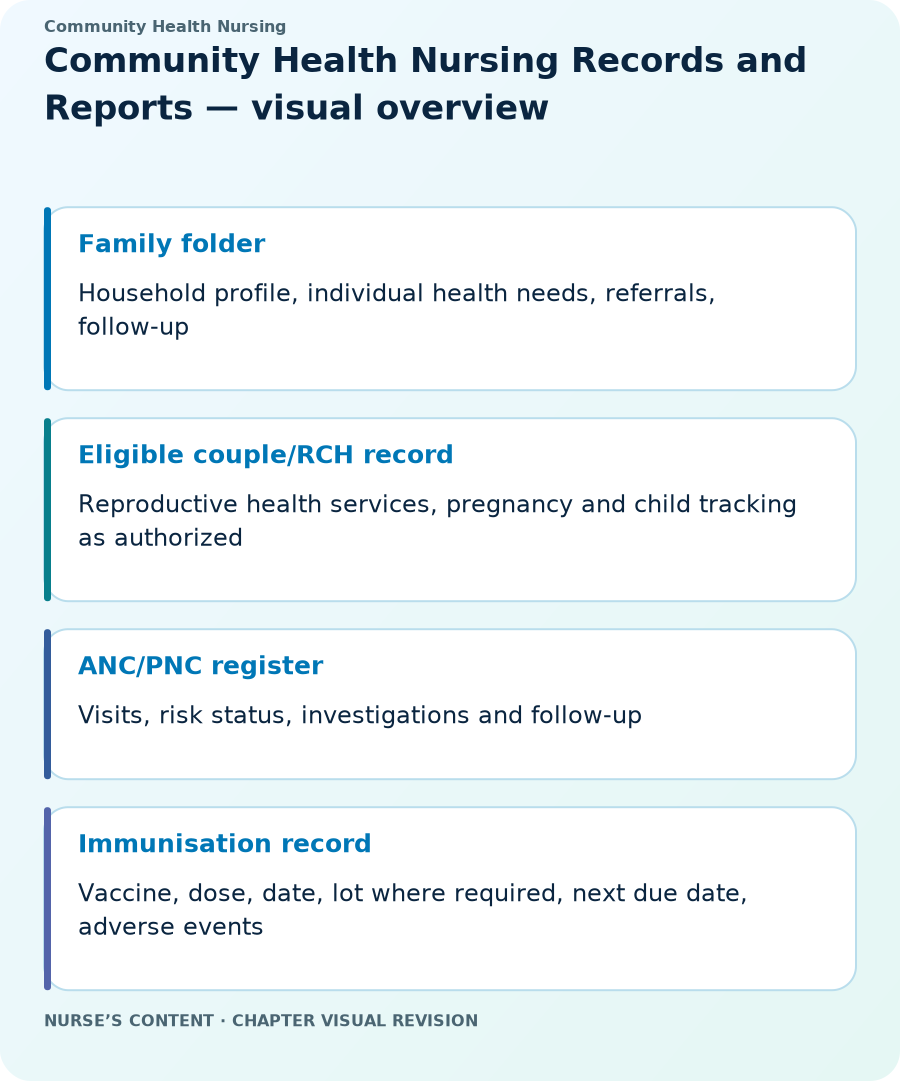
| Family folder | Household profile, individual health needs, referrals, follow-up |
| Eligible couple/RCH record | Reproductive health services, pregnancy and child tracking as authorized |
| ANC/PNC register | Visits, risk status, investigations and follow-up |
| Immunisation record | Vaccine, dose, date, lot where required, next due date, adverse events |
| Home visit record | Purpose, assessment, intervention and plan |
| Disease register/line list | Case definition, onset, clinical and laboratory status, follow-up |
| Stock/cold chain register | Receipts, issues, balance, expiry, temperature monitoring |
| Referral record | Reason, destination, urgency, clinical details and outcome |
3. Principles of documentation
Record promptly, accurately, legibly or digitally using approved fields. Include date/time, identity, objective findings, actions, communication, response and signature/designation as required. Distinguish observed facts from patient-reported information. Use approved abbreviations; correct errors transparently with audit trail, never erase or backdate. Document refusal, missed contact and unavailable services truthfully.
4. Reports and information flow
Routine daily/monthly reports summarize services, coverage, supplies, births/deaths and indicators. Immediate alerts report notifiable events, unusual clusters or serious safety concerns. Referral reports transfer patient-specific information securely. Reports should have a clear period, denominator, source and responsible person. Verify totals against registers and reconcile duplicate or missing entries.
5. Health information systems in India
| System | Purpose |
|---|---|
| HMIS | Aggregated routine service indicators and monitoring |
| RCH portal | Authorized tracking of reproductive and child health services |
| U-WIN | Digital routine immunisation records and due-service tracking |
| IDSP/IHIP | Disease surveillance and outbreak response |
| Ni-kshay | TB case tracking and programme support |
| National NCD portal | NCD screening, management and follow-up support |
Systems and fields may change. Use approved logins and follow state implementation; do not enter fabricated data to meet targets.
6. Confidentiality and ethical documentation
Collect minimum necessary information; explain why it is needed; restrict access to authorized personnel; protect devices, passwords and paper records; share identifiable data only for legitimate care or lawful reporting. Use de-identified information in teaching or public presentations. Do not post identifiable patient or household details on personal social media or informal messaging groups. Follow applicable retention and correction policies.
7. Example home visit entry (fictional)
Date/time: 15 June, 10:00. Purpose: vaccine follow-up. Assessment: caregiver reports inability to attend scheduled session; record confirms dose due. Action: explained eligibility and offered alternative session; caregiver agreed. Plan: verify vaccination at next visit. Signed: community nurse. This illustrates objective recording without unnecessary personal identifiers.
8. Nursing responsibilities
Maintain registers, review completeness, validate monthly reports, notify urgent events, protect confidential information, coordinate referral documentation and use data in planning and quality improvement.
9. Good documentation and data quality
Record accurate, timely, factual and complete information with date, time and responsible staff identification. Differentiate patient-reported history from measured findings and clinical judgments. Correct errors according to the approved paper or electronic system; never erase or falsify an original entry. Use standard programme definitions to avoid inconsistent reporting.
| Record | Key fields |
|---|---|
| Family folder | Household identifier, members, relevant needs and follow-up. |
| Immunisation register | Beneficiary identifier, date, product, dose and next due information. |
| Home visit record | Purpose, assessment, intervention, referral and next review. |
| Disease line list | Authorized case identifier, relevant times, location and status. |
| Stock register | Receipt, issue, balance, expiry and reconciliation. |
10. Reporting and reconciliation example
A nurse compares the vaccination session tally with individual vaccination records and the electronic report. Two entries have been duplicated. Reconcile using authorized identifiers, correct according to the system's audit procedure and document discrepancies. Submit verified totals, then follow missed beneficiaries. Do not use a public messaging group to transmit identifiable patient information unless a specifically authorized secure process permits it.
Confidentiality principles
Collect only necessary information, restrict access to authorized personnel and protect physical and digital records. Share only relevant information for care, legally required notification or another legitimate purpose. Public reports should ordinarily use aggregated or appropriately de-identified data.
11. Important Examination Questions
Long Answer Questions
- 1. Describe types, principles and uses of community health records and reports.
- 2. Describe community records, reporting procedures and data quality management.
- 3. Explain lawful, confidential handling of community health information.
Short Answer Questions
- 1. Family folder
- 2. home visit report
- 3. HMIS
- 4. confidentiality
- 5. disease line list
- 6. Family folder.
- 7. Due list.
- 8. Register reconciliation.
- 9. Electronic health records.
Very Short Answer Questions (with answers)
- 1. TB platform? Ni-kshay.
- 2. Immunisation platform? U-WIN.
- 3. Surveillance platform? IHIP.
- 4. What is a line list? — A structured list of individual cases and relevant variables.
- 5. Why avoid duplicate records? — They distort counts and follow-up.
12. Quick Revision
- • Record facts at the time of care whenever possible.
- • Maintain confidentiality and accurate identifiers.
- • Reconcile source registers and submitted reports.
- • Protect both paper and electronic records.
Conclusion
Reliable records turn community care into continuous, measurable and accountable services.
Chapter reference images