Community Health Nursing
Community Health Assessment
Concepts of community, types of communities, community diagnosis, community assessment, family assessment, community health needs, health indicators and community health surveys.
Open quizzes and study tools Download PDF
CHAPTER 04 / COMMUNITY HEALTH NURSING 04. Community Health Assessment
1. Definition and types of community
Community assessment is a systematic process of identifying population health conditions, determinants, resources, strengths and priorities. Communities may be geographical (village, ward), functional (workplace, school), interest-based or based on common needs (e.g., people living with diabetes).
2. Community diagnosis
Community diagnosis summarizes a population health problem with contributing factors and supporting evidence. Unlike a medical diagnosis of an individual, it identifies a group-level health need. Example: incomplete vaccination among children in Ward A related to missed outreach and migration, supported by a dated register review and household verification.
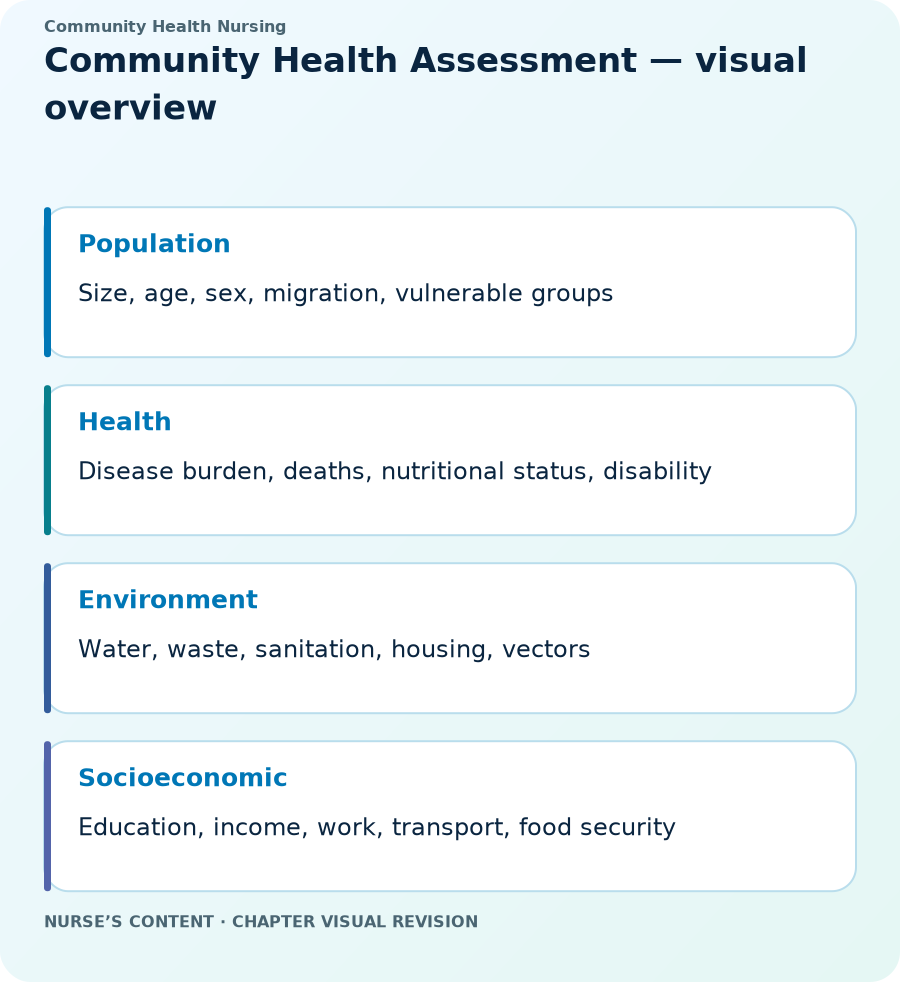
3. Components of community assessment
| Domain | Information to collect |
|---|---|
| Population | Size, age, sex, migration, vulnerable groups |
| Health | Disease burden, deaths, nutritional status, disability |
| Environment | Water, waste, sanitation, housing, vectors |
| Socioeconomic | Education, income, work, transport, food security |
| Services | Facilities, staff, medicines, referral access |
| Community assets | Local groups, volunteers, leaders, social support |
4. Methods and sources
Primary data: household survey, interview, observation, focus group, physical assessment, environmental walk-through. Secondary data: census, HMIS, SRS, NFHS, disease registers and local records. Use multiple sources to reduce error; routinely collected service data do not necessarily measure true disease prevalence.
5. Steps of community survey
- 1. Define geographical area, objectives, population and time period.
- 2. Seek administrative approvals and engage community representatives.
- 3. Choose census or sample approach; develop and pilot a questionnaire.
- 4. Train data collectors, obtain consent and protect privacy.
- 5. Collect and validate information; identify missing or duplicate records.
- 6. Tabulate indicators and map service gaps without exposing identifiable households.
- 7. Share findings and rank needs jointly; plan and evaluate interventions.
6. Family assessment
Assess family structure and relationships (genogram), social supports (ecomap), household environment, income and resources, health histories, pregnancy, child immunisation, nutrition, medications, disability and caregiving. Identify both risks and protective factors; include the family's own priorities.
7. Health indicators
| Indicator | What it measures |
|---|---|
| Incidence | New disease occurrence |
| Prevalence | Existing disease burden |
| IMR | Infant deaths per 1,000 live births |
| MMR | Maternal deaths per 100,000 live births |
| Immunisation coverage | Eligible people receiving a defined vaccine/dose |
| Service access | Geographic, financial and practical barriers |
8. Prioritization and action plan
Consider severity, magnitude, feasibility, community concern, prevention potential and equity. Example: 30 of 120 eligible children missed a dose: dose coverage is 75% if the other 90 received it. Establish a due list, identify reasons, plan outreach and measure verified vaccination coverage again.
9. Nursing responsibilities
Maintain accurate household records, obtain informed participation, avoid stigmatizing labels, document data dates and denominators, refer identified illness, work with local bodies and evaluate whether the intervention reduced the gap.
10. Tools for community assessment
Community mapping
Draw a resource map showing households, water points, roads, schools, health facilities, waste disposal sites and areas with access barriers. Use a separate confidential system for personally identifiable clinical information; never publish household diagnoses on an open map.
Community diagnosis statement
Describe the problem, population, supporting evidence and contributing factors. Example: low timely immunisation coverage among infants in a remote village, supported by reconciled due lists, with transport difficulty and missed outreach as potential contributors. Verify causes with caregivers before choosing interventions.
| Data collection method | Strength | Limitation |
|---|---|---|
| Household interview | Reveals needs and barriers | Recall and social desirability bias |
| Direct observation | Records visible environmental conditions | May not explain reasons |
| Focus group | Explores community perspectives | Not representative of all residents |
| Register review | Uses service and follow-up records | Missing or duplicate entries |
11. Worked assessment and evaluation
A survey identifies 120 eligible children; 90 have documentation of a scheduled vaccine. Verified coverage is 90/120 × 100 = 75%. Review the 30 children without recorded vaccination individually; some may have received a dose elsewhere. Create an updated due list and coordinate outreach. In the next review, compare coverage in the same defined population and period, accounting for new eligibility and migration.
12. Important Examination Questions
Long Answer Questions
- 1. Explain community assessment, diagnosis and survey steps.
- 2. Describe family assessment and health indicators.
- 3. Describe community diagnosis, resource mapping and prioritization with an example.
- 4. Explain methods of collecting and validating community health data.
Short Answer Questions
- 1. Primary vs secondary data
- 2. genogram
- 3. community assets
- 4. priority setting
- 5. Community mapping.
- 6. Focus group versus household interview.
- 7. Community diagnosis statement.
Very Short Answer Questions (with answers)
- 1. New cases? Incidence.
- 2. Existing cases? Prevalence.
- 3. Family relationship diagram? Genogram.
- 4. What is a denominator? — The population or quantity to which a measure refers.
- 5. What is a resource map? — A representation of community services and assets.
13. Quick Revision
- • Community assessment covers needs and strengths.
- • Use several data sources to verify findings.
- • Prioritize severity, magnitude, feasibility and community views.
- • Do not publish identifiable household health data.
Conclusion
Assessment is the basis of evidence-informed, locally relevant community care.
Chapter reference images