Child Health Nursing
Child Health Services and National Programmes
Integrated Management of Neonatal and Childhood Illness (IMNCI), Rashtriya Bal Swasthya Karyakram (RBSK), Universal Immunisation Programme (UIP), child health services, school health services and other relevant national programmes.
Open quizzes and study tools Download PDF
CHAPTER 24 / CHILD HEALTH NURSING 24. Child Health Services and National Programmes
1. India's child health continuum
NHM RMNCAH+N (reproductive, maternal, newborn, child, adolescent health and nutrition) connects antenatal, delivery, newborn, child and adolescent services. Care moves from community/Arogya Mandir/PHC to secondary and tertiary facilities depending acuity. ASHA, ANM, CHO, nurse and medical officer coordinate follow-up and referrals.
2. Key programmes
| Programme | Objective and nursing role |
|---|---|
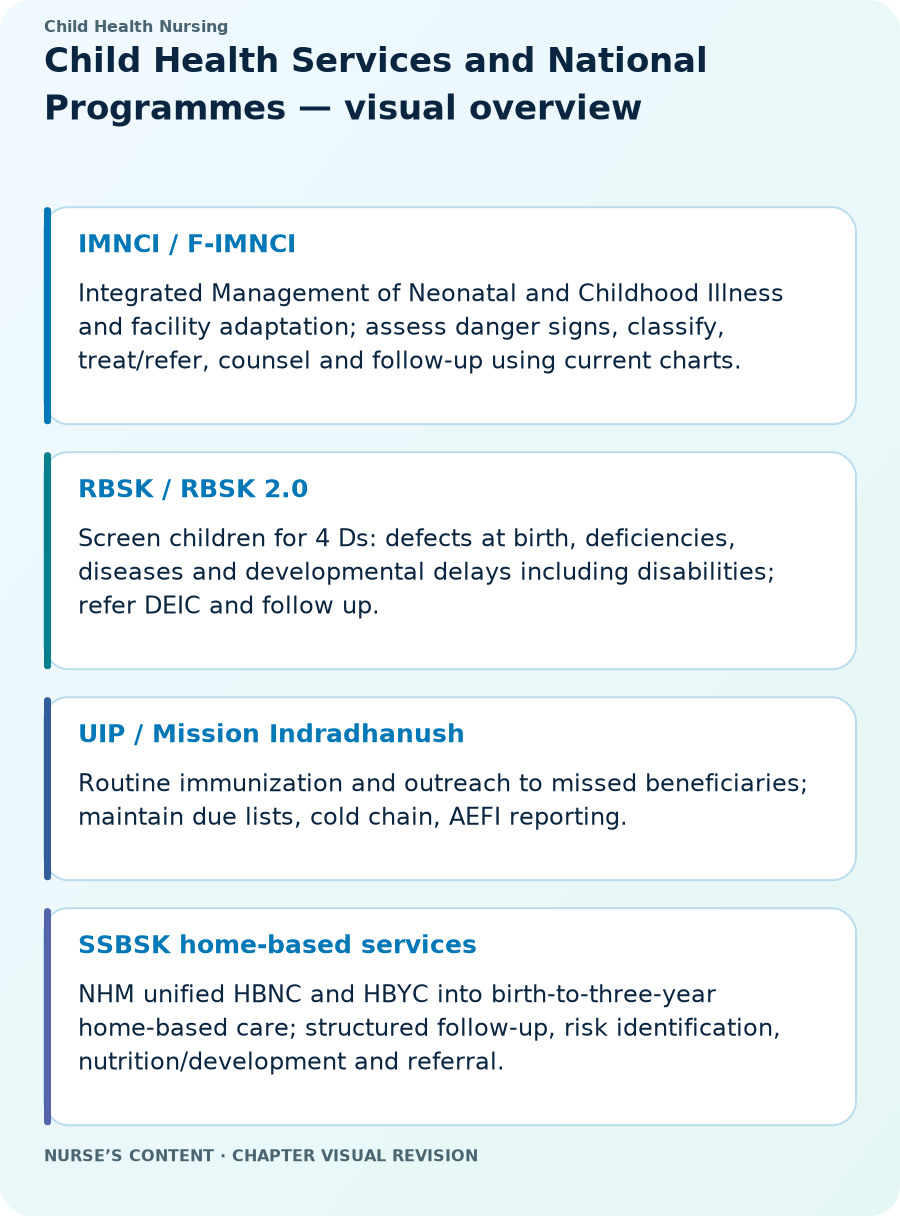
| IMNCI / F-IMNCI | Integrated Management of Neonatal and Childhood Illness and facility adaptation; assess danger signs, classify, treat/refer, counsel and follow-up using current charts. |
| RBSK / RBSK 2.0 | Screen children for 4 Ds: defects at birth, deficiencies, diseases and developmental delays including disabilities; refer DEIC and follow up. |
| UIP / Mission Indradhanush | Routine immunization and outreach to missed beneficiaries; maintain due lists, cold chain, AEFI reporting. |
| SSBSK home-based services | NHM unified HBNC and HBYC into birth-to-three-year home-based care; structured follow-up, risk identification, nutrition/development and referral. |
| Facility-based newborn care | NBCC at delivery points, NBSU for stabilization, SNCU for small/sick newborns; MNCU supports mother-newborn care. |
| Nutrition services | Anganwadi/POSHAN interventions, nutrition rehabilitation and growth monitoring; counsel and refer severe malnutrition. |
| School health / PM POSHAN | Screening/health promotion and eligible school meals; coordinate teachers and community teams. |
| RKSK | Adolescent health, nutrition, mental and reproductive health and life skills services. |
3. IMNCI clinical workflow
Assess general danger signs first (unable to drink/breastfeed, vomiting everything, convulsions, lethargy/unconsciousness in relevant age group). Assess cough/difficult breathing, diarrhoea, fever, ear problems, nutrition, anaemia and immunization. Young infants have separate signs/classifications. Classify severity using chart; pink urgent referral/admission, yellow specific treatment/counselling, green home care advice in commonly taught charts. Provide pre-referral care as authorized and ensure transport and feedback.
4. Nursing responsibilities
Maintain immunization records, growth charts, screening and referral registers, monitor coverage and missed visits, educate caregivers, support high-risk newborn follow-up and confidentiality. Verify current national and state implementation changes rather than relying on outdated textbook lists.
5. Important Examination Questions
Long Answer Questions
- 1. Explain IMNCI and RBSK with nursing roles.
Short Answer Questions
- 1. Describe SNCU and NBSU
- 2. discuss UIP
- 3. list four Ds.
Very Short Answer Questions (with answers)
- 1. What is SNCU? — Special Newborn Care Unit.
- 2. What does RBSK screen for? — Four Ds.
6. Quick Revision
- • Use age-specific IMNCI charts.
- • Screening needs referral and completion.
- • Programmes connect facility and community care.
7. Conclusion
Use age-specific IMNCI charts. Screening needs referral and completion. Programmes connect facility and community care.
Chapter reference images