Child Health Nursing
Paediatric Assessment and Nursing Process
Paediatric history taking, physical examination, anthropometric measurements, vital signs by age, pain assessment, nursing diagnosis, care planning, implementation and evaluation.
Open quizzes and study tools Download PDF
CHAPTER 23 / CHILD HEALTH NURSING 23. Paediatric Assessment and Nursing Process
1. History and examination
Record child identifiers, age, gestation/birth history, present complaint, nutrition, immunization, milestones, medicines/allergies, past illness, family/social history and safety. Observe general appearance and interaction; exam from least distressing to more invasive, allow parent holding when safe. Assess respiratory, cardiovascular, abdominal, neurological, skin and musculoskeletal findings.
2. Vital signs by age (illustrative resting clinical study ranges)
| Age | Heart rate/min | Respirations/min |
|---|---|---|
| Newborn | 100–160 | 30–60 |
| Infant | 100–160 | 30–50 |
| Toddler | 90–150 | 24–40 |
| Preschool | 80–140 | 22–34 |
| School age | 70–120 | 18–30 |
| Adolescent | 60–100 | 12–20 |
Ranges vary by source, state and illness; crying/fever affect values. Use institutional age-specific early warning charts. BP depends on age, height and sex for routine classification; correct cuff is essential. Pulse oximetry interpret with breathing/perfusion. Measure temperature using approved age-appropriate method.
3. Anthropometry and pain
Weight, recumbent length/height, head circumference, MUAC when indicated, BMI-for-age and serial growth trajectory. Use calibrated equipment and correct chart. Assess pain through child's report when possible, faces scales or validated behavioural tools (FLACC) and neonatal scale as appropriate. Assess nutrition and development together.
4. Nursing process example: child with diarrhoea
| Step | Illustrative entry |
|---|---|
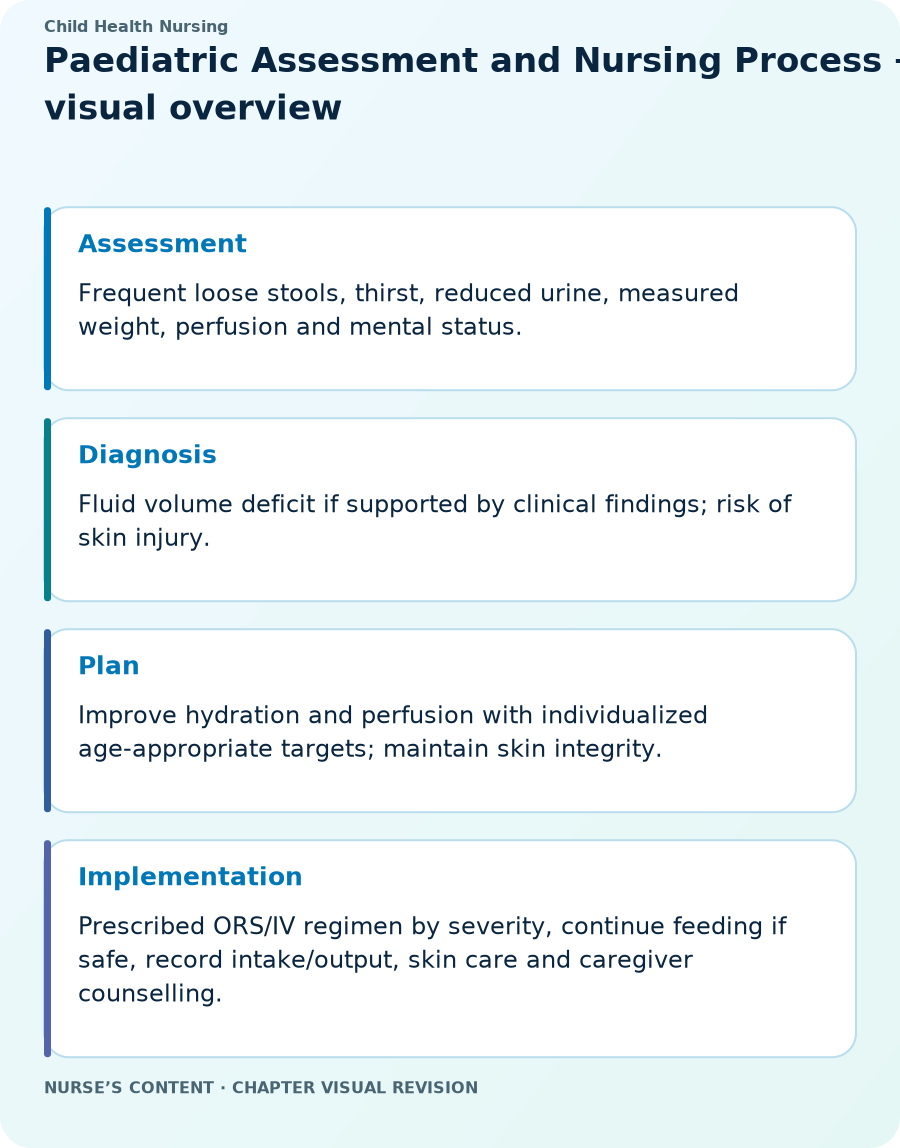
| Assessment | Frequent loose stools, thirst, reduced urine, measured weight, perfusion and mental status. |
| Diagnosis | Fluid volume deficit if supported by clinical findings; risk of skin injury. |
| Plan | Improve hydration and perfusion with individualized age-appropriate targets; maintain skin integrity. |
| Implementation | Prescribed ORS/IV regimen by severity, continue feeding if safe, record intake/output, skin care and caregiver counselling. |
| Evaluation | Reassess alertness, perfusion, urine, weight and ongoing losses; escalate deterioration. |
5. Documentation
Document observations, source, age, device/site, consent, objective findings, action/time/response and warning signs discussed. Use SBAR for handover and escalation; do not chart unobserved findings. Maintain confidentiality and safeguard child.
6. Important Examination Questions
Long Answer Questions
- 1. Describe paediatric history, examination and nursing process.
Short Answer Questions
- 1. Explain age-related vital signs
- 2. describe anthropometry
- 3. prepare dehydration care plan.
Very Short Answer Questions (with answers)
- 1. Why use age-specific vitals? — Physiological norms change with development.
- 2. What is ADPIE? — Assessment, diagnosis, planning, implementation, evaluation.
7. Quick Revision
- • Observe before touching.
- • Trends and context matter.
- • Nursing care is goal-oriented and family-centred.
8. Conclusion
Observe before touching. Trends and context matter. Nursing care is goal-oriented and family-centred.
Chapter reference images