Child Health Nursing
Paediatric Nursing Procedures
Medication administration, dosage calculation, paediatric fluid calculation, intravenous therapy, oxygen administration, nebulisation, nasogastric feeding, specimen collection and paediatric catheterisation.
Open quizzes and study tools Download PDF
CHAPTER 21 / CHILD HEALTH NURSING 21. Paediatric Nursing Procedures
1. Medication calculations
Use measured weight in kg, verify prescription basis (mg/kg/dose vs mg/kg/day), maximum dose, concentration, route, interval and renal/hepatic status. Independent check for high-alert drugs. Educational example: order 10 mg/kg/dose for 12 kg = 120 mg per dose; if liquid 100 mg/5 mL, volume = 6 mL. If 30 mg/kg/day divided three doses at 12 kg, total 360 mg/day = 120 mg each. These are arithmetic examples, not drug recommendations.
2. Maintenance fluid calculations (educational)
Traditional Holliday–Segar daily estimate: first 10 kg 100 mL/kg/day, next 10 kg 50 mL/kg/day, each kg above 20 kg 20 mL/kg/day. For 18 kg = 1000 + 400 = 1400 mL/day (~58.3 mL/h). The hourly 4–2–1 approximation gives 56 mL/h; do not mix calculations. Actual maintenance, deficits and ongoing losses are separate prescriptions; infants/neonates, DKA, malnutrition, renal/cardiac disease need special protocols. Many hospitalized children need isotonic maintenance fluid with individualized dextrose/potassium rather than routine hypotonic solutions.
3. Procedures and safety
| Procedure | Nursing essentials |
|---|---|
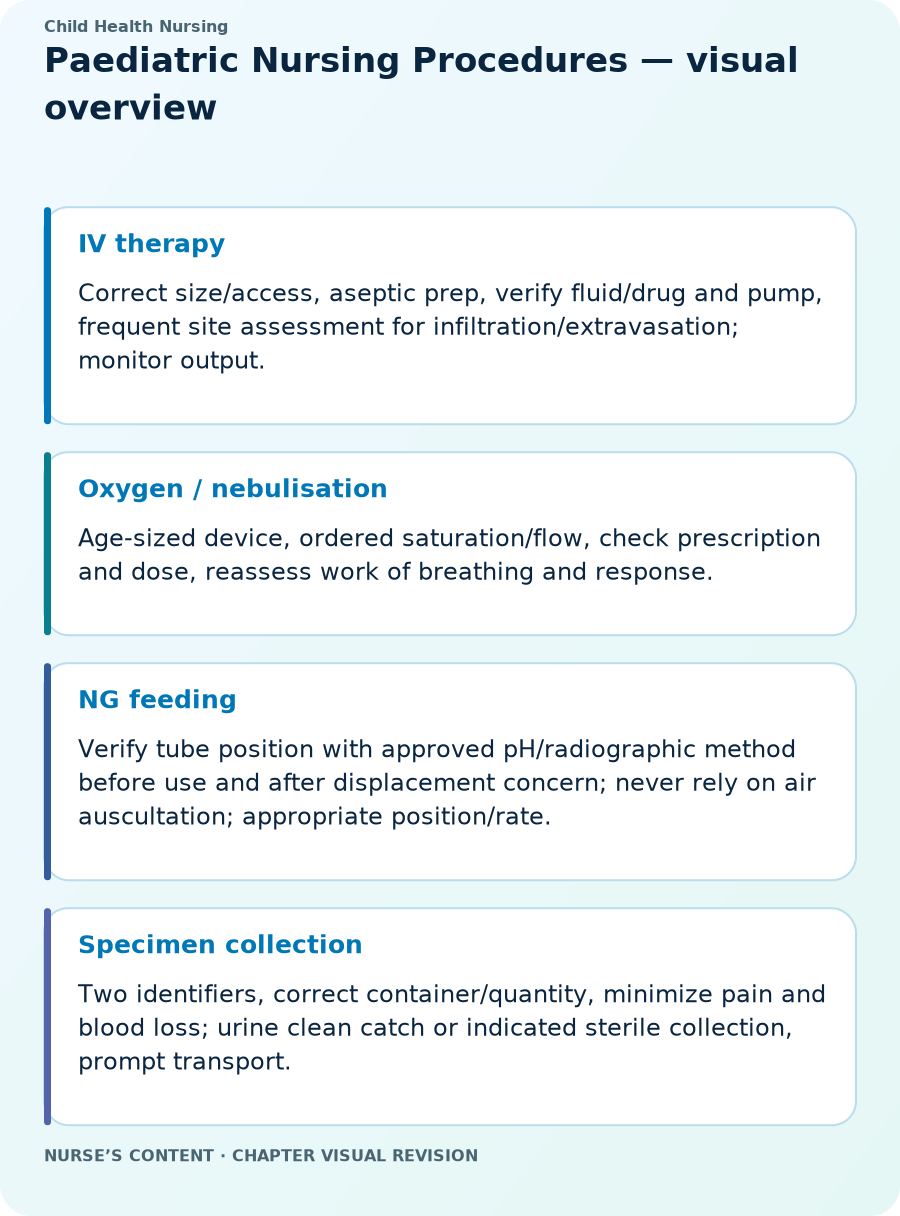
| IV therapy | Correct size/access, aseptic prep, verify fluid/drug and pump, frequent site assessment for infiltration/extravasation; monitor output. |
| Oxygen / nebulisation | Age-sized device, ordered saturation/flow, check prescription and dose, reassess work of breathing and response. |
| NG feeding | Verify tube position with approved pH/radiographic method before use and after displacement concern; never rely on air auscultation; appropriate position/rate. |
| Specimen collection | Two identifiers, correct container/quantity, minimize pain and blood loss; urine clean catch or indicated sterile collection, prompt transport. |
| Catheterisation | Only when indicated, trained technique, appropriate catheter, aseptic insertion, confirm placement before balloon inflation, closed drainage and early removal. |
| Medication administration | Use oral syringe for liquids, distinguish concentrations, verify IM/IV route and site, observe swallowing and adverse effects. |
4. Procedure sequence
Assess child, identify and explain with age-appropriate language, consent/assent, gather equipment, hand hygiene and comfort, perform under supervision, reassess, disposal and documentation. Offer caregiver support and analgesia/distraction. Do not restrain unnecessarily or use incorrect dosing spoons.
5. Important Examination Questions
Long Answer Questions
- 1. Explain paediatric dose and maintenance fluid calculations with examples.
Short Answer Questions
- 1. Describe NG feeding safety
- 2. explain IV therapy monitoring
- 3. list preparation steps.
Very Short Answer Questions (with answers)
- 1. How convert g to mg? — Multiply by 1000.
- 2. Is air auscultation reliable for NG position? — No.
6. Quick Revision
- • Weight in kg and dose units are critical.
- • Calculated maintenance is not a universal prescription.
- • Minimize procedure-related distress.
7. Conclusion
Weight in kg and dose units are critical. Calculated maintenance is not a universal prescription. Minimize procedure-related distress.
Chapter reference images