Child Health Nursing
Child with Special Needs
Care of physically challenged children, intellectually disabled children, children with sensory impairment, rehabilitation, early intervention and family support.
Open quizzes and study tools Download PDF
CHAPTER 20 / CHILD HEALTH NURSING 20. Child with Special Needs
1. Concepts and classifications
Children with disabilities or additional support needs may experience physical, intellectual, developmental, sensory, communication or multiple impairments. Functional limitations reflect both condition and environmental barriers. Respect individual language preferences and rights to education, health, participation and protection.
2. Assessment and family support
Assess ADLs, mobility, communication, pain, feeding/swallowing, hearing/vision, learning, participation, access, caregiver strain and strengths. Intellectual disability involves deficits in intellectual and adaptive functioning during development; assess conceptual, social and practical skills, not IQ alone. For physical disability support mobility and skin protection; for sensory impairment provide communication aids and accessible environments.
3. Rehabilitation and early intervention
| Team/resource | Role |
|---|---|
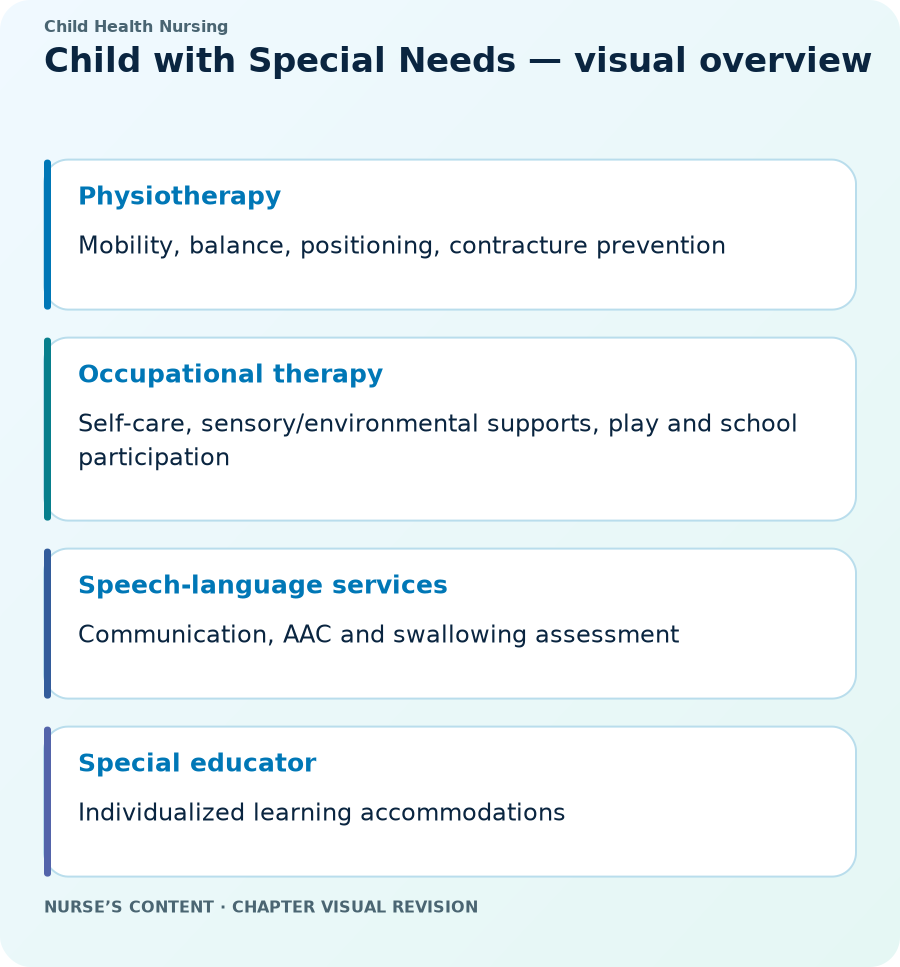
| Physiotherapy | Mobility, balance, positioning, contracture prevention |
| Occupational therapy | Self-care, sensory/environmental supports, play and school participation |
| Speech-language services | Communication, AAC and swallowing assessment |
| Special educator | Individualized learning accommodations |
| Social work / DEIC | Service linkage, benefits, family support and early intervention |
4. Nursing responsibilities
Develop shared functional goals with the child/family, provide safe feeding and medication education, assist equipment fitting and safe transfers with therapists, monitor skin and pain, coordinate respite and follow-up. Prevent isolation through inclusive play and schooling. Use simple accessible communication, ask preferences, avoid restraints for convenience, protect from abuse and neglect. Provide anticipatory guidance on puberty, sexuality and transition to adult care.
5. Example care plan
A child with cerebral palsy and feeding difficulty: assess swallowing and growth, refer to feeding specialist, provide prescribed texture and positioning, teach caregiver aspiration signs and monitor weight. Outcome: safe feeding with adequate intake and caregiver confidence, adapted to child's needs.
6. Important Examination Questions
Long Answer Questions
- 1. Explain rehabilitation and early intervention for children with disabilities.
Short Answer Questions
- 1. Describe adaptive functioning
- 2. explain family support
- 3. discuss inclusive nursing care.
Very Short Answer Questions (with answers)
- 1. What is AAC? — Augmentative and alternative communication.
- 2. What is DEIC? — District Early Intervention Centre.
7. Quick Revision
- • Function and participation matter.
- • Avoid assuming inability from disability.
- • Support the entire family.
8. Conclusion
Function and participation matter. Avoid assuming inability from disability. Support the entire family.
Chapter reference images