Child Health Nursing
Common Behavioural and Developmental Problems
Autism spectrum disorder, attention-deficit/hyperactivity disorder, learning disabilities, speech disorders, enuresis, behavioural problems and developmental delay.
Open quizzes and study tools Download PDF
CHAPTER 19 / CHILD HEALTH NURSING 19. Common Behavioural and Developmental Problems
1. Assessment principles
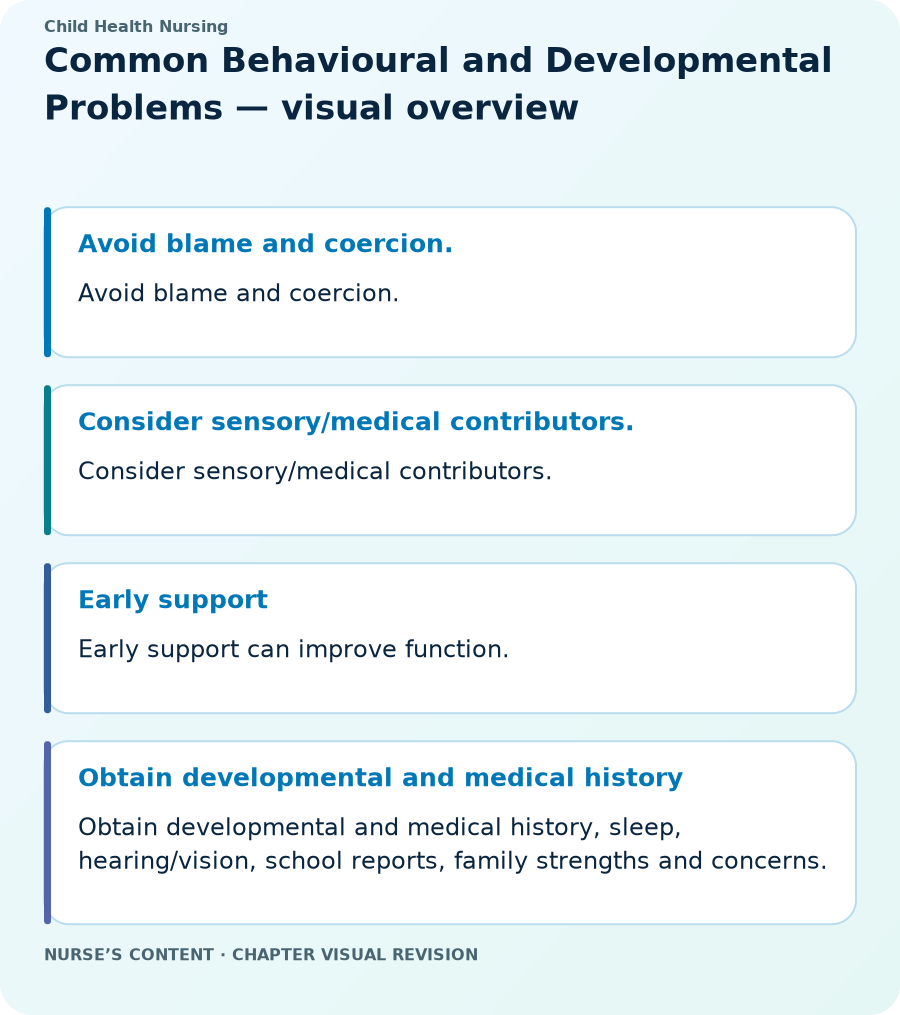
Obtain developmental and medical history, sleep, hearing/vision, school reports, family strengths and concerns. Use validated screening suited to age, language and culture; screening is not diagnosis. Rule out medical, sensory, learning and environmental contributors. Respect child and caregiver preferences.
Autism spectrum disorder
Definition and pathophysiology: Neurodevelopmental condition involving social communication differences and restricted/repetitive patterns or sensory differences.
Clinical features and investigations: Variable language, play, sensory responses and routines; specialist developmental assessment.
Management and nursing care: Early individualized communication/occupational support, predictable environment, sensory accommodations, advocate inclusion; avoid claiming cure or forcing eye contact.
ADHD
Definition and pathophysiology: Persistent developmentally inappropriate inattention and/or hyperactivity-impulsivity with impairment across settings.
Clinical features and investigations: Difficulty sustaining attention, impulsivity, excessive activity; history from multiple settings, assess alternative causes.
Management and nursing care: Parent/school behavioural support, routines, environmental adaptation; prescribed medication when appropriate, monitor appetite, growth, sleep, BP and response.
Learning and speech disorders
Definition and pathophysiology: Specific difficulties in academic skills or language despite opportunities; speech/language issues may have varied causes.
Clinical features and investigations: Reading, writing, mathematics or expressive/receptive difficulties; hearing and specialist assessment.
Management and nursing care: Refer early, individualized education, speech-language support, accessible instructions and psychological support; avoid labelling child lazy.
Enuresis
Definition and pathophysiology: Intermittent urinary incontinence during sleep at developmental age when dryness expected (commonly ≥5 years).
Clinical features and investigations: Primary or secondary; assess daytime symptoms, constipation, UTI, diabetes and stress.
Management and nursing care: Nonpunitive education, toileting routine, manage constipation, alarm or prescribed desmopressin for appropriate cases with fluid-safety instructions.
Behavioural problems and developmental delay
Definition and pathophysiology: Behaviour may reflect stress, neurodevelopment, sleep or unmet needs; delays affect motor, language, cognition/social domains.
Clinical features and investigations: Persistent impairment, delayed skills or regression; screen and evaluate medical causes.
Management and nursing care: Strength-based positive strategies, safe environment, caregiver coaching, early intervention and safeguarding. Sudden regression requires evaluation.
2. Nursing management
Listen to caregivers and child, document observable behaviour, adapt environment, reinforce desired skills, coordinate multidisciplinary services and school plans. Assess self-harm, abuse or serious safety concerns and refer urgently when indicated.
3. Important Examination Questions
Long Answer Questions
- 1. Discuss autism, ADHD and developmental delay with nursing management.
Short Answer Questions
- 1. Explain learning disorder
- 2. describe enuresis
- 3. list developmental assessment domains.
Very Short Answer Questions (with answers)
- 1. Is screening a diagnosis? — No.
- 2. Is loss of skills a warning sign? — Yes.
4. Quick Revision
- • Avoid blame and coercion.
- • Consider sensory/medical contributors.
- • Early support can improve function.
5. Conclusion
Avoid blame and coercion. Consider sensory/medical contributors. Early support can improve function.
Chapter reference images