Child Health Nursing
Paediatric Emergencies
Paediatric basic life support, shock, seizures, poisoning, burns, drowning, choking, trauma, respiratory failure and emergency nursing management.
Open quizzes and study tools Download PDF
CHAPTER 18 / CHILD HEALTH NURSING 18. Paediatric Emergencies
1. Initial assessment and paediatric BLS
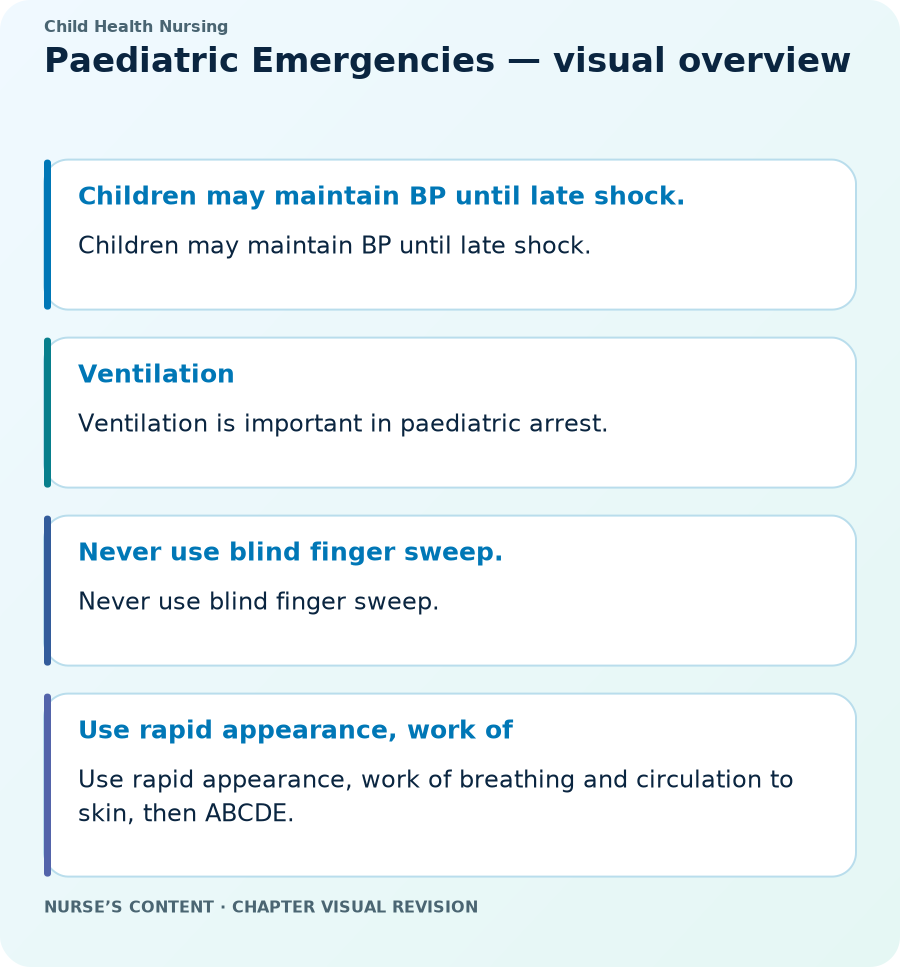
Use rapid appearance, work of breathing and circulation to skin, then ABCDE. Ensure scene safety, call emergency team, check response/breathing and pulse together for trained providers ≤10 s. If pulseless or HR <60/min with poor perfusion despite adequate oxygenation/ventilation, begin CPR per paediatric protocol. Compress 100–120/min, depth at least one-third AP chest (about 4 cm infant, 5 cm child), full recoil. Single rescuer 30:2, two trained rescuers 15:2 without advanced airway; use AED with paediatric attenuation if available. 2025 AHA guidance for infants uses one-hand or two-thumb encircling techniques rather than two-finger compressions. Newborn-at-birth algorithm differs.
Shock and sepsis
Definition and pathophysiology: Inadequate perfusion from hypovolaemia, distributive, cardiac or obstructive causes; infection may cause organ dysfunction.
Clinical features and investigations: Tachycardia, delayed refill, cool/mottled skin or warm shock, altered mental state, reduced urine; hypotension often late.
Management and nursing care: Urgent ABCDE, IV/IO access by trained team, cause- and setting-specific fluids with reassessment, prescribed antimicrobials/vasoactive support; cardiac disease/malnutrition require special protocols.
Seizures
Definition and pathophysiology: Abnormal electrical cerebral activity; fever, epilepsy, infection or metabolic causes.
Clinical features and investigations: Altered awareness or movements; check duration, glucose and breathing.
Management and nursing care: Protect child, no restraint or objects in mouth, urgent rescue medication/assessment for ≥5 min or recurrent without recovery. Provide oxygen/ventilatory support as indicated.
Poisoning
Definition and pathophysiology: Accidental or intentional toxic exposure.
Clinical features and investigations: Assess substance/time, consciousness, pupils, respiratory pattern, glucose and ECG as indicated.
Management and nursing care: Call poison/emergency service, ABCDE, remove exposure safely, antidote when indicated. Do not induce vomiting or give food/drink routinely; safeguarding assessment.
Burns and trauma
Definition and pathophysiology: Thermal or physical injury, possible occult internal injury.
Clinical features and investigations: Assess airway, bleeding, perfusion, pain, head/spine mechanism.
Management and nursing care: Control bleeding, immobilize when indicated, prevent hypothermia; cool thermal burns as appropriate, cover, specialist referral. Use weight/age-specific resuscitation.
Drowning
Definition and pathophysiology: Respiratory impairment from immersion/submersion.
Clinical features and investigations: Hypoxia, apnoea, altered consciousness, hypothermia.
Management and nursing care: Safe rescue, immediate emergency activation and rescue breaths/CPR as trained; ventilation essential; assess after significant symptoms or resuscitation. Do not attempt to drain water by abdominal thrusts.
Choking and respiratory failure
Definition and pathophysiology: Foreign body or disease compromises airway/ventilation.
Clinical features and investigations: Ineffective cough, inability to cry/speak, distress, cyanosis; fatigue or altered consciousness.
Management and nursing care: Effective cough encouraged. Severe obstruction: 5 back blows alternating with 5 chest thrusts in infant; 5 back blows alternating with 5 abdominal thrusts in child (2025 AHA). If unresponsive start CPR and remove only visible object; no blind sweep. Escalate airway support in respiratory failure.
2. Nursing role
Prepare age-sized emergency equipment, verify actual weight and drug concentrations, assign roles, record times and response, reassess after intervention and debrief. Support family presence if safe and maintain privacy. Certified hands-on BLS/PALS training and local protocols are essential.
3. Important Examination Questions
Long Answer Questions
- 1. Describe paediatric BLS and emergency nursing for shock and choking.
Short Answer Questions
- 1. Compare infant/child choking measures
- 2. explain drowning care
- 3. list shock signs.
Very Short Answer Questions (with answers)
- 1. Paediatric CPR rate? — 100–120/min.
- 2. Is low BP an early reliable sign of child shock? — No.
4. Quick Revision
- • Children may maintain BP until late shock.
- • Ventilation is important in paediatric arrest.
- • Never use blind finger sweep.
5. Conclusion
Children may maintain BP until late shock. Ventilation is important in paediatric arrest. Never use blind finger sweep.
Chapter reference images