Child Health Nursing
Congenital and Genetic Disorders
Down syndrome, congenital heart defects, cleft lip and palate, spina bifida, hydrocephalus, genetic disorders and nursing care of children with congenital abnormalities.
Open quizzes and study tools Download PDF
CHAPTER 17 / CHILD HEALTH NURSING 17. Congenital and Genetic Disorders
1. Concepts and assessment
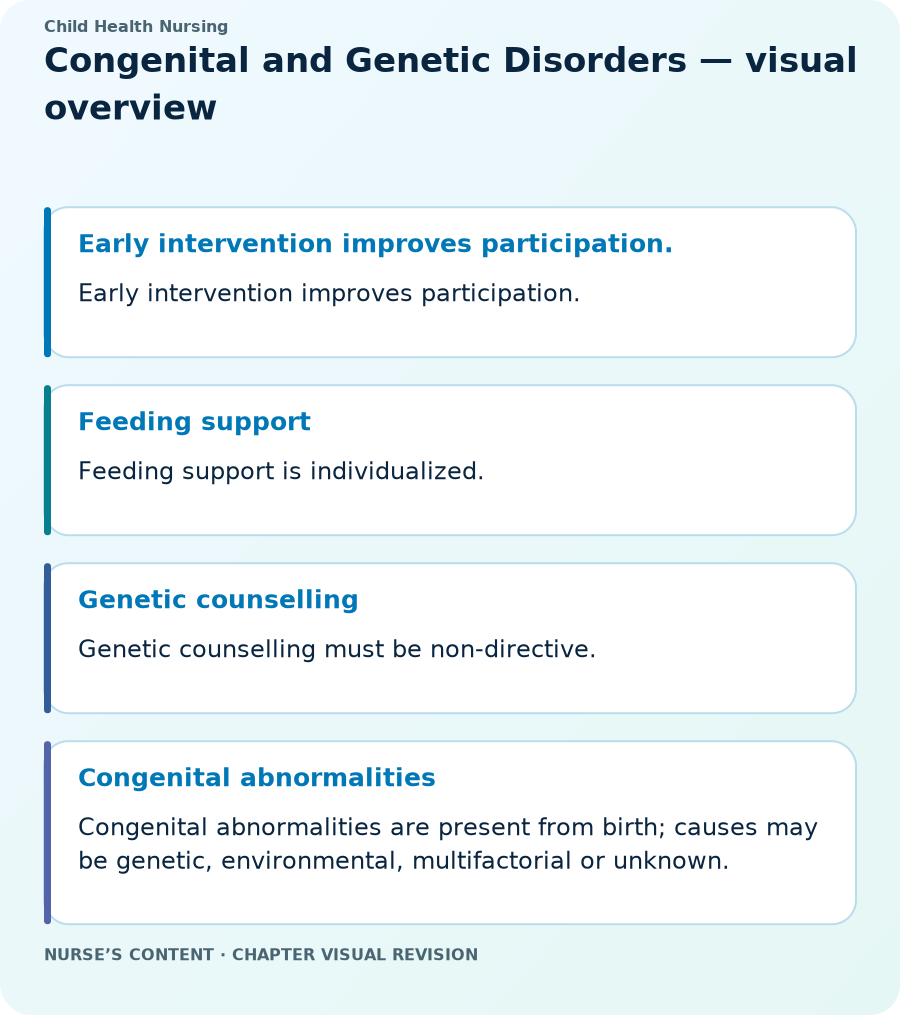
Congenital abnormalities are present from birth; causes may be genetic, environmental, multifactorial or unknown. Genetic disorders include chromosomal, single-gene and multifactorial conditions. Prenatal and newborn screening identify risk; diagnostic testing and counselling clarify findings with informed consent.
Down syndrome
Definition and pathophysiology: Usually trisomy 21; translocation/mosaic forms also occur.
Clinical features and investigations: Variable developmental differences, hypotonia, characteristic features, CHD, thyroid/hearing/vision risks; chromosome testing.
Management and nursing care: Individualized development and growth surveillance, cardiac/thyroid/hearing assessment, early intervention, respectful education and family support.
Congenital heart defects
Definition and pathophysiology: Structural lesions such as ASD, VSD, PDA and TOF.
Clinical features and investigations: Murmur, feeding difficulties, poor growth or cyanosis; echo.
Management and nursing care: Monitor oxygenation, feeding/growth, perfusion and surgical follow-up; support families with specialist plan.
Cleft lip and palate
Definition and pathophysiology: Incomplete fusion of lip and/or palate structures.
Clinical features and investigations: Feeding difficulty, nasal regurgitation, ear/hearing and speech problems.
Management and nursing care: Support individualized feeding devices and upright feeding, assess growth, surgery planning and wound care; speech/audiology/dental follow-up.
Spina bifida and hydrocephalus
Definition and pathophysiology: Neural tube defect may occur with hydrocephalus/Chiari malformation.
Clinical features and investigations: Spinal lesion, motor/sensory or bladder impairment; increasing head size if hydrocephalus.
Management and nursing care: Protect open lesion, urgent specialist referral, monitor shunt signs, bladder/bowel and skin care, mobility and developmental support.
Other genetic disorders
Definition and pathophysiology: Sickle cell/thalassaemia, PKU, cystic fibrosis and muscular dystrophy represent different inherited mechanisms.
Clinical features and investigations: Variable symptoms and specific newborn or targeted tests.
Management and nursing care: Refer for condition-specific therapy/surveillance, avoid assumptions; discuss family testing and recurrence with genetics team.
2. Genetic counselling and prevention
Pedigree, family and exposure history; advance testing information, consent and non-directive counselling. Periconception folic acid, diabetes control, vaccination review and avoid harmful exposures reduce selected risks. Do not imply all congenital disorders are preventable. Support family adjustment and disability inclusion; use respectful, person-preferred language.
3. Important Examination Questions
Long Answer Questions
- 1. Explain Down syndrome and cleft lip/palate nursing management.
Short Answer Questions
- 1. Describe inheritance and screening
- 2. explain spina bifida care
- 3. list prenatal preventive measures.
Very Short Answer Questions (with answers)
- 1. What is trisomy 21? — Extra copy of chromosome 21.
- 2. Is every congenital condition inherited? — No.
4. Quick Revision
- • Early intervention improves participation.
- • Feeding support is individualized.
- • Genetic counselling must be non-directive.
5. Conclusion
Early intervention improves participation. Feeding support is individualized. Genetic counselling must be non-directive.
Chapter reference images