Child Health Nursing
Neurological Disorders in Children
Febrile seizures, epilepsy, meningitis, encephalitis, cerebral palsy, hydrocephalus, neural tube defects and increased intracranial pressure.
Open quizzes and study tools Download PDF
CHAPTER 12 / CHILD HEALTH NURSING 12. Neurological Disorders in Children
1. Assessment
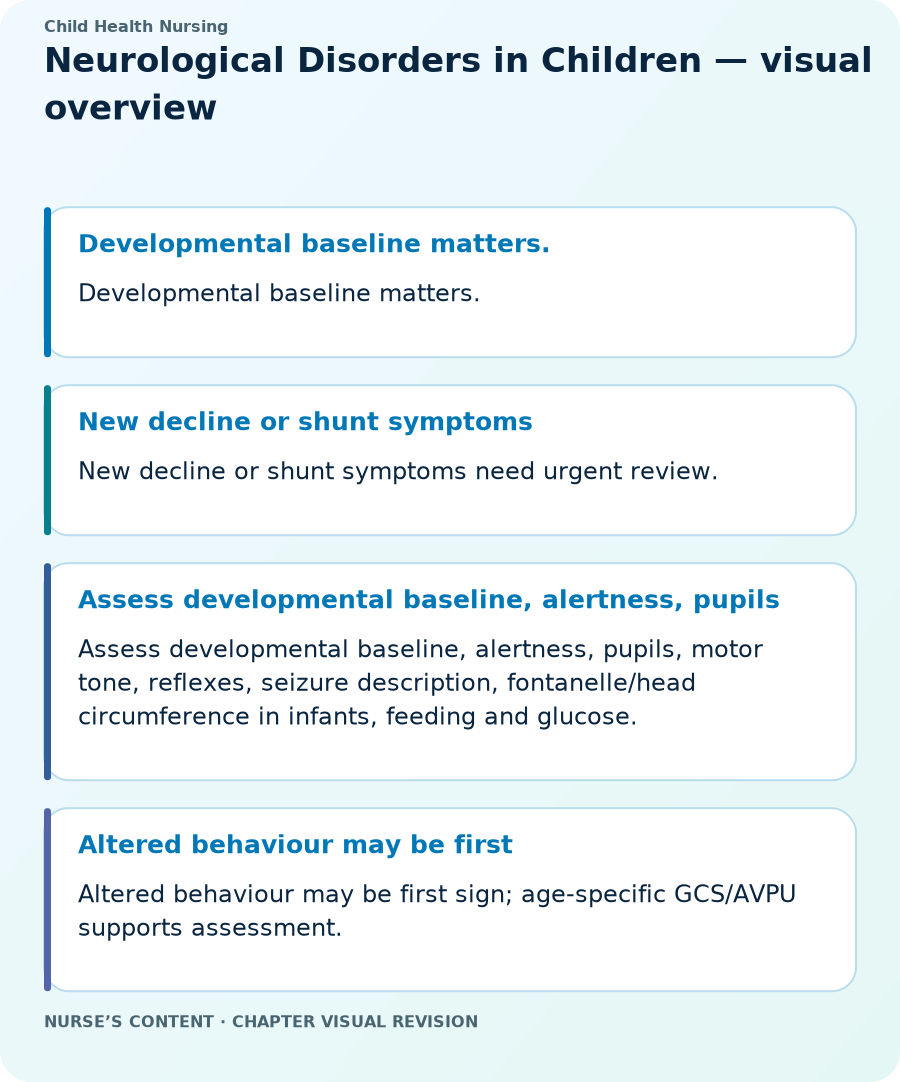
Assess developmental baseline, alertness, pupils, motor tone, reflexes, seizure description, fontanelle/head circumference in infants, feeding and glucose. Altered behaviour may be first sign; age-specific GCS/AVPU supports assessment.
Febrile seizures
Definition and pathophysiology: Seizures with fever typically age 6 months–5 years without CNS infection or other defined cause.
Clinical features and investigations: Simple: generalized, <15 min, once in 24 h; complex: focal, prolonged or recurrent. Exclude serious infection.
Management and nursing care: Protect airway/injury, time seizure, urgent assessment if ongoing ≥5 min, no objects in mouth. Antipyretics improve comfort but do not reliably prevent recurrence.
Epilepsy
Definition and pathophysiology: Recurrent unprovoked seizures or defined high recurrence risk.
Clinical features and investigations: Focal/generalized events, altered awareness; history, EEG and imaging as indicated.
Management and nursing care: Prescribed antiseizure therapy/adherence and rescue plan; education, school support and safety; prolonged or recurrent seizures without recovery require emergency care.
Meningitis and encephalitis
Definition and pathophysiology: Infection/inflammation of meninges or brain.
Clinical features and investigations: Fever, headache, neck stiffness; infants may be irritable, lethargic, poor feeding or bulging fontanelle; encephalitis may cause seizures/confusion.
Management and nursing care: Urgent medical evaluation and timely treatment, appropriate precautions, monitor perfusion, consciousness and seizures. Lumbar puncture only when safe and indicated.
Cerebral palsy
Definition and pathophysiology: Nonprogressive disturbance of developing brain causing permanent motor/postural disorder; functional needs change.
Clinical features and investigations: Spasticity, dystonia, delayed milestones, possible feeding, seizures or sensory issues.
Management and nursing care: Early therapy, positioning, assistive devices, swallow/nutrition care, seizure/pain management and family-centred functional goals.
Hydrocephalus
Definition and pathophysiology: Excess CSF due to impaired flow/absorption or other causes.
Clinical features and investigations: Increasing head circumference, bulging fontanelle, vomiting, sunset eyes; older child headache/visual signs.
Management and nursing care: Neurosurgical evaluation, shunt or endoscopic therapy as indicated; monitor shunt infection/blockage and neurological status.
Neural tube defects
Definition and pathophysiology: Incomplete neural tube closure, e.g., spina bifida/myelomeningocele.
Clinical features and investigations: Spinal lesion, motor/sensory and bladder/bowel impairment, hydrocephalus possible.
Management and nursing care: Protect exposed lesion with prescribed sterile moist non-adherent cover, avoid pressure and contamination, neurosurgical referral. Bladder/bowel, skin and mobility care; folic acid prevention education.
Raised intracranial pressure
Definition and pathophysiology: Increased pressure from trauma, infection, mass, hydrocephalus.
Clinical features and investigations: Declining consciousness, pupillary change, vomiting/headache; Cushing response late.
Management and nursing care: Urgent ABCDE, avoid hypoxia/hypotension, prescribed positioning and neurological monitoring, prepare specialist care. Do not perform unsafe LP.
2. Important Examination Questions
Long Answer Questions
- 1. Describe febrile seizures, meningitis and hydrocephalus with nursing care.
Short Answer Questions
- 1. Compare febrile seizure and epilepsy
- 2. explain cerebral palsy
- 3. list raised ICP signs.
Very Short Answer Questions (with answers)
- 1. What is CSF? — Cerebrospinal fluid.
- 2. Should objects be inserted during seizure? — No.
3. Quick Revision
- • Developmental baseline matters.
- • Time seizures.
- • New decline or shunt symptoms need urgent review.
4. Conclusion
Developmental baseline matters. Time seizures. New decline or shunt symptoms need urgent review.
Chapter reference images