Child Health Nursing
Immunization and Child Welfare
National Immunization Schedule, vaccines, routes and sites of administration, cold chain, adverse events following immunization, growth monitoring, child welfare services and preventive pediatric care.
Open quizzes and study tools Download PDF
CHAPTER 06 / CHILD HEALTH NURSING 06. Immunisation and Child Welfare
1. Immunity and vaccine types
Active immunity develops after infection/vaccination; passive immunity is temporary transferred antibody. Live attenuated (BCG, OPV, MR), inactivated (IPV), toxoid (Td), subunit/recombinant (hepatitis B, HPV) and conjugate (PCV/Hib) examples. Vaccines prevent specific diseases; vitamin A is a supplement, not vaccine.
2. Indian National Immunization Schedule (routine UIP)
| Age | Vaccine/supplement |
|---|---|
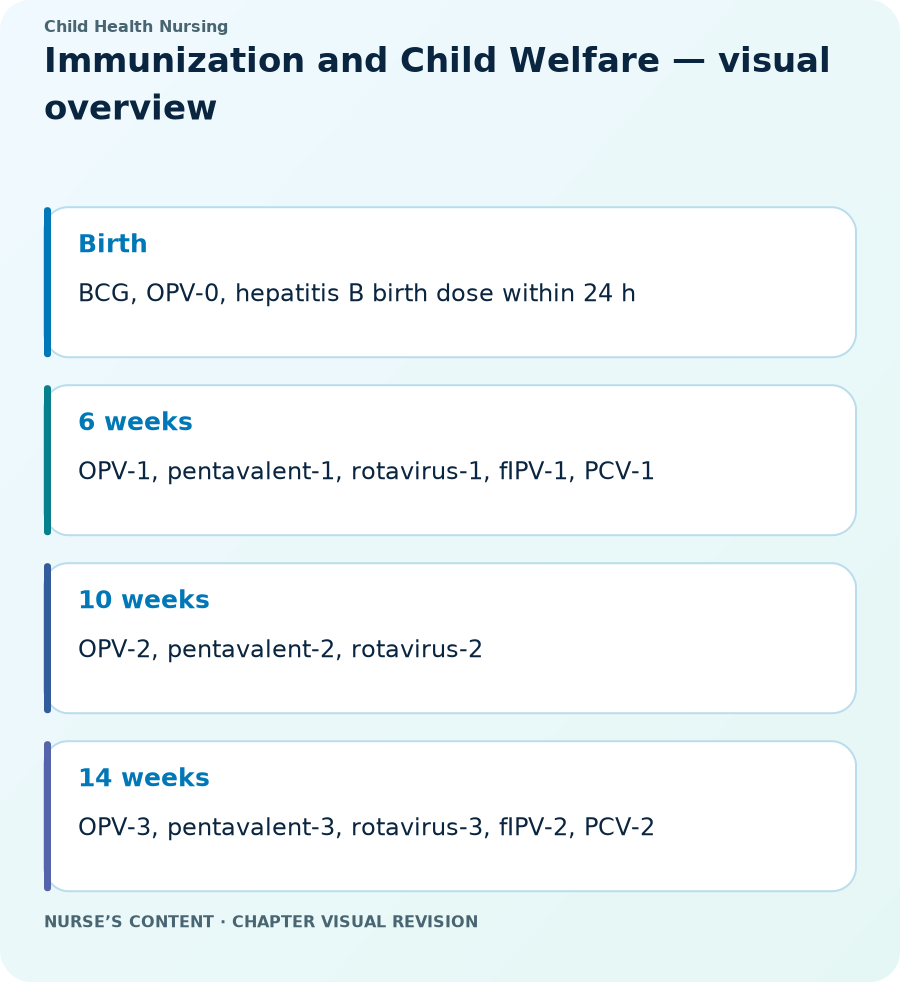
| Birth | BCG, OPV-0, hepatitis B birth dose within 24 h |
| 6 weeks | OPV-1, pentavalent-1, rotavirus-1, fIPV-1, PCV-1 |
| 10 weeks | OPV-2, pentavalent-2, rotavirus-2 |
| 14 weeks | OPV-3, pentavalent-3, rotavirus-3, fIPV-2, PCV-2 |
| 9–11 completed months | MR-1, PCV booster, fIPV-3, JE-1 in designated districts, vitamin A first dose |
| 16–23 completed months | MR-2, DPT booster-1, OPV booster, JE-2 where designated, vitamin A second dose |
| 5–6 years | DPT booster-2 |
| 10 and 16 years | Td |
India launched a free voluntary single-dose HPV vaccination campaign for eligible 14-year-old girls on 28 February 2026; verify current local eligibility, prior vaccine history and consent. Vitamin A first dose 100,000 IU at 9 months, then 200,000 IU per programme with six-month intervals after second dose up to 5 years (nine total). Use current UIP job aid for missed doses and product-specific details.
3. Common dose, route and site examples
| Vaccine | Dose/route | Site |
|---|---|---|
| BCG | 0.05 mL ID up to 1 month; 0.1 mL thereafter up to 1 year | Left upper arm |
| OPV | 2 drops oral | Mouth |
| Hep B / pentavalent | 0.5 mL IM | Left anterolateral thigh |
| Rotavirus | Oral, formulation-specific | Mouth |
| fIPV | 0.1 mL ID | Right arm doses 1/2; left arm dose 3 |
| PCV | 0.5 mL IM | Right anterolateral thigh |
| MR | 0.5 mL SC | Right upper arm |
| JE | 0.5 mL, product-specific route | Confirm programme job aid |
| DPT / Td | 0.5 mL IM | DPT first booster left thigh, second left upper arm; Td upper arm |
4. Cold chain and AEFI
Most service-point vaccines stored +2 to +8°C; ILR, deep freezer at designated levels, cold boxes, carriers and loggers. Do not freeze freeze-sensitive products. VVM indicates cumulative heat exposure, not freezing. Verify expiry, lot, diluent and temperature record; follow open-vial policy only for eligible vaccines. Serious AEFI requires emergency assessment and reporting; anaphylaxis may present without rash and needs prompt IM adrenaline per protocol. Observe for recommended interval (commonly 30 min).
5. Preventive child welfare
Growth monitoring, nutrition counselling, developmental and hearing/vision screening, RBSK referrals, safe water, oral health, injury prevention, school health and safeguarding. Document vaccinations, next due date, counselling and catch-up plan; promote confidence with accurate information.
6. Important Examination Questions
Long Answer Questions
- 1. Describe NIS and cold chain management.
Short Answer Questions
- 1. Explain vaccine types
- 2. discuss AEFI
- 3. state BCG and fIPV routes.
Very Short Answer Questions (with answers)
- 1. What does VVM monitor? — Cumulative heat exposure.
- 2. Is vitamin A a vaccine? — No.
7. Quick Revision
- • Verify local schedule before administration.
- • Maintain cold chain and documentation.
- • Mild illness alone is generally not a contraindication.
8. Conclusion
Verify local schedule before administration. Maintain cold chain and documentation. Mild illness alone is generally not a contraindication.
Chapter reference images